
Simulations based on particles and point-cloud data are fueling an unprecedented surge in the volume and intricacy of scientific and industrial datasets, often reaching billions or even trillions of individual points. Managing, compressing, and analyzing such colossal datasets efficiently-without overwhelming modern GPU capabilities-poses a significant challenge across disciplines like cosmology, geology, molecular dynamics, and 3D imaging. Addressing this, a collaborative team from Florida State University, the University of Iowa, Argonne National Laboratory, the University of Chicago, and other institutions has developed GPZ, a GPU-accelerated, error-controlled lossy compression tool that dramatically enhances throughput, compression efficiency, and data accuracy for particle datasets, surpassing five leading contemporary compressors by substantial margins.
The Challenge of Compressing Particle and Point-Cloud Data
Unlike structured grid data, particle or point-cloud datasets consist of irregularly distributed discrete elements scattered across multidimensional space. This irregularity is crucial for accurately modeling complex physical systems but results in minimal spatial and temporal coherence and scarce redundancy. Consequently, conventional lossless or generic lossy compression techniques struggle to achieve effective compression without sacrificing data integrity.
To illustrate the scale:
- The Summit supercomputer produced a single snapshot of a cosmological simulation totaling 70 terabytes using Nvidia V100 GPUs.
- The USGS 3D Elevation Program’s point-cloud data for U.S. terrain surpasses 200 terabytes in size.
Common strategies such as aggressive downsampling or real-time data processing often discard up to 90% of the original data, compromising reproducibility and long-term storage. Moreover, compressors designed for mesh-based data rely on correlations absent in particle datasets, resulting in poor compression ratios and sluggish GPU performance.
GPZ’s Innovative Compression Pipeline
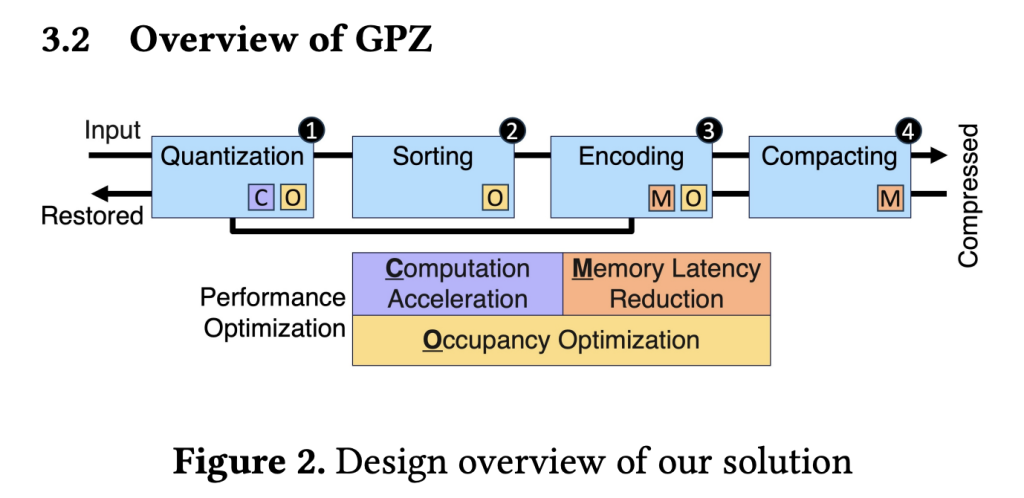
GPZ introduces a four-phase parallel pipeline optimized for GPU architectures, specifically tailored to the unique characteristics of particle data and the demands of high-throughput parallel processing.
1. Spatial Quantization
- Particle coordinates, originally in floating-point format, are converted into integer-based segment identifiers and offsets. This transformation respects user-defined error tolerances while leveraging fast FP32 operations to maximize GPU arithmetic efficiency.
- Segment dimensions are carefully calibrated to optimize GPU occupancy and resource utilization.
2. Spatial Sorting
- Within each CUDA warp-assigned block, particles are sorted by their segment IDs to improve the effectiveness of subsequent lossless encoding steps.
- This sorting is performed using warp-level primitives to minimize synchronization overhead, balancing compression gains with shared memory constraints.
3. Lossless Encoding
- Advanced parallel run-length and delta encoding techniques remove redundancies from the sorted segment IDs and quantized offsets.
- Bit-plane coding further compresses data by eliminating zero bits, with all operations optimized for GPU memory access patterns.
4. Data Compaction
- Compressed data blocks are efficiently consolidated into a contiguous output buffer through a three-step device-level approach that minimizes synchronization delays and maximizes memory bandwidth-achieving up to 809 GB/s on an RTX 4090, approaching hardware limits.
Decompression reverses these steps, extracting and decoding the compressed data to reconstruct particle positions within the specified error bounds, enabling precise post-processing and analysis.
Optimizations Tailored for Modern GPU Hardware
GPZ’s performance gains stem from a series of hardware-conscious enhancements:
- Memory Coalescing: Data accesses are aligned to 4-byte boundaries, significantly boosting DRAM throughput by up to 1.6 times compared to non-coalesced patterns.
- Efficient Register and Shared Memory Usage: The pipeline maintains high GPU occupancy by limiting register pressure and using FP32 precision where feasible to avoid costly spills.
- Optimized Compute Scheduling: Employing a one-warp-per-block strategy, leveraging CUDA intrinsics such as fused multiply-add (FMA) operations, and applying loop unrolling to enhance instruction throughput.
- Elimination of Expensive Operations: Slow division and modulo operations are replaced with precomputed reciprocals and bitwise masks to accelerate computation.
Comprehensive Benchmarking Across Diverse Datasets and GPUs
GPZ was rigorously tested on six real-world datasets spanning cosmology, geology, plasma physics, and molecular dynamics, across three GPU platforms:
- Consumer-grade: Nvidia RTX 4090
- Data center-class: Nvidia H100 SXM
- Edge computing: Nvidia L4
Comparisons were made against five leading compressors-cuSZp2, PFPL, FZ-GPU, cuSZ, and cuSZ-i-most of which are optimized for structured scientific meshes. These alternatives either failed or exhibited significant degradation in performance and quality on particle datasets exceeding 2 GB, whereas GPZ maintained consistent robustness and efficiency.
Performance Highlights
- Throughput: GPZ achieved compression speeds up to 8 times faster than the nearest competitor, with average rates of 169 GB/s on the L4, 598 GB/s on the RTX 4090, and 616 GB/s on the H100. Decompression speeds were even higher.
- Compression Efficiency: GPZ consistently delivered superior compression ratios, outperforming others by as much as 600% in challenging scenarios. Even when other tools slightly surpassed GPZ in ratio, it maintained a 3x to 6x speed advantage.
- Data Fidelity: Rate-distortion analyses demonstrated GPZ’s superior preservation of critical scientific features, achieving higher peak signal-to-noise ratios (PSNR) at lower bitrates. Visual inspections, including 10x magnified views, confirmed that GPZ’s reconstructions were nearly indistinguishable from original data, unlike competitors that introduced visible artifacts.
Implications for Scientific Data Management and Future Directions
GPZ establishes a new benchmark for real-time, large-scale particle data compression on GPUs. By recognizing the inherent limitations of generic compressors and exploiting GPU parallelism and precision tuning, it offers a tailored solution that meets the rigorous demands of modern scientific computing.
For scientists and engineers handling massive datasets, GPZ provides:
- Reliable, error-bounded compression suitable for both in-situ processing and post-experiment analysis.
- High throughput and compression ratios across a spectrum of hardware, from consumer GPUs to high-performance computing clusters.
- Near-lossless reconstruction quality, enabling accurate downstream analytics, visualization, and simulation tasks.
As data volumes continue to escalate, tools like GPZ will be pivotal in shaping the future landscape of GPU-driven scientific research and large-scale data management.