Mistral AI has unveiled Devstral 2, an advanced family of coding models tailored for software engineering agents, alongside Mistral Vibe CLI, an open-source command-line assistant designed to operate seamlessly within terminals or IDEs that support the Agent Communication Protocol.
Overview of Devstral 2 and Devstral Small 2: Model Specifications and Performance
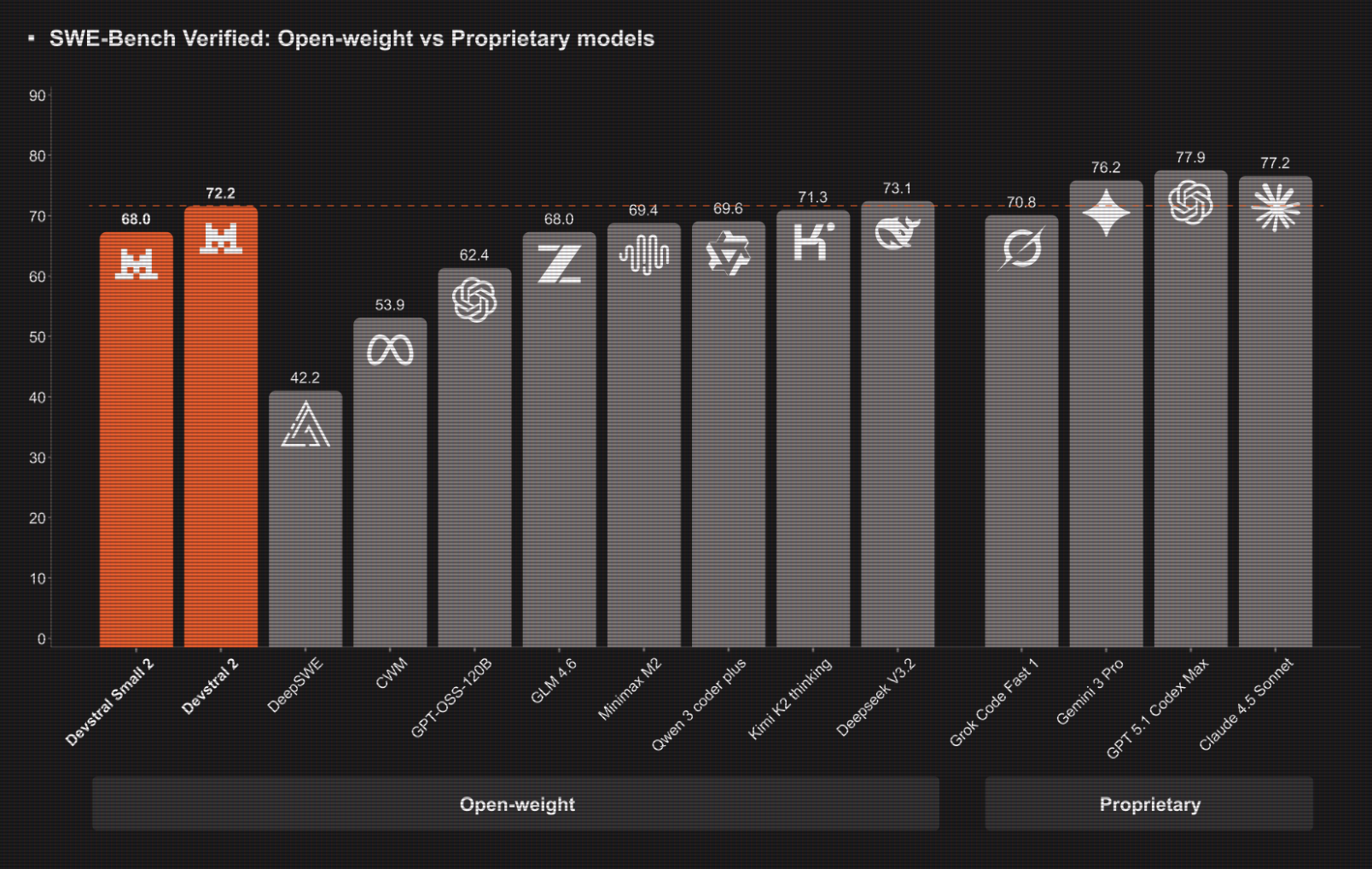
Devstral 2 is a dense transformer model boasting 123 billion parameters and an extensive 256,000-token context window. It achieves an impressive 72.2% score on the SWE-bench Verified benchmark, positioning it among the top open-weight models for software development tasks. This model is available under a modified MIT license and can be accessed freely through the Mistral API.
Complementing this, Devstral Small 2 features 24 billion parameters while maintaining the same expansive 256K token context. It attains a 68.0% score on SWE-bench Verified, rivaling models with up to five times more parameters. Released under the permissive Apache 2.0 license, it is well-suited for production environments requiring flexible licensing.
Both models are open source with permissive licenses, crafted specifically for agentic coding workloads. According to Mistral, Devstral 2 offers up to sevenfold cost efficiency compared to Claude Sonnet when handling real-world coding challenges at comparable quality levels, a critical advantage for continuous agent operations.
Comparative Scale: Devstral Models vs. Leading Systems
When benchmarked against cutting-edge systems, Devstral 2 and Devstral Small 2 are significantly more compact. Devstral 2 is approximately five times smaller than DeepSeek V3.2 and eight times smaller than Kimi K2, while Devstral Small 2 is 28 and 41 times smaller than these respective models, highlighting their efficiency in delivering high performance with reduced computational demands.
Engineered for Robust, Production-Level Software Development
Devstral 2 is engineered to empower software engineering agents with capabilities to navigate complex code repositories, manage dependencies, and coordinate edits across multiple files while preserving architectural context. It excels in identifying errors, performing corrective retries, and supporting extensive tasks such as bug resolution and legacy system modernization at scale.
Moreover, Devstral 2 can be fine-tuned to prioritize specific programming languages or optimize performance for large-scale enterprise codebases. Devstral Small 2 mirrors these design principles in a more compact form factor, ideal for local deployments, rapid iteration cycles, and fully private runtime environments. It also supports multimodal inputs, including images, enabling agents to interpret both code and visual elements like diagrams or screenshots.
Human-Centric Evaluations: Devstral 2 vs. DeepSeek V3.2 and Claude Sonnet 4.5
In practical coding assessments conducted using the Cline agent tool, Devstral 2 demonstrated a notable edge over DeepSeek V3.2, securing a 42.8% win rate compared to a 28.6% loss rate. These evaluations underscore Devstral 2’s superior real-world coding proficiency and reliability.
Mistral Vibe CLI: A Native Terminal Coding Assistant
Mistral Vibe CLI is an open-source, Python-based command-line assistant powered by Devstral models. It enables developers to explore, modify, and execute codebase changes through natural language commands directly within the terminal or compatible IDEs like Zed, where it is available as an extension. The tool is distributed under a permissive open-source license.
Key features of Vibe CLI include:
- Repository-aware context: Automatically scans file structures and Git status to maintain an up-to-date understanding of the project.
- Intelligent referencing: Supports
@for file autocompletion,!for shell commands, and slash commands for configuration adjustments. - Multi-file coordination: Analyzes the entire codebase, not just the active file, to facilitate architectural changes and streamline pull request cycles.
- Persistent interaction: Offers chat-style history, autocompletion, and customizable themes optimized for daily terminal use.
Configuration is straightforward via a config.toml file, allowing users to connect Vibe CLI to Devstral 2 through the Mistral API or other local/remote models. It supports automated runs, toggleable auto-approval for tool executions, and fine-grained permission controls to safeguard sensitive repositories by requiring confirmations for high-risk operations.
Summary of Highlights
- Devstral 2 is a 123-billion-parameter dense coding model with a 256K token context, achieving 72.2% on SWE-bench Verified, and is available under a modified MIT license.
- Devstral Small 2, with 24 billion parameters and the same context size, scores 68.0% on SWE-bench Verified and is licensed under Apache 2.0 for easier integration into production.
- Both models are optimized for agentic coding tasks, capable of comprehensive repository exploration, dependency tracking, and multi-file editing with built-in error detection and retry mechanisms.
- Mistral Vibe CLI is a Python-based, open-source terminal coding assistant that interfaces with Devstral models, offering project-aware context, smart referencing, and multi-file orchestration through a conversational interface within terminals or compatible IDEs.