Contents Overview
Understanding Agentic RAG: A New Paradigm in AI
Agentic Retrieval-Augmented Generation (RAG) represents an evolution beyond conventional RAG models by integrating autonomous agent capabilities with large language models (LLMs). While traditional RAG relies on retrieving relevant external information to ground AI-generated responses, Agentic RAG empowers AI agents to independently manage the entire process-from selecting data sources and formulating queries to invoking APIs and iteratively refining answers. This dynamic orchestration enables the system to adapt workflows in real-time, resulting in responses that are not only more precise but also contextually nuanced and tailored to complex queries.
Limitations of Basic RAG and How Agentic RAG Overcomes Them
Standard RAG approaches often falter when faced with vague questions, multi-step reasoning, or noisy datasets. Agentic RAG addresses these challenges by incorporating several advanced mechanisms:
- Strategic Query Planning: Breaking down complex questions into manageable sub-queries before retrieval.
- Selective Retrieval: Determining when and from which sources to fetch information, optimizing relevance.
- Iterative Self-Correction: Continuously evaluating retrieved data and refining queries to improve accuracy.
- Relational Data Exploration: Navigating knowledge graphs to uncover interconnected insights rather than relying on isolated data chunks.
Practical Implementations Across Industries
Agentic RAG is rapidly gaining traction in diverse sectors, enabling solutions that demand sophisticated reasoning and contextual awareness:
- Customer Service: AI-driven support systems that dynamically tailor responses based on customer history and preferences, accelerating issue resolution and enhancing satisfaction.
- Medical Field: Tools that assist healthcare professionals by synthesizing patient data, clinical studies, and treatment protocols to support accurate diagnoses and personalized care plans.
- Financial Sector: Automated compliance monitoring and risk assessment platforms that analyze evolving regulations alongside transactional data to mitigate risks efficiently.
- Education: Adaptive learning environments that curate personalized content and learning trajectories, boosting student engagement and achievement.
- Enterprise Knowledge Management: Intelligent systems that locate, verify, and route internal documents, streamlining information access for teams.
- Business Analytics: Automated multi-layered analysis of KPIs and market trends, integrating external data sources and APIs for comprehensive reporting.
- Scientific Research: Accelerated literature review assistants that extract and summarize key findings, significantly reducing manual effort.
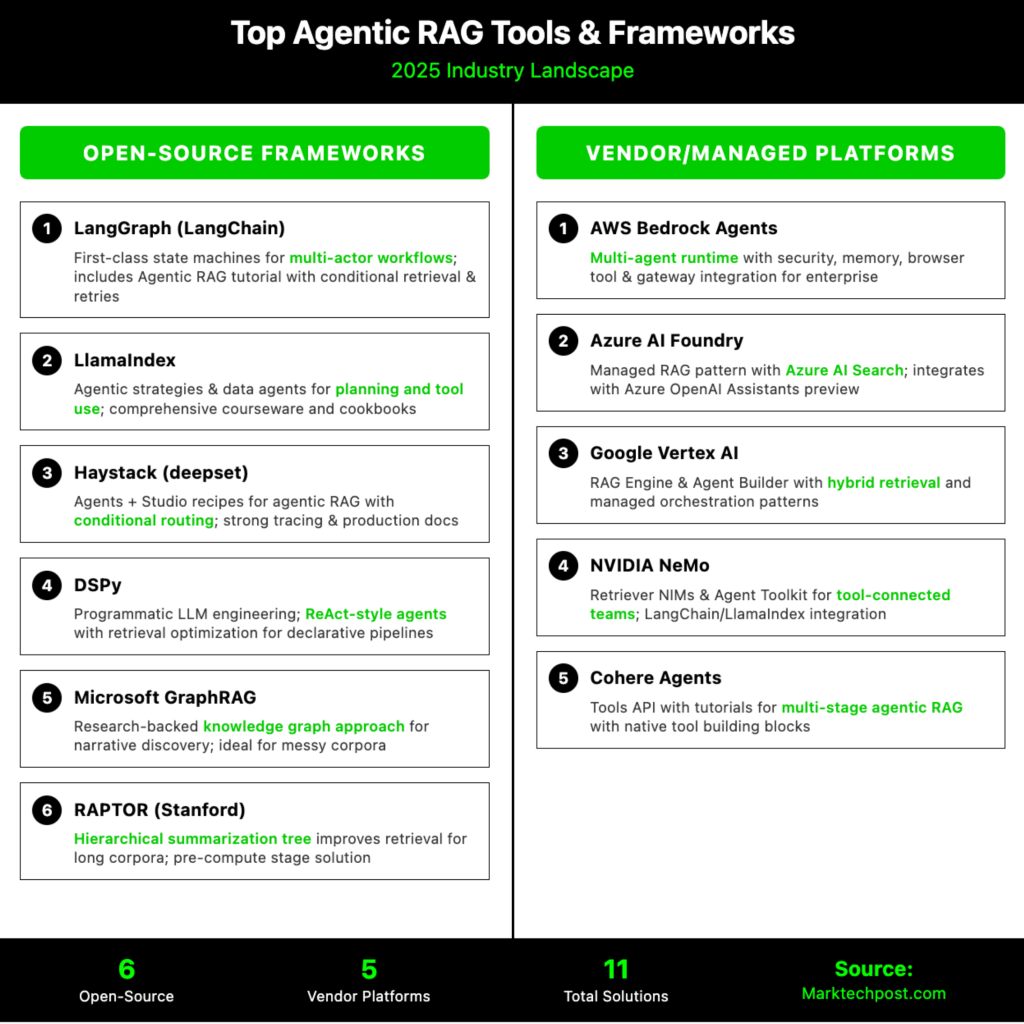
Leading Agentic RAG Frameworks and Platforms in 2025
Open-Source Solutions
- LangGraph (LangChain): Offers robust state machine capabilities for managing multi-agent workflows, featuring tutorials on conditional retrieval and retry mechanisms ideal for graph-based control.
- LlamaIndex: Provides agentic strategies and data agents that enhance planning and tool integration atop existing query engines, supported by comprehensive educational resources.
- Haystack (deepset): Delivers agent frameworks and studio recipes for agentic RAG, including conditional routing and fallback to web sources, with strong production documentation.
- DSPy: Focuses on programmatic LLM engineering with ReAct-style agents that combine retrieval and optimization, suited for teams seeking declarative pipelines.
- Microsoft GraphRAG: Employs a knowledge graph approach for narrative discovery, particularly effective with unstructured or messy datasets, backed by research publications.
- RAPTOR (Stanford): Implements hierarchical summarization trees to enhance retrieval from extensive corpora, functioning as a preprocessing step in agentic architectures.
Commercial and Managed Platforms
- AWS Bedrock Agents (AgentCore): Enterprise-grade multi-agent runtime featuring security, memory management, browser tools, and gateway integrations.
- Azure AI Foundry & Azure AI Search: Provides managed RAG patterns, indexing, and agent templates, integrated with Azure OpenAI Assistants for seamless deployment.
- Google Vertex AI: RAG Engine & Agent Builder: Offers hybrid retrieval and agent orchestration with managed tooling for scalable AI workflows.
- NVIDIA NeMo: Supplies retriever neural modules and an Agent Toolkit designed for tool-connected multi-agent teams, compatible with LangChain and LlamaIndex.
- Cohere Agents / Tools API: Features tutorials and modular components for constructing multi-stage agentic RAG systems with native tool support.
Advantages of Adopting Agentic RAG
- Complex Reasoning Autonomy: Agents independently devise and execute multi-step strategies to derive accurate answers.
- Adaptive Goal-Oriented Processes: Systems dynamically adjust workflows to align with user objectives, surpassing linear RAG limitations.
- Continuous Validation and Improvement: Built-in mechanisms for verifying retrieved data and refining outputs minimize misinformation.
- Collaborative Multi-Agent Problem Solving: Specialized agents work in concert to tackle intricate queries efficiently.
- Enhanced Contextual Flexibility: Learning from interactions enables adaptation across varied domains and user needs.
Selecting the Right Agentic RAG Stack: Practical Recommendations
- For Research Assistance with Extensive Documents: Combine LlamaIndex or LangGraph with RAPTOR for summarization; optionally layer with GraphRAG for enhanced narrative exploration.
- Enterprise Customer Support: Deploy Haystack agents featuring conditional routing and web fallback, or utilize AWS Bedrock Agents for managed runtime environments with governance.
- Data and Business Intelligence Tools: Use DSPy for programmatic agent pipelines with SQL integration; consider Azure or Google Vertex AI for managed services and monitoring.
- High-Security Production Environments: Opt for managed agent platforms like AWS Bedrock AgentCore or Azure AI Foundry to ensure standardized memory, identity, and tool access controls.
Agentic RAG is revolutionizing generative AI by transforming static retrieval-augmented models into dynamic, self-directed systems that excel in enterprise, research, and development contexts.
Frequently Asked Questions
1. How does Agentic RAG differ from traditional RAG?
Unlike traditional RAG, which primarily retrieves and summarizes data, Agentic RAG incorporates autonomous reasoning, strategic planning, and tool utilization. This enables the AI to refine queries, integrate information from multiple sources, and iteratively improve its responses.
2. What are the primary use cases for Agentic RAG?
Agentic RAG excels in domains requiring complex, multi-step reasoning and dynamic context integration, including customer support, healthcare decision-making, financial compliance, education personalization, business intelligence, knowledge management, and scientific research.
3. In what ways does Agentic RAG enhance accuracy?
By iteratively cross-verifying retrieved information and refining outputs through multiple data sources, Agentic RAG significantly reduces errors and hallucinations that are common in simpler RAG implementations.
4. Can Agentic RAG be implemented both on-premises and in cloud environments?
Yes, most Agentic RAG frameworks support flexible deployment options, including on-premises setups and cloud-based architectures, catering to enterprise security requirements and integration with proprietary databases and external APIs.