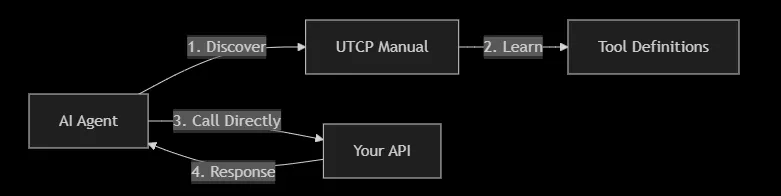
The Universal Tool Calling Protocol (UTCP) presents a streamlined, secure, and scalable framework that enables AI agents and applications to directly discover and invoke tools without relying on intermediary wrapper servers.
Core Advantages of UTCP
- Efficient and Secure: Facilitates direct access to tools, eliminating unnecessary intermediary layers that can introduce vulnerabilities or delays.
- Highly Scalable: Designed to handle extensive numbers of tools and providers while maintaining optimal performance.
- Modular Architecture: Version 1.0.0 introduces a plugin-centric core, simplifying extension, testing, and packaging processes.
- Built with Pydantic Models: Employs clear, well-structured data schemas that ease implementation and ensure consistency.
Challenges in Conventional Tool Integration
Traditional methods for integrating external tools often involve several cumbersome steps that hinder efficiency:
- Developing and maintaining dedicated wrapper servers for each tool.
- Routing all interactions through centralized protocols or services, creating bottlenecks.
- Recreating authentication and security layers individually for every tool.
- Introducing additional latency and complexity into the communication flow.
These factors collectively increase development overhead and slow down execution times.
How UTCP Transforms Tool Connectivity
UTCP revolutionizes tool integration by:
- Establishing a universal, language-neutral standard to describe tools and their interfaces.
- Enabling AI agents to communicate directly with tools via their native protocols.
- Supporting extensibility through plugins that add:
- New communication protocols such as HTTP, Server-Sent Events (SSE), Command Line Interfaces (CLI), and more.
- Alternative storage backends.
- Customizable search and discovery strategies.
All these enhancements are achievable without altering the core UTCP library.
By removing the dependency on wrapper servers and heavy middleware, UTCP reduces latency and simplifies security by leveraging the tool’s inherent authentication mechanisms. This lean design not only accelerates development and testing but also scales gracefully as the ecosystem of tools and providers expands.
Operational Workflow of UTCP
The integration process with UTCP is straightforward and reliable. Initially, an AI agent retrieves a UTCP manual-a comprehensive document detailing the tool’s capabilities and metadata. The agent then interprets the manual’s call templates to understand how to interact with each tool. With this knowledge, the agent directly invokes the tool’s API using its native communication protocol. The tool processes the request and returns a standard response, ensuring smooth interoperability without the need for additional translation layers or middleware.
UTCP’s Modular Architecture Explained
UTCP version 1.0 features a plugin-based, modular design aimed at flexibility and scalability. Central to this architecture are manuals that define tools and their metadata, alongside call templates that specify interaction methods across various protocols.
The UTCP Client serves as the core engine responsible for tool discovery and execution of calls. Surrounding this core is a plugin ecosystem that accommodates protocol adapters, communication methods, tool repositories, and search algorithms. This clear separation allows developers to customize or extend the system for specific environments without modifying the foundational components.
Comparing UTCP with MCP: Distinct Approaches to Tool Integration
While both UTCP and the Modular Communication Protocol (MCP) facilitate AI agent interactions with external tools, their methodologies differ significantly:
- System Design: UTCP enables direct communication between agents and tools, whereas MCP introduces an intermediary layer that routes calls.
- Performance Impact: UTCP minimizes communication hops, reducing latency; MCP centralizes processing but adds overhead.
- Infrastructure Requirements: UTCP requires only manuals and a discovery endpoint; MCP depends on dedicated servers for wrapping and routing tools.
- Protocol Compatibility: UTCP supports diverse protocols including HTTP, WebSocket, CLI, and SSE; MCP primarily focuses on JSON-RPC transport.
- Security Model: UTCP leverages existing tool authentication mechanisms; MCP manages access control within its server layer.
- Flexibility and Deployment: UTCP supports hybrid deployments via its MCP plugin, while MCP offers centralized governance and monitoring.
In essence, UTCP is optimal for lightweight, adaptable integrations, whereas MCP suits organizations seeking a standardized gateway with centralized control.
Final Thoughts
UTCP stands out as a versatile protocol that benefits both tool providers and AI developers. It empowers API owners, SaaS vendors, and enterprise teams to expose services-such as RESTful or GraphQL APIs-to AI agents securely and effortlessly. Simultaneously, developers crafting AI agents or applications gain a simplified pathway to connect with both internal and external tools. By minimizing complexity and overhead, UTCP enhances integration efficiency and unlocks seamless access to powerful functionalities.