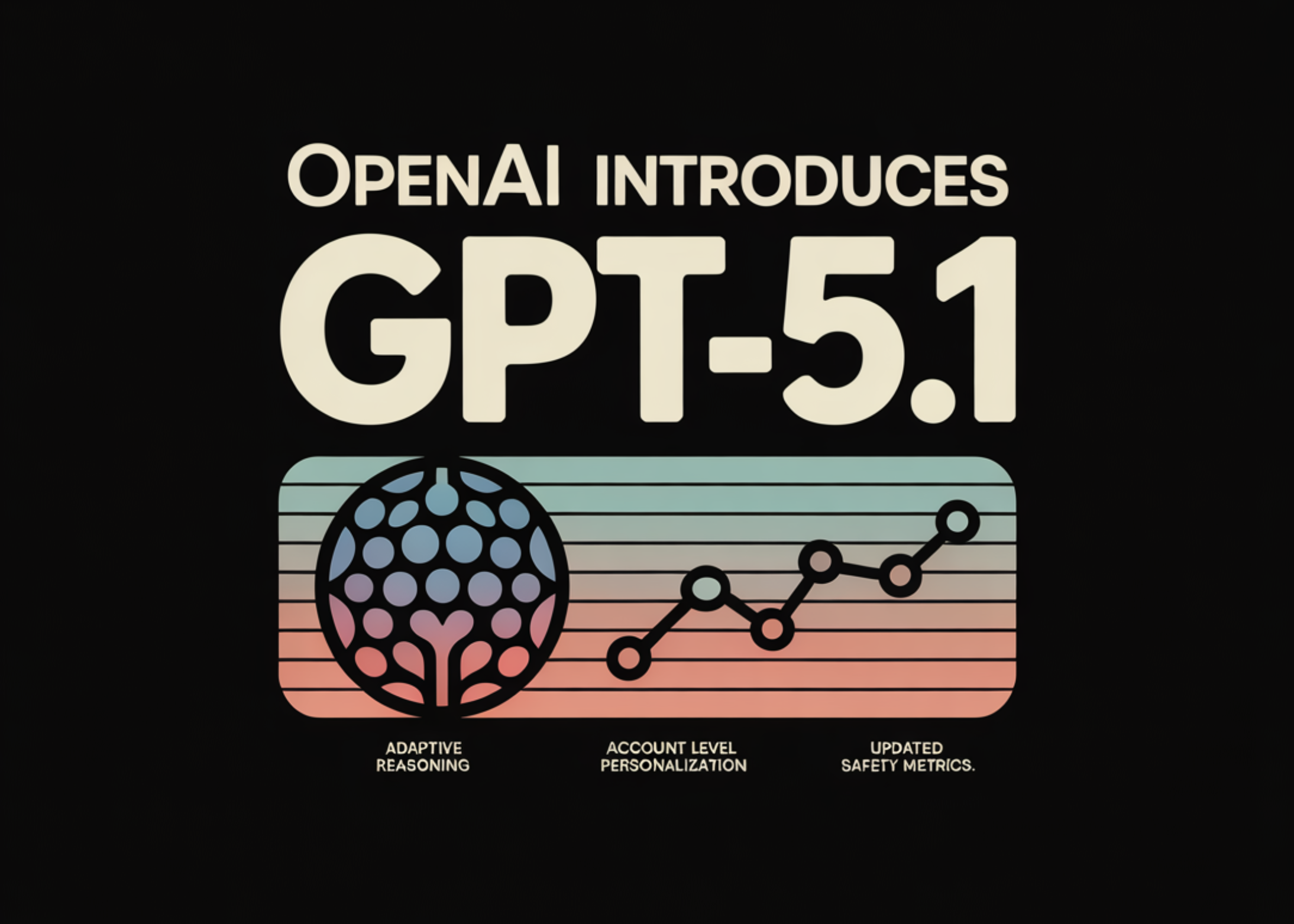
OpenAI has unveiled the latest advancement in the GPT-5 series with the release of GPT-5.1, featuring two primary variants: GPT-5.1 Instant and GPT-5.1 Thinking. This update emphasizes three core improvements-enhanced adaptive reasoning, more transparent explanations, and refined control over tone and safety measures.
Overview of Model Variants and Their Roles
The GPT-5.1 lineup includes GPT-5.1 Instant, which serves as the default conversational engine within ChatGPT. This model is designed for widespread use, offering a warmer, more approachable tone and superior adherence to user instructions. Meanwhile, GPT-5.1 Thinking is tailored for complex reasoning tasks, featuring explicit thinking durations that dynamically adjust based on the complexity of the query. Additionally, GPT-5.1 Auto functions as an intelligent routing system, seamlessly directing user inputs to the most appropriate variant without requiring manual selection.
GPT-5.1 Instant: Efficient Reasoning for Everyday Interactions
GPT-5.1 Instant balances responsiveness with intelligent reasoning by employing adaptive computation. For straightforward queries, it delivers rapid responses through a brief internal processing pass. However, for more challenging tasks-such as multi-step mathematical problems or intricate coding challenges-it allocates additional computational effort before generating an answer. This adaptive approach has led to notable improvements in benchmark performance, including higher scores on the 2025 AIME math competition and Codeforces programming contests, all while maintaining low latency suitable for casual conversations.
Another key enhancement is its improved compliance with explicit instructions. For instance, GPT-5.1 Instant reliably follows constraints like “respond using exactly six words” and maintains these rules consistently across multiple exchanges. This precision is particularly valuable for developers building applications that require strict output formats, such as structured data generation, templated messaging, or chained tool workflows that depend on concise responses.
By combining adaptive reasoning with stringent instruction adherence, GPT-5.1 Instant offers a dependable interface for many automated agent systems, where most interactions are simple but some demand deeper cognitive processing.
GPT-5.1 Thinking: Adaptive Computation for Complex Queries
Building on the foundation of GPT-5 Thinking, GPT-5.1 Thinking optimizes the allocation of internal processing time based on the difficulty of each prompt. When tested across a broad range of ChatGPT tasks, this model demonstrates approximately twice the speed of its predecessor on simpler queries, while dedicating more time to solve the most challenging problems. This dynamic compute allocation ensures efficient handling of diverse workloads without exposing additional complexity to API users.
Moreover, GPT-5.1 Thinking generates responses with clearer language and fewer technical terms, reducing the cognitive load on users. This makes it particularly effective as an interactive tutor for subjects like statistics, computer algorithms, and system architecture, where clarity is paramount.
On the API front, GPT-5.1 Instant is accessible via the endpoint gpt-5.1-chat-latest, while GPT-5.1 Thinking is available as gpt-5.1. Both variants incorporate adaptive reasoning capabilities by default.
Enhanced Personalization and Tone Customization
Alongside the model improvements, ChatGPT now offers a more explicit personalization framework. Users can select from a variety of preset conversational styles-including Default, Professional, Friendly, Candid, Quirky, Efficient, Nerdy, and Cynical-applicable across all GPT-5.1 models. This allows for a tailored interaction experience that aligns with individual preferences or professional contexts.
OpenAI is also piloting fine-grained controls through adjustable sliders that let users modify response attributes such as conciseness, warmth, and readability, as well as the frequency of emoji usage. Notably, ChatGPT can suggest updates to these settings during conversations if it detects repeated requests for a particular tone. These preferences now apply instantly to both ongoing and new chats, marking a shift from previous versions where changes only affected future sessions.
Robust Safety Measures and Improved Content Moderation
The GPT-5.1 models maintain the comprehensive safety protocols established in GPT-5, including content filters, sensitive case routing, and policy-aligned refusal mechanisms. Both GPT-5.1 Instant and GPT-5.1 Thinking employ these safeguards to mitigate risks associated with disallowed content.
Performance on safety benchmarks has improved significantly. For example, GPT-5.1 Instant achieves a not_unsafe score of 0.918 for illicit or violent content and 0.897 for hate speech, surpassing its predecessor. In terms of resistance to jailbreak attempts, measured by the StrongReject evaluation, GPT-5.1 Instant attains a remarkable 0.976 score, compared to 0.850 for the earlier GPT-5 Instant. GPT-5.1 Thinking also maintains strong robustness with a score of 0.967, closely matching GPT-5 Thinking’s 0.974.
Preparedness assessments for high-risk domains, such as biological and chemical capabilities, continue to be anchored in the GPT-5 system framework, ensuring consistent oversight and risk management.
Summary of Key Enhancements in GPT-5.1
- Introduction of two main GPT-5.1 variants-Instant and Thinking-along with an automatic routing system, representing an incremental upgrade within the GPT-5 family rather than a new generation.
- GPT-5.1 Instant employs adaptive reasoning to allocate computational resources efficiently, improving performance on math and coding benchmarks like AIME 2025 and Codeforces, while maintaining low latency and enhanced instruction compliance.
- GPT-5.1 Thinking dynamically adjusts thinking time per query, doubling speed on simple tasks and dedicating more effort to complex ones, with clearer, jargon-free explanations suited for technical tutoring.
- Expanded personalization options in ChatGPT include preset conversational styles and experimental sliders for tone control, enabling persistent user preferences across sessions and models.
- Retention and enhancement of GPT-5’s safety framework, with improved scores on disallowed content detection and jailbreak resistance, alongside continued preparedness for sensitive high-risk applications.