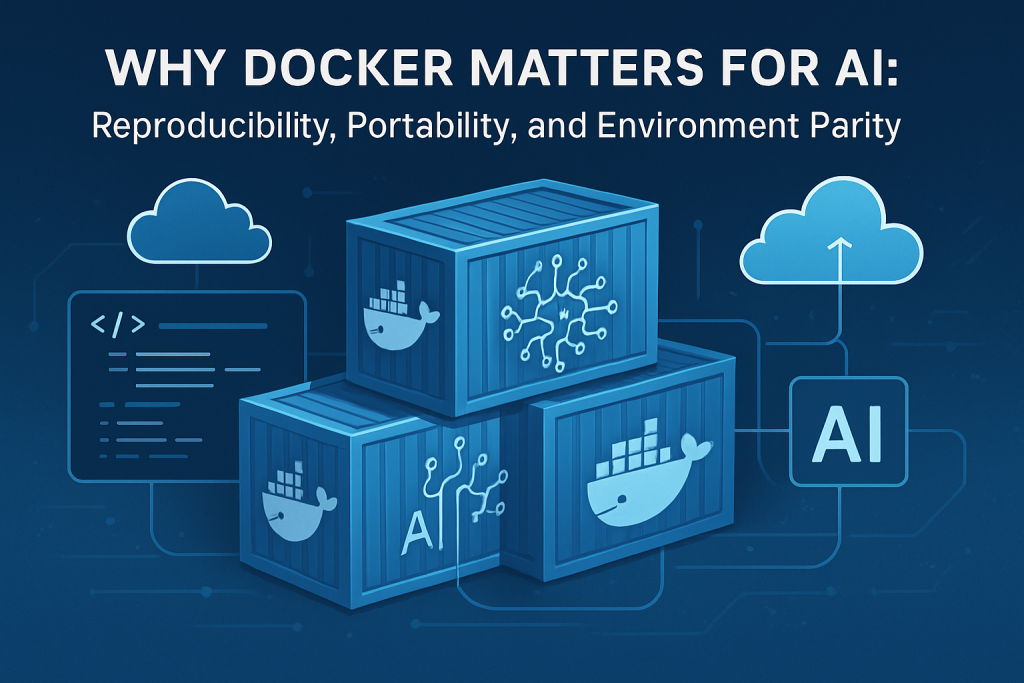
Artificial intelligence and machine learning workflows are inherently intricate, characterized by rapidly evolving codebases, diverse dependencies, and the critical need for consistent, repeatable outcomes. By examining the fundamental requirements for AI to be dependable, collaborative, and scalable, it becomes evident that containerization technologies such as Docker are indispensable tools for today’s ML professionals. This article explores the primary reasons Docker has become a cornerstone for reproducible machine learning: consistency, portability, and environment uniformity.
Ensuring Consistency: The Foundation of Trustworthy AI
Consistency is essential for validating AI research and production models. Without it, verifying results, conducting audits, or transferring models across different platforms becomes unreliable.
- Explicit Environment Specification: Docker allows developers to define every element of their environment-including code, libraries, system utilities, and environment variables-within a
Dockerfile. This guarantees the ability to reconstruct the identical environment on any system, effectively eliminating the notorious “it works on my machine” dilemma that has long challenged AI practitioners. - Versioning Beyond Code: Alongside source code, Docker enables version control of dependencies and runtime settings, empowering teams-or even individual researchers-to rerun experiments with precision, verify outcomes, and troubleshoot with confidence.
- Streamlined Teamwork: Sharing Docker images or configuration files allows collaborators to replicate environments instantly, removing setup inconsistencies and facilitating smoother peer reviews and joint development.
- Seamless Transition from Research to Deployment: The exact container used during experimentation can be deployed in production without modification, ensuring that scientific rigor is preserved throughout the AI lifecycle.
Portability: One Build, Universal Deployment
AI and ML initiatives now operate across a spectrum of platforms-from personal laptops and on-premises servers to cloud infrastructures and edge devices. Docker abstracts away the complexities of underlying hardware and operating systems, enabling frictionless deployment:
- Host-Agnostic Execution: Containers bundle applications with all their dependencies, ensuring consistent performance whether running on Ubuntu, Windows, or macOS.
- Cross-Platform Flexibility: The same containerized application can be launched on major cloud providers like AWS, Google Cloud, Azure, or on local environments, simplifying migrations and hybrid deployments.
- Effortless Scalability: As datasets expand, containers can be duplicated across numerous nodes, facilitating horizontal scaling without dependency conflicts or manual setup.
- Adaptability to Emerging Technologies: Docker’s design supports cutting-edge deployment models such as serverless AI and edge computing, allowing teams to innovate without overhauling existing infrastructure.
Environment Uniformity: Eliminating “It Works Here, Not There”
Maintaining identical behavior of code across development, testing, and production stages is critical. Docker excels at delivering this uniformity:
- Isolation and Independence: Each ML project runs within its own container, preventing clashes from incompatible libraries or system resources. This is particularly important in data science, where projects often require different versions of Python, CUDA, or specialized ML frameworks.
- Parallel Experimentation: Multiple containers can operate simultaneously, enabling high-throughput experimentation and concurrent research without risk of interference.
- Accelerated Debugging: When issues arise in production, developers can quickly replicate the exact environment locally, drastically reducing the mean time to resolution (MTTR).
- Integrated CI/CD Pipelines: Environment parity supports fully automated workflows-from code commits through testing to deployment-minimizing unexpected failures caused by environment discrepancies.
Building a Modular AI Ecosystem
Contemporary machine learning pipelines typically consist of distinct stages such as data collection, feature extraction, model training, evaluation, deployment, and monitoring. Each phase can be containerized independently, allowing orchestration tools like Docker Compose and Kubernetes to manage complex AI workflows efficiently.
This modular approach not only simplifies development and troubleshooting but also lays the groundwork for advanced MLOps practices, including model versioning, continuous monitoring, and automated delivery-anchored by the reliability that reproducibility and environment uniformity provide.
Why Containerization Is Vital for AI Success
By addressing the core challenges of reproducibility, portability, and environment consistency, Docker and container technologies resolve the most demanding aspects of ML infrastructure:
- They transform reproducibility from a cumbersome task into a straightforward process.
- They enable seamless portability across diverse and hybrid computing environments.
- They guarantee environment uniformity, eradicating elusive bugs and accelerating collaboration.
Whether you are an independent researcher, part of a startup, or embedded within a large enterprise, leveraging Docker for AI initiatives is no longer optional-it is a fundamental requirement for delivering credible, scalable, and impactful machine learning solutions.