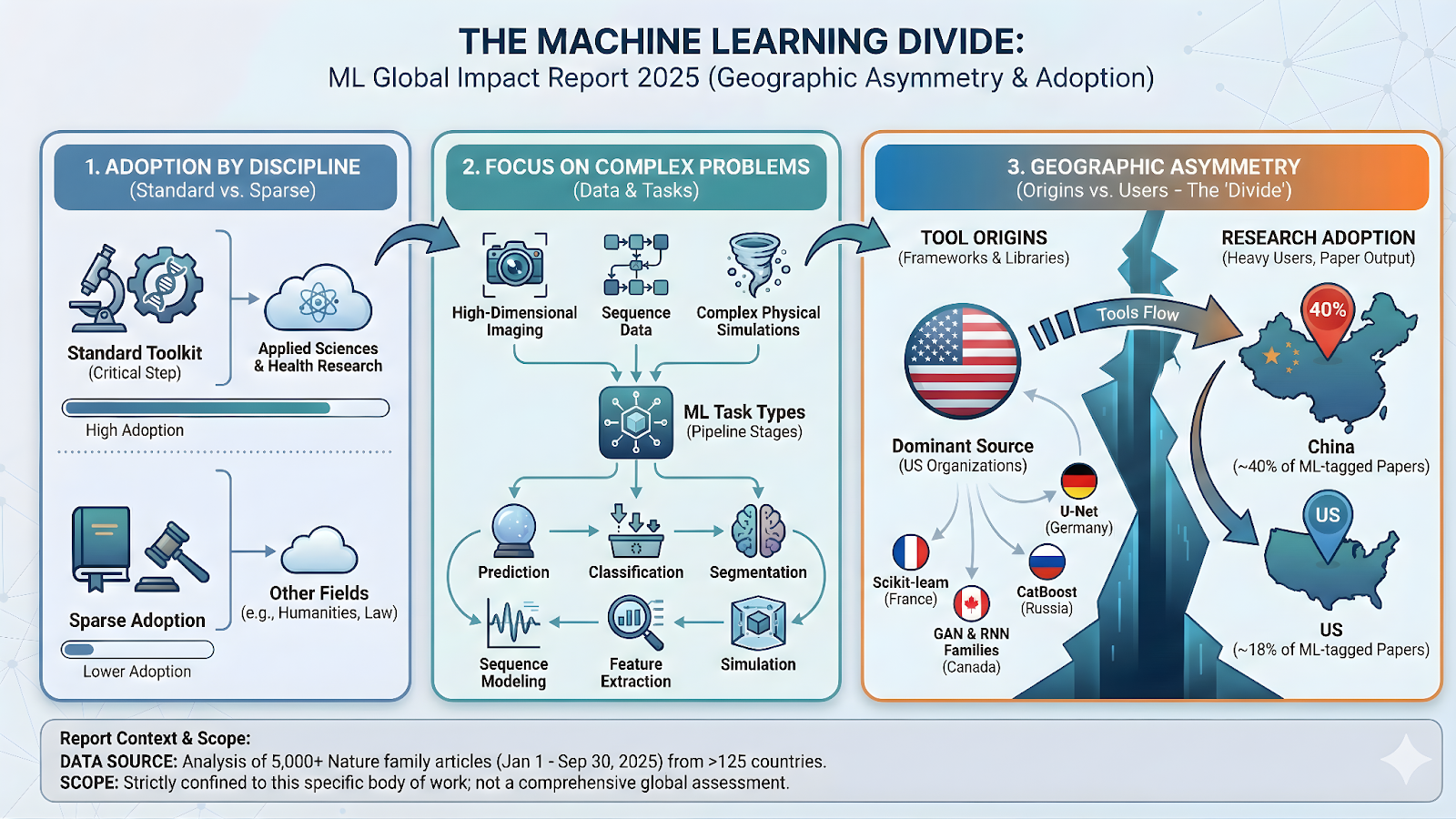
Los Angeles, December 11, 2025 — Marktechpost has unveiled its comprehensive ML Global Impact Report 2025, an in-depth educational analysis derived from over 5,000 scholarly articles published across more than 125 countries. These articles, all featured within the Nature family of journals between January 1 and September 30, 2025, form the exclusive dataset for this report. It is important to note that this study focuses solely on this curated collection and does not represent an exhaustive evaluation of worldwide machine learning research.

Exploring the Integration of Machine Learning Across Disciplines
The report centers on three pivotal inquiries:
- Which academic fields have fully embraced machine learning as a fundamental research method, and which areas still show limited adoption?
- What types of scientific challenges most commonly depend on machine learning techniques, such as analyzing high-dimensional imaging, sequence data, or conducting complex physical simulations?
- How do patterns of machine learning application vary geographically and across different research ecosystems, based on the global distribution of the analyzed publications?
Machine Learning’s Entrenchment in Applied Sciences and Health Research
Findings reveal that machine learning has become an integral component of the methodological frameworks predominantly within applied sciences and health-related research. In these sectors, ML is frequently utilized as a vital element embedded within broader experimental workflows rather than being the primary focus of investigation. This trend underscores ML’s role as a powerful enhancer of existing research methodologies, facilitating more efficient data processing and interpretation. Conversely, other scientific domains exhibit slower integration rates, indicating potential opportunities for future expansion of ML applications.
Key Problem Domains Leveraging Machine Learning
The report identifies that machine learning is most effectively applied to complex analytical challenges, including but not limited to high-dimensional imaging, sequence data interpretation, and sophisticated physical simulations. By categorizing tasks such as prediction, classification, segmentation, sequence modeling, feature extraction, and simulation, the study maps out the diverse stages of research where ML contributes significantly. This detailed breakdown highlights ML’s versatility, from initial data handling to generating actionable insights and predictive models.
Geographical Disparities in Machine Learning Tool Development and Usage
A striking geographic divide emerges between the origins of machine learning tools and their predominant users. The United States remains the primary source of many foundational ML frameworks and libraries, maintaining leadership in tool development. However, China leads in research output, contributing approximately 40% of all ML-related publications within the dataset, more than double the United States’ share of around 18%. Additionally, the report acknowledges the influence of non-US tools widely adopted in the global research community, such as Scikit-learn from France, U-Net from Germany, CatBoost from Russia, and Canadian innovations including Generative Adversarial Networks (GANs) and Recurrent Neural Networks (RNNs).
Insights into the Global Machine Learning Research Ecosystem
Overall, the ML Global Impact Report 2025 offers valuable perspectives on the evolving landscape of machine learning research worldwide. It confirms that ML has solidified its position as a standard methodological approach, especially within applied sciences and health sectors. The concentration of ML applications on intricate data challenges like high-dimensional imaging and physical simulations underscores its critical role in advancing scientific discovery. Furthermore, the pronounced geographic split between tool originators-primarily US-based organizations-and the most prolific users, notably China, reflects the dynamic and interconnected nature of the global ML research ecosystem. These findings provide a foundation for understanding current trends and guiding future developments in machine learning across diverse scientific disciplines.