AI Singapore (AISG) has unveiled SEA-LION v4, an advanced open-source multimodal language model created in partnership with Google. Built upon the Gemma 3 (27B) architecture, this model is tailored to support a wide range of Southeast Asian languages, including those with scarce digital representation. SEA-LION v4 excels in both textual and visual comprehension and is distributed under a commercially permissive license, enabling easy deployment on standard computing hardware.

Outstanding Performance on Southeast Asian Language Benchmarks
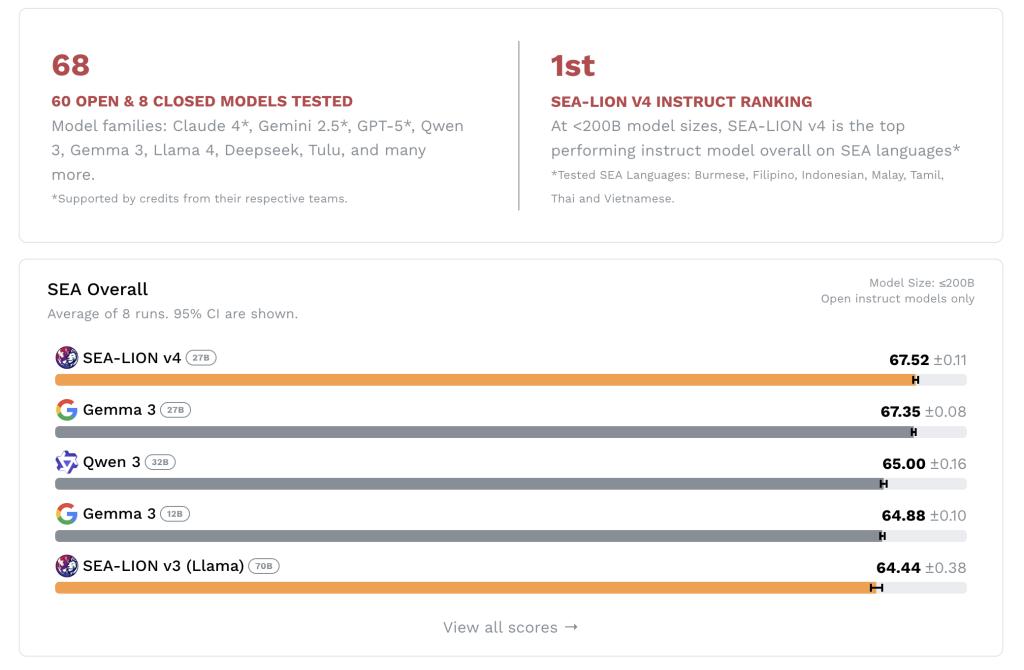
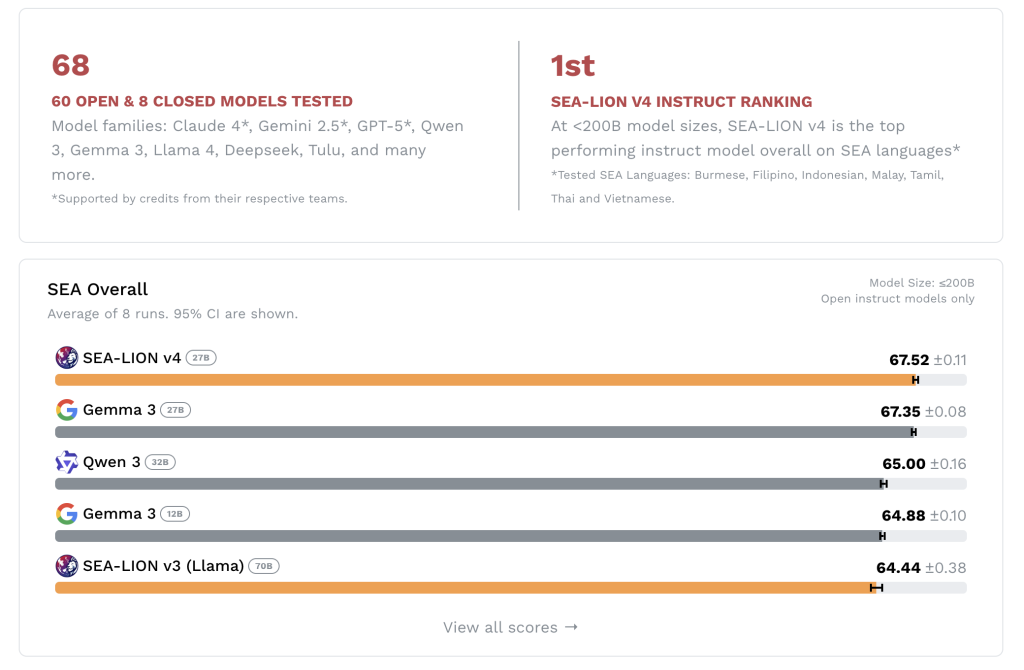
SEA-LION v4 has demonstrated exceptional results on the SEA-HELM benchmark, a comprehensive multilingual evaluation suite specifically designed for Southeast Asian languages. The model consistently ranks at the top among language models with fewer than 200 billion parameters, securing the 5th position out of 55 models globally. It excels in languages such as Burmese, Filipino, Indonesian, Malay, Tamil, Thai, and Vietnamese.
Remarkably, SEA-LION v4 outperforms well-known open-source models like Llama 3, Qwen 3, and even its predecessor Gemma 3, while competing closely with proprietary models that have significantly larger parameter sizes.
- Filipino: SEA-LION v4 scores 74.53 compared to Gemma 3’s 74.09
- Malay: 71.31 versus 71.20 by Gemma 3
- Tamil: 68.47, slightly ahead of Gemma 3’s 68.45
- Burmese: 57.18, narrowly trailing Gemma 3’s 57.78 but surpassing Llama 4 MoE (109B)
This impressive balance of compact size and high accuracy positions SEA-LION v4 as one of the most efficient and powerful multilingual models accessible for both academic research and commercial applications.
Innovations and Features in SEA-LION v4
Open-Source Accessibility with Commercial Flexibility
SEA-LION v4 is distributed under the Gemma license, which permits commercial use, significantly lowering barriers for startups, academic institutions, and enterprises. The model is available across multiple platforms, including:
- Hugging Face: both base and fine-tuned versions
- Google Cloud Vertex AI
- AWS SageMaker
- Kaggle: ideal for lightweight experimentation
- NVIDIA NIM and Ollama: optimized for edge device deployment
This broad availability ensures seamless integration into diverse environments, from cloud infrastructures to on-device applications.
Optimized for Speed and Portability
Despite its 27 billion parameters, SEA-LION v4 is engineered for efficient operation on modest hardware. Quantized versions using FP4 and FP8 precision formats enable:
- Less than 0.5% reduction in accuracy compared to full precision
- Inference speeds up to 50% faster
- Deployment on consumer-grade machines, such as laptops with 32GB RAM
This level of efficiency democratizes access to high-performance multimodal AI, making it feasible for developers and researchers without extensive computational resources.
Multimodal Capabilities: Integrating Text and Visual Data
SEA-LION v4 marks AISG’s first foray into multimodal AI, combining text and image understanding within a single model. This capability unlocks new applications, including:
- Multilingual document processing with embedded images
- Image-based question answering in local Southeast Asian languages
- Interactive workflows that require contextual understanding of both text and visuals
Additionally, the model supports an extensive 128,000-token context window, facilitating complex reasoning over lengthy documents, transcripts, or multi-turn conversations-an essential feature for enterprise and research use cases.
Advanced Interaction Features for Real-World Applications
Beyond generating text, SEA-LION v4 offers enhanced interaction tools such as:
- Function calling: allowing seamless integration with external APIs and software agents
- Structured output formats: including JSON and schema-compliant responses for automation pipelines
- Support for agentic workflows, facilitating complex task orchestration in enterprise environments
These capabilities extend the model’s utility beyond simple Q&A, enabling sophisticated applications like research assistants, workflow automation, and multimodal enterprise bots.
Focused Training for Southeast Asia, Versatile for Global Use
SEA-LION v4’s training corpus exceeds 1 trillion tokens, with a significant portion dedicated to a carefully curated dataset representing Southeast Asian languages and cultural contexts. This specialized training empowers the model to excel in low-resource languages and dialects often overlooked by global models.
On SEA-HELM tasks involving Filipino, Malay, Tamil, and Burmese, SEA-LION v4 consistently ranks among the top performers across all model sizes. This makes it a vital tool for promoting digital inclusivity in a region home to over 600 million people with diverse linguistic needs.
Simultaneously, the model retains strong general-purpose reasoning abilities inherited from Gemma, ensuring competitive performance on English and other international benchmarks, making it a flexible solution for worldwide deployment.
Summary
SEA-LION v4 exemplifies how a 27-billion-parameter model, when fine-tuned with domain-specific data and optimized for efficiency, can rival much larger models in multilingual and multimodal tasks. Its open licensing, broad platform support, and advanced features position it as a leading choice for advancing AI capabilities in Southeast Asia and beyond.