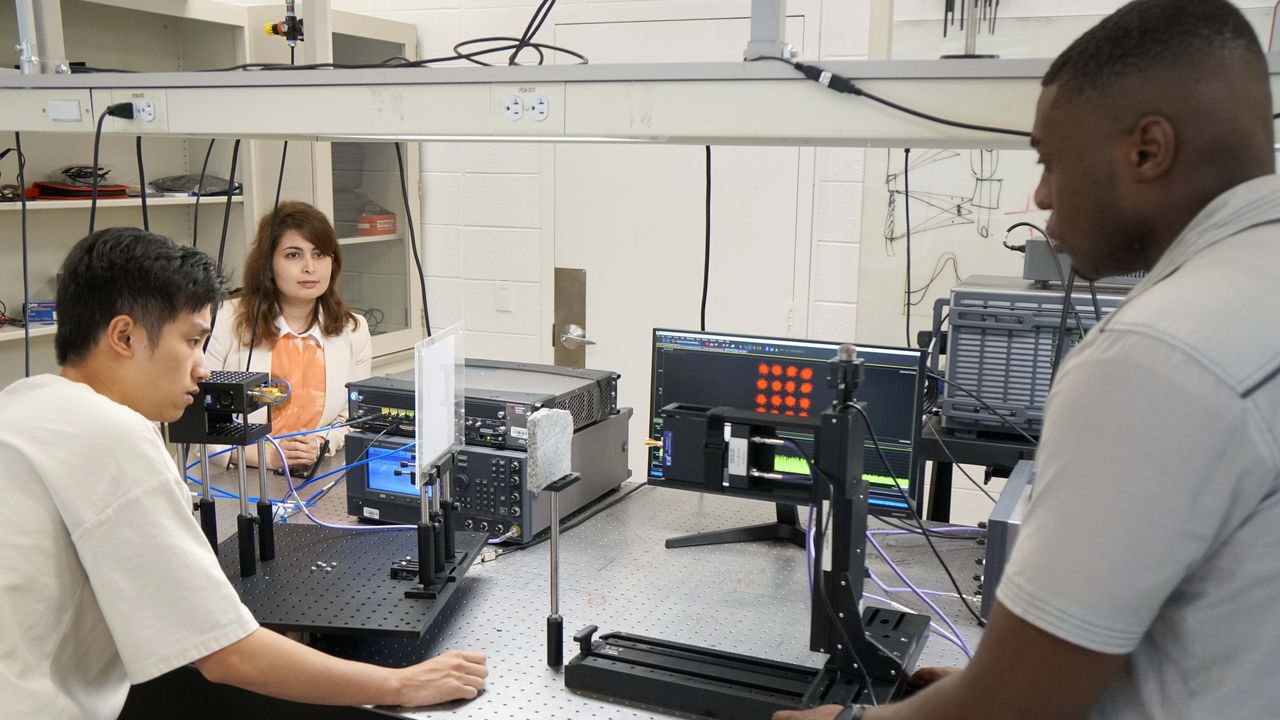
(Image credit: Aaron Nathans/Princeton University)
- High-frequency wireless signals falter when obstructed by walls or moving objects
- Neural networks mastered beam steering by simulating thousands of virtual basketball shots
- Metasurfaces embedded in transmitters enabled precise signal shaping
Overcoming Fragility in Ultrahigh-Frequency Wireless Communications
Ultrahigh-frequency (UHF) wireless transmissions offer the potential for unprecedented data speeds and bandwidth. Yet, these signals are notoriously delicate, often collapsing when encountering everyday obstacles such as walls, furniture, or even people moving through a room. This sensitivity has long limited the practical deployment of UHF technologies in dynamic environments.
Innovative Signal Steering Inspired by Sports Training
While the concept of bending electromagnetic waves to circumvent obstacles isn’t new-engineers have experimented with “Airy beams” that can curve predictably-applying this to real-world wireless communication has proven challenging. Previous research primarily demonstrated the theoretical existence of such beams without addressing their adaptability in complex, changing surroundings.
Haoze Chen, a lead researcher, explains that the difficulty lies in the countless variables influencing beam trajectories, making it nearly impossible to calculate the optimal path in real time. To tackle this, the team drew inspiration from basketball players who, rather than calculating every shot, develop intuition through repetitive practice.
Virtual Training with Neural Networks Accelerates Beam Adaptation
Replacing physical trial-and-error with a virtual training environment, doctoral student Atsutse Kludze developed a simulator where a neural network could practice navigating signal paths around obstacles. This method drastically shortened training durations while ensuring the model remained grounded in the physics governing Airy beams.
Once trained, the neural network could rapidly adjust beam shapes using a specially engineered metasurface integrated directly into the transmitter. Unlike traditional reflectors that rely on external surfaces, this metasurface technology allows signals to curve dynamically around sudden obstructions, maintaining connectivity without requiring a clear line of sight.
Demonstrated Success and Future Potential in Sub-Terahertz Communications
The research team showcased the neural network’s ability to select optimal beam paths in cluttered, shifting environments-capabilities beyond the reach of conventional wireless methods. This breakthrough paves the way for exploiting the sub-terahertz frequency band, which could deliver data rates up to ten times higher than current wireless systems.
Yasaman Ghasempour, the project’s principal investigator, emphasized that overcoming signal blockage is critical for enabling bandwidth-intensive applications such as immersive virtual reality experiences and fully autonomous vehicle networks.
“This advancement addresses a persistent challenge that has hindered the use of ultrahigh frequencies in dynamic wireless communications,” Ghasempour stated.
Challenges Ahead: From Lab to Real-World Deployment
Despite promising laboratory results, significant hurdles remain before this technology can be commercialized. Scaling the metasurface hardware, refining neural network training for diverse real-world conditions, and ensuring rapid adaptation to complex environments are essential next steps.
Nonetheless, the prospect of wireless links approaching terabit-per-second speeds is becoming increasingly tangible, signaling a transformative future for high-frequency communications.