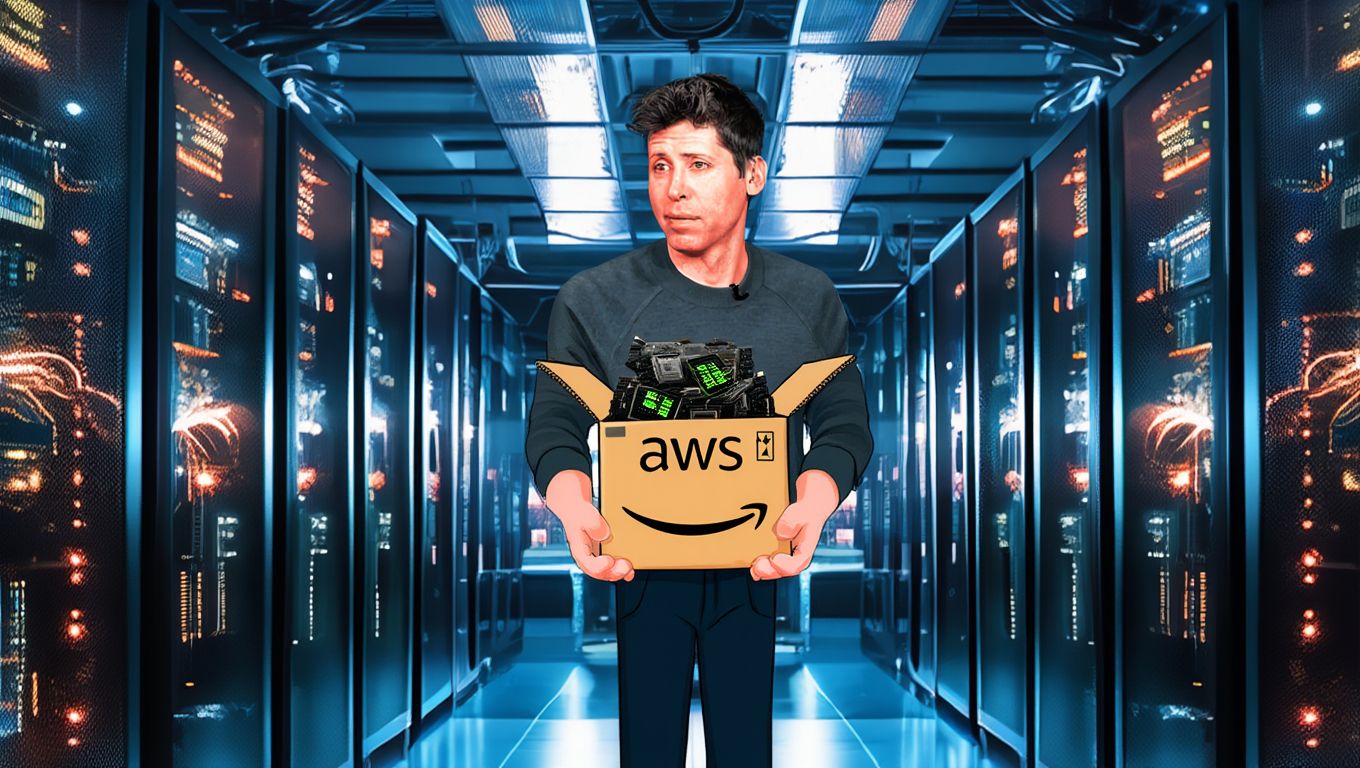
Good morning, AI enthusiasts. OpenAI has just committed a staggering $38 billion to Amazon Web Services for computing power-part of a massive investment spree in AI infrastructure that is rapidly approaching the trillion-dollar mark.
Amid growing concerns about the financial sustainability of such enormous expenditures relative to OpenAI’s current revenue, CEO Sam Altman offered a bold response to skeptics: if you want to sell your shares, he will find a buyer.
Today’s AI Highlights:
- OpenAI’s landmark $38 billion AWS compute contract
- Coca-Cola’s renewed AI-driven holiday advertising campaign
- How to leverage Microsoft Copilot as a personalized learning assistant
- New benchmark reveals AI’s limitations in freelance task automation
- Four innovative AI tools, community workflows, and more
OpenAI’s Strategic Expansion with Amazon Web Services


OpenAI has inked a monumental seven-year deal valued at $38 billion with Amazon Web Services (AWS), marking a significant diversification from its previous reliance on Microsoft’s cloud infrastructure.
- This agreement grants OpenAI access to hundreds of thousands of Nvidia GPUs housed in AWS data centers, with full deployment expected by late 2026.
- The computing resources will power everything from ChatGPT’s real-time interactions to the development of future AI models, with scalable capacity built into the contract.
- Following a recent renegotiation with Microsoft, OpenAI is no longer bound by exclusivity clauses, enabling it to source compute power from multiple providers.
- The AWS deal is a component of OpenAI’s ambitious $1.4 trillion infrastructure expansion, which also includes collaborations with Oracle, Google, Nvidia, and Broadcom.
Significance: This massive investment underscores OpenAI’s commitment to scaling its AI capabilities despite skepticism about the financial viability of such spending. CEO Sam Altman’s candid remark to investors highlights confidence in the company’s long-term vision.
Streamlining Workflows with Slack’s AI-Powered Search
Employees reportedly lose up to 33% of their workday switching between apps and searching for information-sometimes toggling over 1,200 times daily. Slack’s AI-enhanced Enterprise Search aims to eliminate this inefficiency by consolidating search across multiple platforms into a single, intelligent interface.
- Instantly retrieve relevant data from messages, files, Salesforce, OneDrive, and Google Drive.
- Use natural language queries to receive context-aware answers instead of keyword-based results.
- Maintain enterprise-level security while accessing real-time insights across integrated tools.
Discover how AI-driven search is transforming workplace productivity and reducing digital friction.
Coca-Cola’s Bold AI-Enhanced Holiday Campaign


For its 2025 holiday season, Coca-Cola is doubling down on AI by releasing new versions of its iconic “Holidays Are Coming” commercials, this time featuring AI-generated animal characters instead of humans. This follows last year’s AI-driven campaign, which faced criticism from creative communities concerned about the impact on artists.
- Collaborations with AI studios Silverside and Secret Level enabled the production of over 70,000 clips in just 30 days, a dramatic reduction from the typical 12-month timeline.
- Only a handful of specialists were needed to generate and refine the content, showcasing AI’s efficiency in creative workflows.
- Despite social media backlash, Coca-Cola continues to embrace AI as a core element of its marketing strategy, with global VP Pratik Thakar acknowledging that “the genie is out of the bottle.”
Why it matters: As AI-generated video content becomes increasingly sophisticated, Coca-Cola’s persistence signals a broader industry trend toward integrating AI in advertising, even amid early resistance.
Transform Your Learning with Microsoft Copilot’s Vision and Voice Features


Unlock a new dimension of interactive learning by using Microsoft Copilot’s integrated Vision and Voice capabilities. This tutorial guides you through turning your desktop into a dynamic study assistant that can analyze documents and engage in verbal discussions.
- Download Microsoft Copilot for Windows or macOS (version 14.0+ with M1 chip), launch the app, and sign in with your Microsoft account.
- Enable “Voice Mode” and “Copilot Vision” in the settings, then open your study materials such as PDFs or notebooks in your browser.
- Activate Vision mode by saying “Hey Copilot” and clicking the eyeglasses icon, then request a walkthrough of your document with key insights.
- Follow up with questions like “Explain this concept as if I were 15” or “Create a practice problem and solve it interactively with me.”
- After your session, ask for analogy-driven notes with step-by-step explanations, which you can export or edit before saving.
Pro tip: Use Copilot’s Deep Research feature post-session to receive comprehensive analyses and discover connections between studied concepts.
Exploring Multi-Agent Systems with Galileo
Multi-agent AI systems offer the potential to tackle complex tasks by coordinating multiple intelligent agents. However, challenges remain in managing orchestration overhead and ensuring reliability in production environments.
Galileo’s latest guide delves into designing scalable multi-agent architectures, mastering context engineering for agent collaboration, and identifying common pitfalls to avoid in coordination.
Scale AI and Center for AI Safety Reveal AI’s Freelance Automation Limits

A new benchmark called the Remote Labor Index, developed by Scale AI in partnership with the Center for AI Safety, evaluated AI models on real freelance projects sourced from Upwork. The results reveal that even the most advanced AI systems successfully complete less than 3% of tasks at a professional human standard.
- The benchmark analyzed 240 verified freelance assignments across 23 categories, comparing AI outputs to human deliverables.
- Six AI models were tested on identical projects, with Manus leading at a 2.5% success rate, followed closely by Grok 4 and Claude Sonnet 4.5 at 2.1%.
- Nearly 97% of AI-generated outputs failed to meet basic client expectations due to issues like poor quality, incomplete work, and corrupted files.
- AI showed competence primarily in narrow tasks such as logo design, audio mixing, and chart creation.
Implications: This study quantifies the gap between AI hype and practical automation capabilities, emphasizing that complex project coordination still requires human oversight. While AI agents can assist with smaller subtasks, human involvement remains essential for now.
Quick Updates in AI
- Launch of Image Model 5 with prompt-based editing and enhanced video features.
- Perplexity introduces AI-powered patent search functionality.
- MiniMax debuts an AI video model with improved realism and motion dynamics.
- Cursor releases a fast, agentic coding model to accelerate development workflows.
Additional news:
- Zendesk’s annual AI summit is now available on demand, showcasing AI’s role in scaling customer service solutions.
- Apple’s upcoming Siri update will reportedly integrate Google’s Gemini AI model, according to industry insiders.
- OpenAI CEO Sam Altman reiterated on the Bg2 podcast that he is ready to facilitate share sales for concerned investors.
- Nvidia-backed startup Lambda secured a multibillion-dollar contract with Microsoft to build AI infrastructure featuring tens of thousands of Nvidia GH300 GPUs.
- Anthropic counts Cognizant among its top enterprise clients, with Claude AI deployed across 350,000 employees.
- Japanese creative companies, including Studio Ghibli and Bandai Namco, have requested OpenAI to cease using their content for training Sora video models.
- Microsoft announced a $15.2 billion investment in UAE data center expansion through 2029, incorporating over 80,000 Nvidia GPUs.
Community Spotlight: AI in Action
Each edition, we highlight how readers are harnessing AI to enhance productivity and innovation.
Today’s feature comes from Rob M. in Grand Rapids, MI, who shares:
“We developed a multimodal chat agent to conduct company-wide strategic planning research and deliver critical insights to an executive committee spanning 150 employees across 30 divisions.”
How are you integrating AI into your workflow? Share your story with us.
Additional Resources & Upcoming Events
Until next time,
Rowan, Joey, Zach, Shubham, and Jennifer – your team behind The Rundown