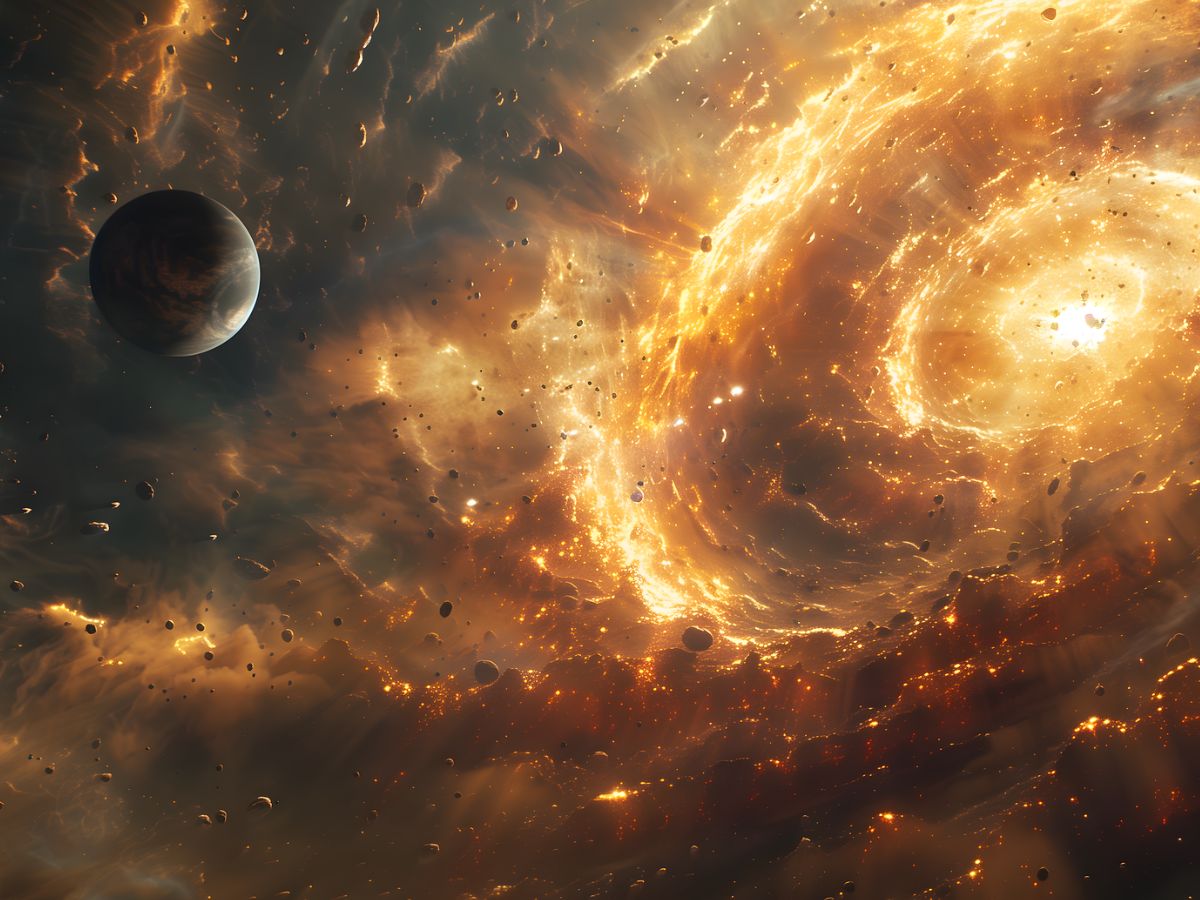


AI Captures Unprecedented Stellar Explosion Near Black Hole
In a groundbreaking achievement, artificial intelligence has, for the first time, detected a star undergoing a cataclysmic explosion during its interaction with a black hole. This milestone marks a significant leap forward in both astronomical research and AI applications.
Revolutionizing Astronomy Through AI-Driven Observations
Technological progress continues to reshape scientific fields, with astronomy benefiting immensely from AI advancements. In July 2023, an extraordinary cosmic event was recorded: a supernova explosion triggered by a star’s encounter with a black hole. This discovery was detailed in a study published in August 2023, highlighting the role of AI in identifying such rare phenomena.
The detection was made possible by the Zwicky Transient Facility (ZTF) at the Palomar Observatory in California. Utilizing sophisticated AI algorithms designed to scan the cosmos for unusual occurrences, the system identified an event approximately 730 million light-years away, designated SN 2023zkd.
Unveiling the Life Cycle of SN 2023zkd
SN 2023zkd was classified as a supernova, an explosive death of a star that emits an intense burst of light. Intriguingly, months after the initial explosion, the star exhibited renewed luminosity, challenging previous assumptions about its demise. Retrospective analyses suggest that the star’s brightness had fluctuated significantly in the four years leading up to the explosion, hinting at complex pre-supernova dynamics.

Exploring Theories Behind the Star-Black Hole Interaction
Scientists have proposed two primary hypotheses to explain the observed phenomena, both implicating the black hole’s influence. The first suggests that the star was gravitationally ensnared in orbit around the black hole, which siphoned off substantial amounts of gas. This mass transfer likely caused the star’s brightness to intensify prior to the supernova event. The immense gravitational forces near the black hole could have compressed matter, increasing its luminosity until the star ultimately exploded.
The alternative theory posits that the black hole directly triggered the star’s destruction, possibly through tidal disruption or accretion processes. Although this explanation is considered less probable, it remains a viable scenario under current astrophysical models. Both hypotheses underscore the black hole’s pivotal role in the star’s dramatic end.
Significance and Future Implications
While theoretical models have long predicted such interactions, this marks the first empirical observation of a star’s explosive demise linked to a black hole encounter. The integration of AI in astronomical surveys has been instrumental in capturing this event, demonstrating the transformative potential of machine learning in space exploration.
Looking ahead, ongoing monitoring of similar cosmic events by AI-powered observatories promises to deepen our understanding of stellar evolution and black hole dynamics. As AI algorithms become increasingly sophisticated, they will continue to unveil hidden phenomena across the universe, opening new frontiers in astrophysics.