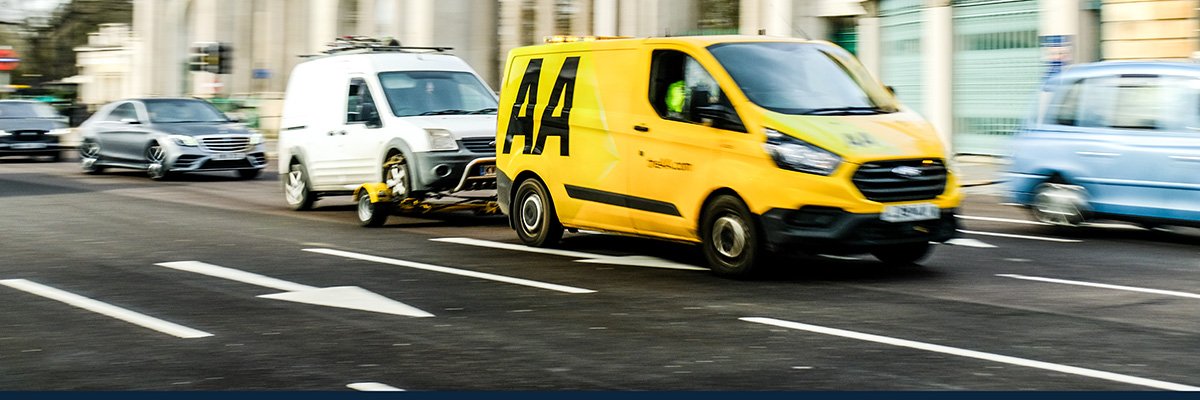
Interview with Antony Hausdoerfer (group CIO, The AA)
The direction of travel is a consideration that everyone at The AA takes seriously. Antony Hausdoerfer is the group CIO and believes that customers should have the best experience possible when they find themselves in a difficult situation.
“How do we know the exact problem that customers are experiencing before we send a police patrol? We make sure we send the right person with the right skills to the customer in the shortest time possible to get them back on the road as quickly as possible,” he says.
Hausdoerfer leads The AA’s digital transformation plan. He joined The AA as director of technology, change and innovation in December 2019, and was promoted to group CIO by April 2022. He was previously the group IT director for Avis Budget Group and held senior technology roles with Three and Vodafone.
Hausdoerfer was a great IT leader at Avis. He enjoyed the challenges of delivering IT, especially establishing touch-free rentals via phone. This project was completed right before the coronavirus epidemic. He also worked on data projects that assessed the amount of petrol left in rental vehicles. These projects helped him understand how information can be used for vehicle management and maintenance.
While he explored new challenges, he received an offer to join The AA. He was excited to take the job: “I saw The AA a prestigious company, and I thought that this would be a great opportunity to use what I had learned about connected vehicles and data from Avis.”
In March 2021, The AA changed ownership and went from being a public company to a private one. Hausdoerfer was given the opportunity to become CIO after a series of changes in senior leadership.
He says, “There was much to do and the new ownership would allow us to make these changes. That potential excited me.”
We’ve been on a long journey and we’re still going on it. But we’ve made big strides forward in terms where we are. Particularly in terms data and improved connectivity so that our patrols could be as good as they can be.
Riding on the rollercoaster
Hausdoerfer said his day-today responsibilities include the IT systems and business processes that support it. He works with other senior executives including the chief data and analytics officer and chief digital officer to ensure The AA exploits technology and information effectively.
He says, “I see the technology capabilities we provide behind the scenes to our customers and colleagues as well as the business systems.”
Our chief digital officer focuses on the digital channel. We also have a Chief Data and Analytics Officer who is responsible for determining how to get the most value out of information. I am responsible for all the technology and infrastructure they use.”
This technology oversight extends to other business portfolios. The road portfolio includes systems that are customer-facing, from the moment a person uses The AA app to report a breakdown to the time the information is passed to a patrol, and then the support the customer receives on the roadside.
“We’ve been on a trip, and we’re on it still, but we’ve taken some big steps in terms where we are”
Antony Hausdoerfer The AA
Hausdoerfer oversees technology for the Insurance portfolio. His team is replatforming The AA’s insurance capabilities. The last few system migrations are taking place. He also mentions his team’s Head Office Programme, which includes managing services that support the staff, such as finance systems, other enterprise platform and incident response functions.
He says, “I am responsible for the entire cyber capability of the company. This keeps me on my toes.”
Lastly, Hausdoerfer oversees IT Architecture. He recently hired a chief architect, and is working on ensuring that architecture is integrated across the organization. He is aware of the diverse nature of his job.
It feels like a rollercoaster. The ownership change has brought a rapid increase in pace. It takes a certain type of character to be able to keep up with such a pace. He says that there are days when the work is quite exhausting, but it is worth it because you are delivering so much.
The work is meaningful in terms what you see at the roadside. It’s about customer satisfaction, speed, and the fixed price at the side. The work pace may leave you feeling tired, but it will allow you to achieve some great results.
Making an impact
Hausdoerfer cites some of the biggest achievements since he became CIO. He refers to the replatforming of the firm’s legacy insurance and road systems as a technology deliverable.
“Roads and insurance were running on a platform that was probably not designed for either.” He says that we abstracted the road and put a Pega capability at the center, with all of the different systems on the outside. We created a proper eco-system, which put the customers at the centre of everything.
We focused on improving customer retention and satisfaction, which meant being able to provide better services and offers, as well as deliver better commercials. Three million customers had to be migrated onto the new system, which was a major task. However, we made that change and we’ve achieved the commercial outcomes we were looking for.”
For insurance, The AA partners with technology specialist CDL, which offers a platform-as-a-service capability to help enhance customer experiences. “This partnership allows us to concentrate on developing more relevant and market-relevant products for our customers,” he says.
Hausdoerfer also oversaw improvements to the colleague experience, including The AA’s Roadside Patrol Teams. His team analyzed the importance of IT to success, and decided to adopt a new approach to technology acquisition.
We went with a leasing model. We have just replaced all desktops with much better ones. We’ve also worked on connectivity for patrols and other abilities to create a huge swing in colleague satisfaction. People feel they have the tools to perform their jobs,” said he.
This increase in satisfaction was one the biggest swings from last year’s employee surveys. There were challenges with how people perceived technology in the past. It’s an ongoing journey. We’ve made a difference and I’m proud because it affects all of us who work at The AA.”
Connecting Roadside Patrols
Hausdoerfer embraces pioneering technology. Roadside recovery teams are often sent to remote areas where they face difficult terrain and limited connectivity.
He says, “They can’t provide the best customer outcomes without connectivity.” “We need to know their location to assign the next most appropriate job.” We need to share data, such as the location and details of the customer, the car and the potential problem.
This organisation wanted to move past its existing solution that operated on SIM-only networks using 3G and 4. Ericsson provided the answer, using a combination primary and backup SIMs to tap into broader frequencies on any spectrum.
In 2022, the AA began implementing this solution. Hausdoerfer rolled out the technology in just over a calendar year because his team wanted a clear business plan. His organisation began with a pilot consisting of 350 patrols located across the country. Of these, 50 had the worst connectivity issues.
We could see very quickly that our teams were improving, partly because of the feedback but also due to the data.
We had a patrol operating in a topology that was challenging and only 60% connected. After we gave them this capability, they reached 90% immediately. These results proved that this was the right solution.”
Prior to implementing Ericsson’s technology, the average connection rate for patrols was around 89%. Today, The AA provides 98.5% of high-value connectivity. This capability allows the organisation to take a proactive approach to patrols by sending customer and vehicle information to teams quickly and effectively.
He says, “Our ability to serve customers effectively has been vastly improved.” “We are exploring new ways to extract value from data for our clients and possibly for other organisations. This work must be in line with the responsibility we have to our customers in terms of protecting data. “But there are other things we’re looking at.”
A proactive approach
Hausdoerfer continues to search for ways to improve internal operations and customer experience. He paints a vision of The AA’s data-enabled strategy in 24 months.
He says, “It will be a personalized service that is pleasing to the customer.” “That’s easy to say, but hard to do. We’re focusing our attention on the fact drivers face different challenges. How can we personalise service to provide customers with what they need in the way that they need it and through the channels that they prefer?
AA is also exploring the ways artificial intelligence (AI), can improve customer experience. Vixa is a car-health assistant developed by the company’s internal innovation group. The system uses Databricks technology, along with algorithms developed internally, to take a proactive approach towards vehicle maintenance.
We can see patterns in how your car performs as a connected vehicle, and we can prevent an issue from happening before it occurs. He says that our battery model is highly accurate, as it takes into account multiple factors such as weather conditions, and other aspects, to determine the performance of your car’s battery.
We can accurately predict if you will have a failure of your battery the next time you start your car. We can tell you that a battery failure is likely if you don’t take the necessary steps. It’s wonderful that we can respond to a breakdown. “But if we can prevent a breakdown from happening, that’s better.”