
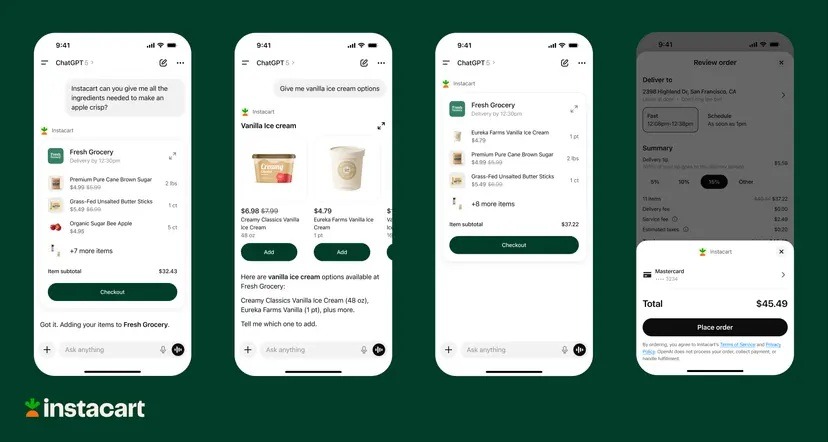
Instacart has introduced a fully integrated checkout system within ChatGPT by utilizing the innovative Agentic Commerce Protocol.
This launch marks Instacart as the pioneer in offering a seamless shopping journey inside ChatGPT, enabling users to move from product inquiry to payment without ever leaving the chat interface.
Revolutionizing Conversational Commerce with Embedded Transactions
One of the longstanding challenges in conversational commerce has been the “handoff” phase-where AI could recommend products or create meal plans, but completing the purchase required redirecting users to external websites or apps, often leading to abandoned carts.
Instacart’s new integration eliminates this friction by allowing users to plan meals and automatically generate a shopping cart based on real-time inventory from local stores. The standout feature is the embedded checkout, which processes payments directly within ChatGPT through a Stripe-powered credit card system.
Nick Turley, VP and Head of ChatGPT, emphasizes the goal of bridging AI-generated recommendations with tangible services. “With Instacart embedded in ChatGPT, customers can effortlessly transition from planning meals to completing their purchase in one fluid conversation,” Turley explained. “This advancement brings us closer to a future where AI not only suggests but also executes, saving users valuable time.”


Collaborative Innovation: Instacart’s Role in Shaping Agentic AI
Beyond a simple API integration, Instacart played a crucial role in the OpenAI Operator research preview, providing insights to ensure the AI could handle complex, real-world constraints while maintaining compliance with operational standards.
Given Instacart’s vast and dynamic inventory-spanning over 100,000 stores and 1.8 billion product instances-the company’s environment served as a rigorous testing ground for OpenAI’s agentic capabilities. Instead of merely adopting the technology, Instacart helped define how AI agents interact with external fulfillment systems.
Accurate, real-time data is essential when integrating large language models (LLMs) into commerce. Anirban Kundu, Instacart’s CTO, highlights the importance of grounding AI responses in reliable data to prevent “hallucinations” such as suggesting out-of-stock items, which could damage both finances and reputation.
“By leveraging the Agentic Commerce Protocol, Instacart and ChatGPT are transforming AI-driven shopping,” Kundu stated. “This integration delivers intelligent, up-to-the-minute assistance for one of life’s essentials-grocery shopping-turning conversations into actionable, secure transactions that bring groceries directly to customers’ doors.”
Dual AI Strategy: Enhancing Customer Experience and Internal Operations
While the embedded checkout feature captures public attention, Instacart is simultaneously deploying AI internally to boost efficiency. The company uses ChatGPT Enterprise to optimize workflows and accelerate customer experience development, alongside OpenAI’s Codex to power an internal coding assistant.
This two-pronged approach-using AI both to drive sales (Agentic Commerce) and to enhance development (Codex)-illustrates a comprehensive operational model. It signals a shift from isolated AI experiments to integrated systems that fuel both revenue growth and research innovation.
Instacart’s strategy also reflects a broader industry trend: recognizing that consumer touchpoints are diversifying beyond proprietary apps. By positioning itself as a backend fulfillment partner for major AI platforms like OpenAI, Google, and Microsoft, Instacart aims to capture demand originating outside its own ecosystem.
Accessing Instacart’s Embedded Shopping in ChatGPT
The embedded shopping experience is currently available on desktop and mobile web versions of ChatGPT, with native iOS and Android app support rolling out soon.
Users can activate the feature by invoking the Instacart app within ChatGPT-for example, by typing, “Instacart, help me find ingredients for apple pie”-and linking their accounts. This opt-in process ensures user consent for data sharing, aligning with enterprise governance standards for consumer-facing AI applications.
Instacart’s integration serves as a pioneering example of agentic AI in retail, demonstrating to industry leaders that the next wave of digital transformation requires robust API frameworks and real-time data pipelines designed to serve AI agents as effectively as human customers.
Maintaining data accuracy and immediacy is critical; without these, agentic commerce workflows risk failing to deliver meaningful returns on investment.