Upon entering Huawei’s Shanghai Acoustics Research and Development Center, I anticipated a routine tour of a typical facility. Instead, I discovered a cutting-edge automotive audio engineering hub that is redefining the standards of in-car sound systems.
Since initiating focused audio research in 2012, Huawei has established three specialized acoustic testing environments within this center: a compact anechoic chamber measuring 4.8 by 4 by 4 meters, a larger semi-anechoic room of 14 by 12 by 5 meters featuring a reflective floor, and a dedicated listening space arranged in a sophisticated 9.1.6 speaker configuration. Although photography was restricted to protect proprietary innovations, the technical details alone reveal the center’s advanced capabilities.
Revolutionizing In-Car Audio Challenges
Led by Goller, whose expertise spans renowned companies such as Gamut Audio, Bang & Olufsen, and Harman International, Huawei’s “master-tuning methodology” blends rigorous acoustic measurements with psychoacoustic insights to perfect sound reproduction. This approach aims to recreate the artist’s original intent, producing a “phantom effect” that immerses listeners in the authentic recording environment.
The process begins with precise objective assessments-analyzing frequency response, phase alignment, timing accuracy, and distortion levels-to define the system’s performance limits. Following this, extensive subjective listening sessions apply psychoacoustic principles to address the unique acoustic challenges posed by vehicle interiors, such as asymmetrical layouts, close-proximity reflections, and bass resonance. The ultimate objective is to deliver sound that remains true to the source material while adapting to the car’s environment.
Introducing the HUAWEI SOUND ULTIMATE Series


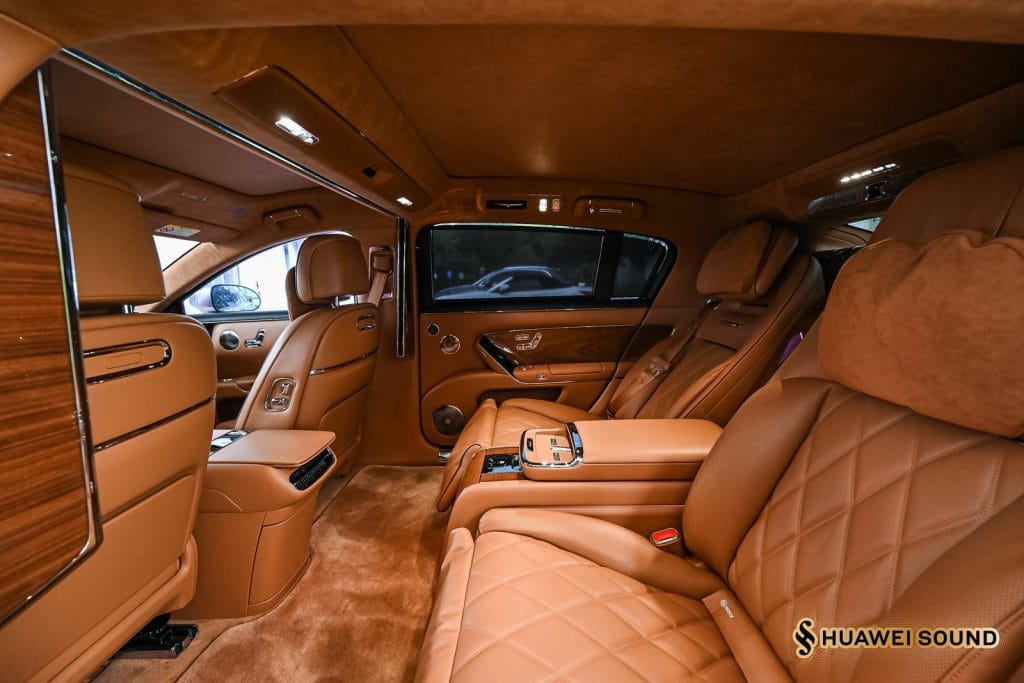
The pinnacle of Huawei’s audio innovation is embodied in the HUAWEI SOUND ULTIMATE Series, currently featured in the Maextro S800 luxury electric vehicle. This system boasts an impressive 43-speaker array powered by dual amplifiers delivering a combined output of 2,920 watts.
Huawei’s groundbreaking “seat-specific 4D immersive surround sound” technology incorporates rear 4D exciters that synchronize tactile sensations with audio and video content, enhancing the sensory experience beyond traditional sound reproduction.
Among the hardware breakthroughs is the Tangential Force Woofer, which reorients conventional door-woofer design by 90 degrees to minimize panel resonance and extend bass performance. Additionally, a patented dual-diaphragm subwoofer utilizes the vehicle’s cabin volume as an acoustic chamber, breaking free from conventional enclosure constraints.


The Crystal Star-Ring Diffuser, which elevates automatically upon occupant entry, integrates with rhythm-synchronized ambient lighting and enhances central sound imaging. Huawei reports a 30% improvement in sound uniformity compared to previous models.
The system’s spatial audio capabilities include 10 overhead channels, adaptive sound-field control, and a proprietary spatial audio track model that optimizes sound positioning and clarity. Integration with HarmonyOS enables “sound-to-light” technology, where AI-driven ambient lighting dynamically responds to musical cues in real time.
Advanced Independent Sound Zones
One of the most innovative features is the independent sound-zone technology. Each of the four headrests contains four dedicated drivers-two tweeters and two midrange speakers. Coupled with Huawei’s advanced sound-field control algorithms, the main speaker array acts as an active noise barrier, significantly reducing audio bleed between front and rear seating areas.
Huawei claims this technology achieves up to 30 decibels of isolation between rows and 99% energy separation. During demonstrations, front-seat passengers enjoyed classical music while rear-seat occupants watched an action movie with minimal audible interference. Real-world performance across diverse audio content and volume levels remains to be fully validated.
The system also incorporates sophisticated road-noise cancellation using an “omnidirectional model” that employs multi-channel amplification with low latency and ear-adaptive algorithms. Complemented by multi-layer acoustic glass and sound-absorbing materials, the cabin achieves a “library-level” baseline noise floor, enhancing overall listening quality.


Substantial Investment in R&D
Huawei’s commitment to innovation is underscored by its massive research and development expenditure: in 2024 alone, the company invested approximately CNY 179.7 billion (around £20 billion / €23.4 billion), representing 20.8% of its total revenue. Over 113,000 employees are engaged in R&D roles, with roughly CNY 60 billion (about £6.6 billion / €7.8 billion) allocated specifically to fundamental scientific research.
These figures highlight Huawei’s strategic focus on automotive sound engineering. Currently, the company supplies technology to more than twenty automobile manufacturers, covering areas such as driver assistance, cockpit systems, acoustics, and control modules. Huawei operates primarily as a component supplier, with individual automakers responsible for market deployment and regional availability.
Implications for the Automotive Audio Market
The automotive audio sector has long been dominated by established European brands. Huawei’s methodical approach-combining purpose-built testing facilities, recruitment of seasoned audio professionals, and significant capital investment-poses a formidable challenge to this status quo.
While the Maextro S800’s audio system demonstrates impressive technological prowess, the critical question is whether such advanced solutions can be scaled across multiple vehicle platforms at competitive price points to achieve widespread adoption.
Goller emphasizes the company’s mission: “to achieve optimal reproduction of the recording, bringing listeners closer to the artist’s original vision.” This aspiration aligns with audiophile ideals but has historically been difficult to realize within the constraints of automotive environments.
Final Evaluation
Having experienced both the research facilities and the in-car audio system firsthand, Huawei’s approach appears robust and well-founded. The integration of objective measurement with subjective tuning refinement reflects best practices in high-end audio, thoughtfully adapted for automotive applications.
Market success will depend on factors beyond acoustic excellence, including manufacturing scalability, supply chain coordination with diverse automakers, and consumer willingness to invest in premium features like independent sound zones and advanced tuning.
Huawei has laid a strong technical foundation; the true test will be the transition of these innovations from flagship showcases to mass-market automotive offerings.