
Inside London’s Autonomous Future: A Ride with Wayve’s Robotaxi
Wayve’s Vision for Driverless Taxis in London
Just weeks ago, I had the unexpected opportunity to ride in one of Wayve’s self-driving vehicles navigating the streets of north London. This experience comes amid Wayve’s recent announcement of a partnership with Uber to trial Level 4 fully autonomous robotaxis, aiming for deployment as early as 2026. This initiative aligns with the UK government’s accelerated plans to fast-track self-driving vehicle trials, potentially leading to a broader rollout by late 2027.
Meanwhile, Alphabet’s Waymo, a pioneer in autonomous driving, has established a strong presence in American cities like San Francisco, Los Angeles, and Phoenix. The company is also preparing to launch its first fully driverless robotaxi service outside the US, targeting London in 2026.
Challenges of Autonomous Driving in London’s Complex Environment
London presents a uniquely difficult environment for autonomous vehicles. Its historic, narrow, and winding streets-originally designed for horse-drawn carriages-pose significant navigation challenges. The city’s tight lanes, frequent potholes, and unpredictable obstacles such as parked cars and even occasional animals on the road complicate matters further. For example, just recently, a loose horse from a military unit was spotted wandering through central London, highlighting the city’s unpredictable traffic conditions.
Weather conditions and the prevalence of roundabouts add additional layers of complexity for robotaxis. Unlike the wide, grid-like streets of many US cities, London demands a more adaptable and cautious driving approach.
Public Perception and the Road to Acceptance
Even if autonomous vehicles master London’s streets, public acceptance remains a significant hurdle. British drivers are among the most skeptical globally about AI integration in cars, according to recent surveys. Past overhyped promises and technological setbacks have left a residue of doubt that new entrants must overcome.
Moreover, London’s iconic black cab drivers have historically resisted disruptive technologies. The introduction of Uber sparked widespread protests and even brought parts of the city to a standstill. However, this time around, the traditional taxi community appears less threatened by autonomous vehicles, possibly signaling a shift in attitudes.
Wayve’s Humble Headquarters and Cutting-Edge Technology
Wayve’s base of operations is far from flashy-a modest warehouse near King’s Cross, an area transformed from industrial wasteland into a tech hub housing giants like Google and Meta. Founded in a Cambridge garage and led by CEO Alex Kendall, Wayve has secured over $1 billion in funding from major investors such as Nvidia and Microsoft, with talks underway to raise an additional $2 billion.
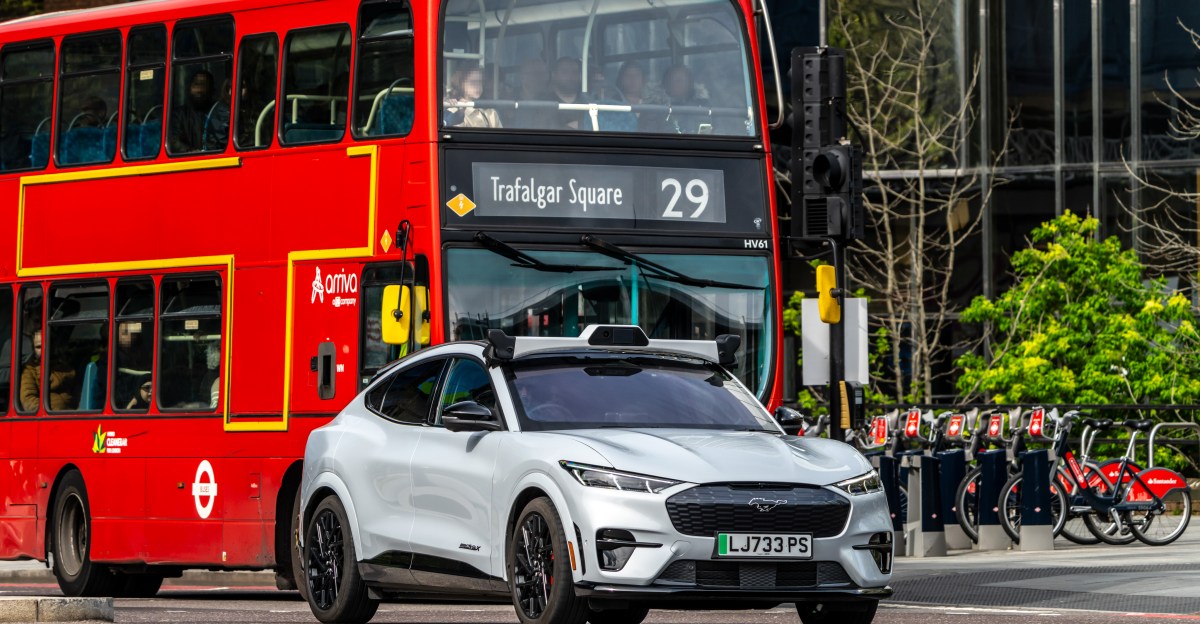
The company’s fleet consists of Ford Mustang Mach-Es, which look like ordinary electric vehicles except for a discreet sensor array mounted atop the windshield. This minimalist design contrasts sharply with the more conspicuous sensor pods seen on competitors’ vehicles.
Firsthand Experience: A Ride Through London’s Streets
Inside the vehicle, everything felt surprisingly normal. The only unusual feature was a prominent red emergency stop button on the center console, a reminder that a human safety driver was ready to intervene if necessary. The moment the robotaxi assumed control was marked by a distinct buzzing sound.
Despite my initial doubts, the autonomous car navigated busy London roads with impressive competence. It slowed courteously for electric bike couriers weaving through traffic and carefully maneuvered between parked cars. The ride wasn’t perfectly smooth-it exhibited a cautious hesitancy reminiscent of a newly licensed driver-but it was far more adept than I anticipated.
We passed landmarks such as Pentonville Prison and followed a cyclist at a safe distance, even though most Londoners would have overtaken by then. This cautious style, while testing my patience, underscored the vehicle’s priority on safety.
Wayve’s Unique AI Approach: Embodied Intelligence
Unlike many autonomous systems that rely on modular software stacks, Wayve employs an end-to-end AI model that mimics human driving behavior. This “embodied AI” enables the vehicle to adapt fluidly to new environments, much like a human driver would when navigating unfamiliar streets.
This approach was evident throughout the journey. The robotaxi handled complex scenarios such as roadworks, learner driver groups, cyclists, and London buses with a human-like sensitivity, albeit more cautiously than typical London drivers. One particularly striking moment occurred when a visually impaired pedestrian extended his cane between parked cars; the vehicle promptly slowed and adjusted its path without hesitation.
Wayve’s AI has been tested extensively worldwide, including a recent “global roadshow” covering 500 cities to ensure adaptability across diverse urban landscapes. This contrasts with London’s traditional “Knowledge” exams for black cab drivers, which require memorization of thousands of streets and landmarks to navigate without GPS.
Conclusion: A New Chapter for Autonomous Driving in London
By the end of the ride, I found myself no longer fixated on who was behind the wheel. The only indication of human oversight was the occasional alert signaling the safety driver’s readiness to intervene. This experience marked a turning point in my acceptance of autonomous vehicles-less science fiction, more practical reality.
Wayve’s human-centric, adaptable AI may well be the key to integrating robotaxis into London’s challenging traffic ecosystem, offering a glimpse of a future where driverless cars coexist seamlessly with the city’s unique rhythms.