At the core of effective AI integration lies a fundamental principle: the quality of AI outputs is directly tied to the integrity of the data fed through your APIs. When API endpoints are erratic, ambiguous, or unstable, AI models expend valuable resources correcting flawed inputs rather than generating meaningful insights. Postman’s comprehensive guide consolidates years of expertise into actionable strategies designed to make APIs consistent, machine-readable, and robust enough to support AI-driven tasks.
As we transition into an era where autonomous Agents-rather than humans-handle transactions, service comparisons, and interactions, the evolution of APIs becomes imperative. Unlike developers who can navigate unclear documentation or unpredictable behaviors, AI Agents depend on uniform standards and dynamically updated, machine-friendly documentation aligned precisely with your API schema. The objective is straightforward: develop APIs that both humans and AI Agents can instantly comprehend, enabling smarter scalability and unlocking the full capabilities of your systems.
Explicit Machine-Readable Metadata
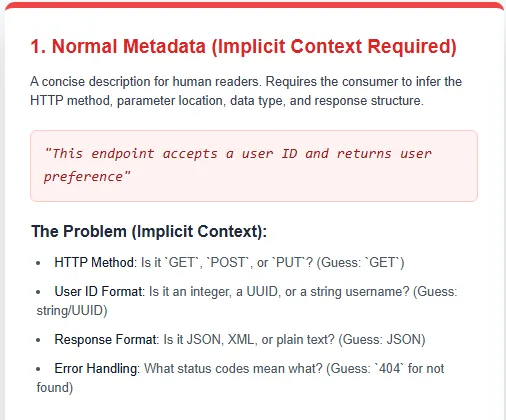
While human developers can fill in gaps from incomplete or vague API documentation, AI Agents require fully explicit, machine-readable metadata to function effectively. Instead of a generic statement like “this endpoint returns user preferences,” an AI-optimized API must meticulously specify the request method, parameter formats, response payloads, and data object definitions. This level of clarity eliminates guesswork, ensuring AI Agents interpret the API precisely as intended.
Comprehensive and Structured Error Reporting
Ambiguous error messages such as “Something went wrong” are manageable for human developers but problematic for AI Agents, which need detailed, structured feedback to self-correct. AI-ready APIs should provide rich error metadata including fields like error code, description, expected input, and actual input. This transparency empowers AI systems to diagnose issues autonomously and adjust their requests accordingly, minimizing workflow interruptions.
Full Schema Introspection for Autonomous Agents
APIs designed for AI consumption must transcend traditional, human-focused documentation. Unlike developers who can infer missing information through experience and RESTful conventions, AI Agents rely solely on comprehensive, structured schemas that explicitly enumerate all endpoints, parameters, data types, and error codes. Without this exhaustive introspection capability, AI workflows risk failure due to misinterpretation or hallucinated responses.
Uniform Naming Conventions and Patterns
Consistency in naming conventions is critical for AI systems to accurately parse and navigate APIs. When endpoints and data fields adhere to predictable patterns-such as standardized REST methods and consistent casing-AI Agents can deduce relationships and expected behaviors without ambiguity. This uniformity enhances automation accuracy, facilitates reasoning, and streamlines integration across complex API ecosystems.
Predictable and Stable API Behavior
AI Agents depend on unwavering consistency: identical inputs must always yield responses with the same structure, format, and fields. While humans can troubleshoot irregularities through intuition, AI cannot investigate anomalies and only learns from the patterns presented. Variations in naming, nesting, or error handling across endpoints lead to unreliable agent performance or complete breakdowns. To be truly AI-ready, APIs must guarantee consistent responses, standardized error management, and eliminate hidden edge cases.
Thorough and Accessible Documentation
Unlike humans who can seek clarifications or infer missing details, AI Agents operate solely based on the explicit information provided by API documentation. Without clear, comprehensive, and up-to-date documentation, AI cannot discover endpoints, understand parameters, anticipate responses, or recover from errors. High-quality documentation is not optional but essential for enabling AI Agents to interact reliably with your services.
High Performance and Reliability
AI Agents often orchestrate rapid, concurrent API calls, making speed and reliability paramount. While humans can tolerate delays or manually retry failed requests, AI systems are prone to timeouts and cascading failures if APIs respond slowly or inconsistently. In automated environments, the overall effectiveness of AI solutions is directly linked to the responsiveness and stability of the underlying APIs. Ensuring your API infrastructure can handle high throughput and maintain uptime is critical for seamless AI integration.
Enhanced API Discoverability
Humans can locate APIs through documentation portals, team communication, or code exploration, but AI Agents require APIs to be explicitly published with structured, searchable metadata. If an API is not properly indexed and accessible via standardized specifications, it effectively remains invisible to AI systems. Leveraging platforms that promote discoverability-such as centralized API networks-ensures both developers and AI Agents can efficiently find, understand, and integrate your APIs.