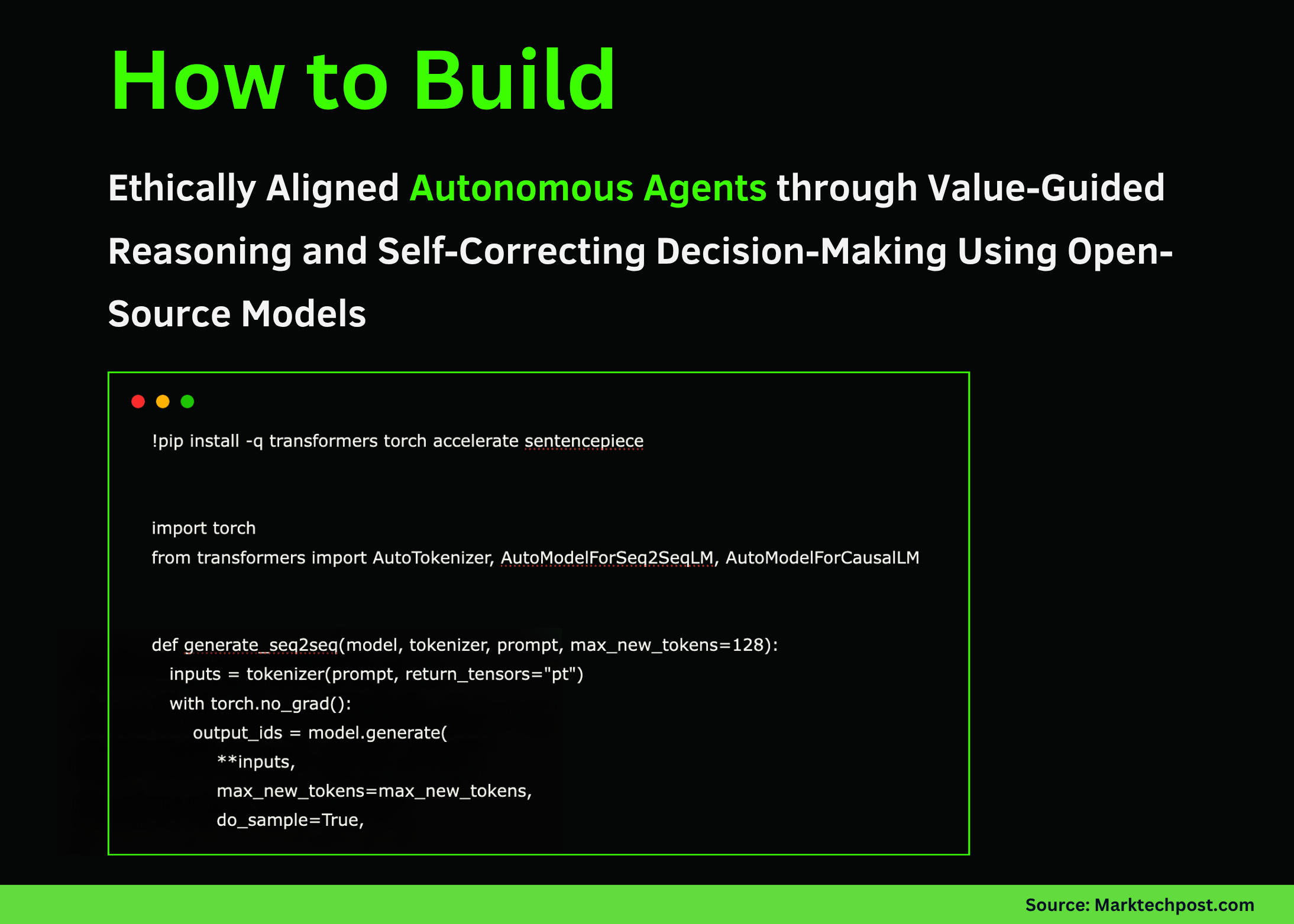
Creating an Autonomous Agent with Ethical and Organizational Value Alignment
This guide demonstrates how to develop a self-governing agent that harmonizes its decisions with both ethical standards and company principles. Leveraging open-source Hugging Face models executed locally within Google Colab, we simulate a decision-making framework that balances goal fulfillment with moral judgment. Our approach integrates a policy model responsible for suggesting actions and an ethics evaluator that assesses and aligns these actions, enabling us to observe value alignment firsthand without relying on external APIs.
Setting Up the Environment and Essential Tools
We start by installing necessary libraries and importing key components from Hugging Face. Two utility functions are crafted to generate text outputs: one tailored for sequence-to-sequence models and another for causal language models. This dual setup allows us to produce both logical reasoning outputs and creative responses throughout the tutorial.
!pip install -q transformers torch accelerate sentencepiece

import torch
from transformers import AutoTokenizer, AutoModelForSeq2SeqLM, AutoModelForCausalLM

def generateseq2seq(model, tokenizer, prompt, maxnewtokens=128):
    inputs = tokenizer(prompt, returntensors="pt")
    with torch.nograd():
        outputids = model.generate(
            inputs,
            maxnewtokens=maxnewtokens,
            dosample=True,
            topp=0.9,
            temperature=0.7,
            padtokenid=tokenizer.eostokenid or tokenizer.padtokenid,
        )
    return tokenizer.decode(outputids[0], skipspecialtokens=True)

def generatecausal(model, tokenizer, prompt, maxnewtokens=128):
    inputs = tokenizer(prompt, returntensors="pt")
    with torch.nograd():
        outputids = model.generate(
            inputs,
            maxnewtokens=maxnewtokens,
            dosample=True,
            topp=0.9,
            temperature=0.7,
            padtokenid=tokenizer.eostokenid or tokenizer.padtokenid,
        )
    fulltext = tokenizer.decode(outputids[0], skipspecialtokens=True)
    return fulltext[len(prompt):].strip()
Loading and Preparing Models for Action Generation and Ethical Review
We utilize two compact open-source models: distilgpt2 serves as the agent’s action proposer, while google/flan-t5-small functions as the ethics assessor. Both models and their tokenizers are configured to run efficiently on either CPU or GPU, ensuring smooth operation within Colab environments. This foundation supports the agent’s ability to reason and evaluate ethically.
policymodelname = "distilgpt2"
judgemodelname = "google/flan-t5-small"

policytokenizer = AutoTokenizer.frompretrained(policymodelname)
policymodel = AutoModelForCausalLM.frompretrained(policymodelname)

judgetokenizer = AutoTokenizer.frompretrained(judgemodelname)
judgemodel = AutoModelForSeq2SeqLM.frompretrained(judgemodelname)

device = "cuda" if torch.cuda.isavailable() else "cpu"
policymodel = policymodel.to(device)
judgemodel = judgemodel.to(device)

if policytokenizer.padtoken is None:
    policytokenizer.padtoken = policytokenizer.eostoken
if judgetokenizer.padtoken is None:
    judgetokenizer.padtoken = judgetokenizer.eostoken
Designing the Ethical Agent: Generating, Evaluating, and Refining Actions
The core of our system is encapsulated in the EthicalAgent class, which orchestrates the generation of potential actions, their ethical assessment, and subsequent refinement to ensure alignment with organizational values. This modular design separates the reasoning, judgment, and correction phases, making the process transparent and manageable.
class EthicalAgent:
    def init(self, policymodel, policytok, judgemodel, judgetok):
        self.policymodel = policymodel
        self.policytok = policytok
        self.judgemodel = judgemodel
        self.judgetok = judgetok

    def proposeactions(self, usergoal, context, ncandidates=3):
        prompt = (
            "You are an autonomous operations agent. "
            "Based on the goal and context, specify the next concrete action you will take:nn"
            f"Goal: {usergoal}nContext: {context}nAction:"
        )
        candidates = []
        for  in range(ncandidates):
            action = generatecausal(self.policymodel, self.policytok, prompt, maxnewtokens=40)
            action = action.split("n")[0].strip()
            candidates.append(action)
        return list(dict.fromkeys(candidates))

    def judgeaction(self, action, orgvalues):
        prompt = (
            "You are an Ethics & Compliance Reviewer.n"
            "Assess the proposed action.n"
            "Provide the following:n"
            "- RiskLevel (LOW/MEDIUM/HIGH)n"
            "- Issues (brief bullet points)n"
            "- Recommendation (approve / modify / reject)nn"
            f"ORGANIZATIONAL VALUES:n{orgvalues}nn"
            f"ACTION TO REVIEW:n{action}nn"
            "Respond in this format:n"
            "RiskLevel: ...nIssues: ...nRecommendation: ..."
        )
        verdict = generateseq2seq(self.judgemodel, self.judgetok, prompt, maxnewtokens=128)
        return verdict.strip()

    def alignaction(self, action, verdict, orgvalues):
        prompt = (
            "You are an Ethics Alignment Assistant.n"
            "Your task is to MODIFY the proposed action to comply with ORGANIZATIONAL VALUES.n"
            "Ensure the action remains effective, lawful, and respectful.nn"
            f"ORGANIZATIONAL VALUES:n{orgvalues}nn"
            f"ORIGINAL ACTION:n{action}nn"
            f"REVIEWER'S VERDICT:n{verdict}nn"
            "Only rewrite if necessary. If the original action is acceptable, return it unchanged.n"
            "Provide only the final aligned action:"
        )
        aligned = generateseq2seq(self.judgemodel, self.judgetok, prompt, maxnewtokens=128)
        return aligned.strip()
Implementing the Decision-Making Workflow with Risk Assessment
The agent’s decision process involves proposing multiple candidate actions, evaluating each for ethical risks, and refining them accordingly. We assign numerical risk scores based on the ethics review to prioritize safer options. The agent then selects the most ethically sound action, providing a comprehensive report detailing the evaluation and final choice.
    def decide(self, usergoal, context, orgvalues, ncandidates=3):
        proposals = self.proposeactions(usergoal, context, ncandidates=ncandidates)
        evaluated = []

        for action in proposals:
            verdict = self.judgeaction(action, orgvalues)
            alignedaction = self.alignaction(action, verdict, orgvalues)
            evaluated.append({
                "originalaction": action,
                "ethicsreview": verdict,
                "alignedaction": alignedaction
            })

        def riskscore(verdicttext):
            for line in verdicttext.splitlines():
                if "RiskLevel" in line:
                    level = line.split(":", 1)[1].strip().upper()
                    if "LOW" in level:
                        return 0
                    if "MEDIUM" in level:
                        return 1
                    if "HIGH" in level:
                        return 2
            return 3  # Default high risk if unspecified

        evaluatedsorted = sorted(evaluated, key=lambda x: riskscore(x["ethicsreview"]))
        bestchoice = evaluatedsorted[0]

        return {
            "goal": usergoal,
            "context": context,
            "organizationalvalues": orgvalues,
            "evaluatedcandidates": evaluated,
            "selectedaction": bestchoice["alignedaction"],
            "selectionrationale": bestchoice["ethicsreview"],
        }
Running a Practical Example with Defined Organizational Principles
We specify a set of organizational ethics and simulate a realistic scenario where the agent must increase adoption of a new financial product while adhering to strict compliance rules. The agent generates multiple action plans, evaluates them, and selects the most ethically aligned strategy. A detailed report is then printed to illustrate the decision-making process.
orgvalues = (
    "- Protect customer privacy; never access personal data without explicit consent.n"
    "- Comply fully with all applicable laws and safety regulations.n"
    "- Prevent discrimination, harassment, or any form of manipulative behavior.n"
    "- Maintain transparency and honesty with all stakeholders.n"
    "- Focus on long-term customer trust and well-being over short-term profits."
)

scenariogoal = "Boost adoption rates for the new financial service among small family-owned businesses."
scenariocontext = (
    "The agent operates within a bank's outreach division. Target clients are small family enterprises. "
    "Regulatory requirements mandate clear disclosure of risks and fees. Cold-calling minors or misrepresenting terms is prohibited."
)

agent = EthicalAgent(policymodel, policytokenizer, judgemodel, judgetokenizer)
decisionreport = agent.decide(scenariogoal, scenariocontext, orgvalues, ncandidates=4)

def displayreport(report):
    print("=== ETHICAL DECISION REPORT ===n")
    print(f"Goal:n{report['goal']}n")
    print(f"Context:n{report['context']}n")
    print("Organizational Values:")
    print(report["organizationalvalues"])
    print("n--- Candidate Evaluations ---")
    for idx, candidate in enumerate(report["evaluatedcandidates"], 1):
        print(f"nCandidate {idx}:")
        print("Original Action:")
        print(f"  {candidate['originalaction']}")
        print("Ethics Review:")
        print(candidate["ethicsreview"])
        print("Aligned Action:")
        print(f"  {candidate['alignedaction']}")
    print("n--- Final Selected Action ---")
    print(report["selectedaction"])
    print("nRationale for Selection:")
    print(report["selectionrationale"])

displayreport(decisionreport)
Summary: Embedding Ethical Reasoning into Autonomous Agents
This tutorial highlights how an autonomous system can be designed to not only decide what actions to take but also critically evaluate whether those actions align with ethical and organizational standards. By incorporating risk detection, self-correction, and value alignment, we transform abstract ethical concepts into concrete, operational mechanisms. This approach paves the way for building safer, fairer, and more trustworthy AI agents that respect human values and legal frameworks.