Building an Autonomous Voice AI Assistant with Advanced Reasoning and Speech Capabilities
This guide walks you through creating a sophisticated voice AI assistant that not only comprehends spoken commands but also reasons through multi-step tasks and responds naturally in real time. We establish a fully integrated voice intelligence framework combining speech-to-text transcription, intent recognition, contextual understanding, multi-layered planning, and text-to-speech synthesis. Leveraging state-of-the-art models like Whisper for speech recognition and SpeechT5 for voice generation, this assistant listens attentively, interprets user goals, formulates actionable plans, and delivers articulate spoken replies.
Setting Up the Environment and Essential Libraries
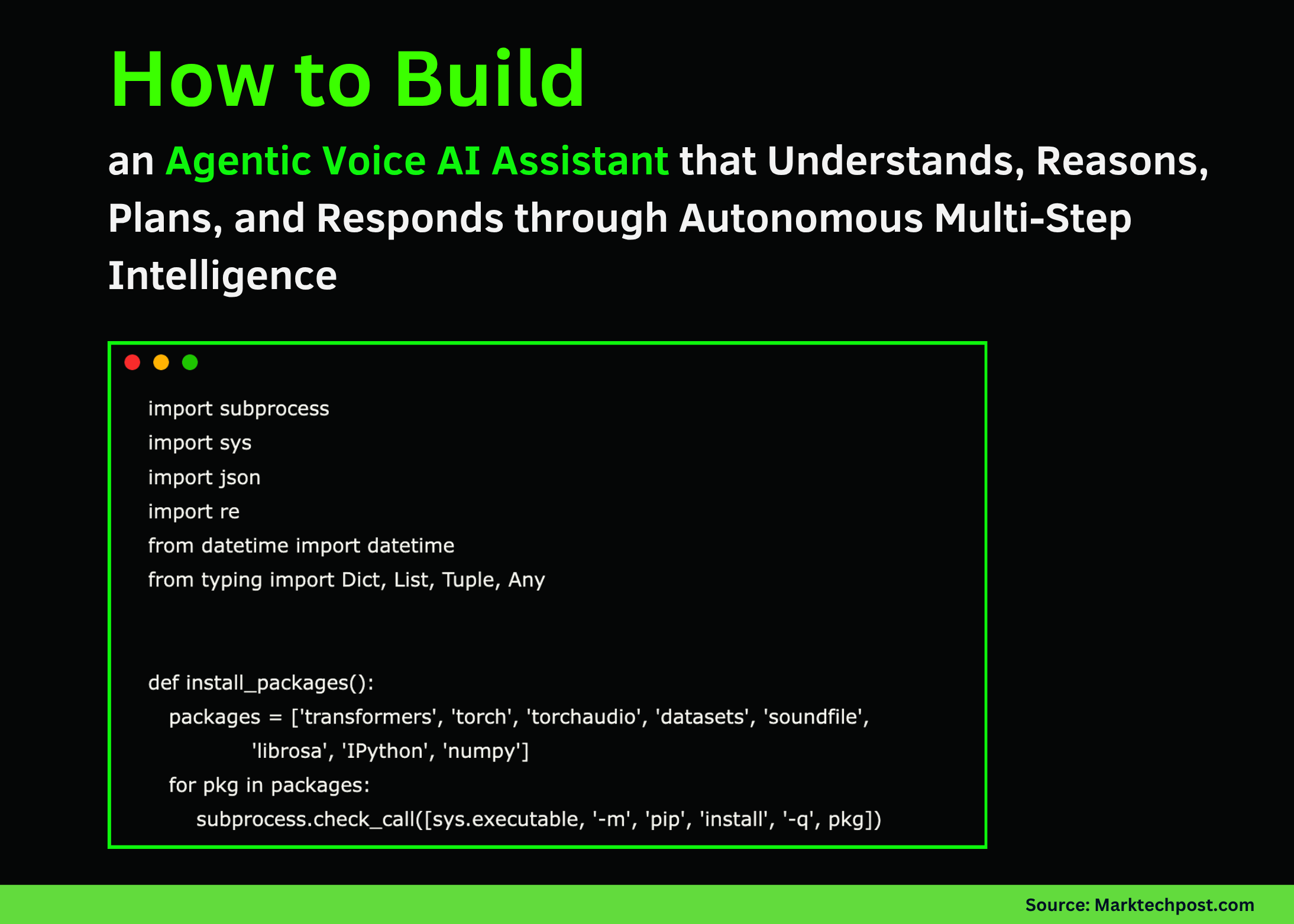
To begin, we install critical Python packages such as Transformers, PyTorch, Torchaudio, and Librosa, which provide the backbone for audio processing and model inference. We also configure the runtime environment to suppress non-critical warnings, ensuring a clean and efficient setup for our voice AI pipeline.
import subprocess
import sys

def install_dependencies():
    required_packages = [
        'transformers', 'torch', 'torchaudio', 'datasets', 'soundfile',
        'librosa', 'IPython', 'numpy'
    ]
    for package in required_packages:
        subprocess.check_call([sys.executable, '-m', 'pip', 'install', '-q', package])

print("🤖 Initializing Agentic Voice AI Assistant...")
install_dependencies()

import torch
import soundfile as sf
import numpy as np
from transformers import (
    AutoModelForSpeechSeq2Seq, AutoProcessor, pipeline,
    SpeechT5Processor, SpeechT5ForTextToSpeech, SpeechT5HifiGan
)
from IPython.display import Audio, display, HTML
import warnings
warnings.filterwarnings('ignore')
Designing the Perception Module: Understanding User Input
The perception component is responsible for interpreting the user’s spoken input by extracting intents, identifying key entities, and gauging sentiment. This layered understanding enables the assistant to contextualize commands effectively and maintain a memory of interactions for continuity.
import re
from datetime import datetime
from typing import Dict, List, Any

class VoiceAgent:
    def __init__(self):
        self.memory = []
        self.context = {}
        self.tools = {}
        self.goals = []

    def perceive(self, audio_text: str) -> Dict[str, Any]:
        intent = self._detect_intent(audio_text)
        entities = self._extract_entities(audio_text)
        sentiment = self._evaluate_sentiment(audio_text)
        perception = {
            'text': audio_text,
            'intent': intent,
            'entities': entities,
            'sentiment': sentiment,
            'timestamp': datetime.utcnow().isoformat()
        }
        self.memory.append(perception)
        return perception

    def _detect_intent(self, text: str) -> str:
        text_lower = text.lower()
        intent_keywords = {
            'compose': ['compose', 'write', 'create', 'draft'],
            'lookup': ['lookup', 'search', 'find', 'show me'],
            'explain': ['explain', 'describe', 'analyze', 'what is'],
            'compute': ['compute', 'calculate', 'sum', 'how much'],
            'organize': ['schedule', 'organize', 'remind', 'set appointment'],
            'translate': ['translate', 'convert', 'say in', 'interpret'],
            'summarize': ['summarize', 'brief', 'overview', 'tl;dr']
        }
        for intent, keywords in intent_keywords.items():
            if any(keyword in text_lower for keyword in keywords):
                return intent
        return 'chat'

    def _extract_entities(self, text: str) -> Dict[str, List[str]]:
        entities = {
            'numbers': re.findall(r'd+', text),
            'dates': re.findall(r'bd{1,2}/d{1,2}/d{2,4}b', text),
            'times': re.findall(r'bd{1,2}:d{2}s*(?:am|pm)?b', text.lower()),
            'emails': re.findall(r'b[A-Za-z0-9._%+-]+@[A-Za-z0-9.-]+.[A-Za-z]{2,}b', text)
        }
        return {key: val for key, val in entities.items() if val}

    def _evaluate_sentiment(self, text: str) -> str:
        positive_terms = ['good', 'great', 'awesome', 'happy', 'love', 'thanks']
        negative_terms = ['bad', 'terrible', 'sad', 'hate', 'angry', 'issue']
        text_lower = text.lower()
        positive_score = sum(word in text_lower for word in positive_terms)
        negative_score = sum(word in text_lower for word in negative_terms)
        if positive_score > negative_score:
            return 'positive'
        elif negative_score > positive_score:
            return 'negative'
        else:
            return 'neutral'
Implementing Reasoning and Strategic Planning
Once the assistant understands the input, it moves to reasoning-defining the user’s goal, verifying necessary resources, and outlining a step-by-step plan to fulfill the request. This structured approach ensures the assistant can handle complex tasks with clarity and precision.
from typing import List

class VoiceAgent(VoiceAgent):  # Extending previous class
    def reason(self, perception: Dict) -> Dict[str, Any]:
        intent = perception['intent']
        reasoning = {
            'goal': self._map_goal(intent),
            'requirements': self._verify_requirements(intent),
            'plan': self._formulate_plan(intent, perception['entities']),
            'confidence': self._estimate_confidence(perception)
        }
        return reasoning

    def act(self, reasoning: Dict) -> str:
        plan = reasoning['plan']
        execution_results = []
        for step in plan['steps']:
            result = self._perform_step(step)
            execution_results.append(result)
        response = self._compose_response(execution_results, reasoning)
        return response

    def _map_goal(self, intent: str) -> str:
        goal_map = {
            'compose': 'Create new content',
            'lookup': 'Fetch relevant information',
            'explain': 'Provide detailed analysis',
            'compute': 'Execute calculations',
            'organize': 'Manage scheduling tasks',
            'translate': 'Convert language',
            'summarize': 'Condense information'
        }
        return goal_map.get(intent, 'Assist with conversation')

    def _verify_requirements(self, intent: str) -> List[str]:
        requirements = {
            'lookup': ['internet connection', 'search API'],
            'compute': ['math engine'],
            'translate': ['language model'],
            'organize': ['calendar access']
        }
        return requirements.get(intent, ['language processing'])

    def _formulate_plan(self, intent: str, entities: Dict) -> Dict:
        plans = {
            'compose': {'steps': ['gather_requirements', 'generate_text', 'review_output'], 'duration': '12s'},
            'explain': {'steps': ['parse_input', 'analyze_data', 'summarize_findings'], 'duration': '6s'},
            'compute': {'steps': ['extract_values', 'select_operation', 'calculate_result'], 'duration': '3s'}
        }
        default_plan = {'steps': ['interpret_query', 'process_data', 'generate_reply'], 'duration': '4s'}
        return plans.get(intent, default_plan)

    def _estimate_confidence(self, perception: Dict) -> float:
        confidence = 0.7
        if perception['entities']:
            confidence += 0.15
        if perception['sentiment'] != 'neutral':
            confidence += 0.1
        if len(perception['text'].split()) > 5:
            confidence += 0.05
        return min(confidence, 1.0)

    def _perform_step(self, step: str) -> Dict:
        # Placeholder for actual step execution logic
        return {'step': step, 'status': 'done', 'output': f'Completed {step}'}

    def _compose_response(self, results: List, reasoning: Dict) -> str:
        goal = reasoning['goal']
        confidence = reasoning['confidence']
        intro = "I understand you want to" if confidence > 0.8 else "It seems you are asking me to"
        response = f"{intro} {goal.lower()}. "
        if len(self.memory) > 1:
            response += "Considering our previous interactions, "
        response += f"I have completed {len(results)} steps to fulfill your request."
        return response
Establishing the Voice Input and Output Interface
To enable seamless voice communication, we integrate Whisper for accurate speech-to-text conversion and SpeechT5 for natural-sounding text-to-speech synthesis. This module handles audio input capture, transcription, and vocal response generation, forming the interactive core of the assistant.
class VoiceIO:
    def __init__(self):
        print("Loading voice models...")
        device = "cuda:0" if torch.cuda.is_available() else "cpu"
        self.stt_pipeline = pipeline("automatic-speech-recognition", model="openai/whisper-base", device=device)
        self.tts_processor = SpeechT5Processor.from_pretrained("microsoft/speecht5_tts")
        self.tts_model = SpeechT5ForTextToSpeech.from_pretrained("microsoft/speecht5_tts")
        self.vocoder = SpeechT5HifiGan.from_pretrained("microsoft/speecht5_hifigan")
        self.speaker_embedding = torch.randn(1, 512) * 0.1
        print("✔ Voice I/O initialized successfully")

    def listen(self, audio_file: str) -> str:
        transcription = self.stt_pipeline(audio_file)
        return transcription['text']

    def speak(self, text: str, output_file: str = "response.wav") -> tuple:
        inputs = self.tts_processor(text=text, return_tensors="pt")
        speech_waveform = self.tts_model.generate_speech(inputs["input_ids"], self.speaker_embedding, vocoder=self.vocoder)
        sf.write(output_file, speech_waveform.numpy(), samplerate=16000)
        return output_file, speech_waveform.numpy()
Integrating Components into a Unified Agentic Voice Assistant
By combining the perception, reasoning, and voice I/O modules, we create a cohesive assistant capable of processing voice commands end-to-end. This integration supports continuous interaction, memory retention, and dynamic response generation.
class AgenticVoiceAssistant:
    def __init__(self):
        self.agent = VoiceAgent()
        self.voice_io = VoiceIO()
        self.interaction_counter = 0

    def handle_audio_input(self, audio_path: str) -> Dict:
        user_text = self.voice_io.listen(audio_path)
        perception = self.agent.perceive(user_text)
        reasoning = self.agent.reason(perception)
        reply_text = self.agent.act(reasoning)
        audio_response_path, audio_data = self.voice_io.speak(reply_text)
        self.interaction_counter += 1
        return {
            'user_text': user_text,
            'perception': perception,
            'reasoning': reasoning,
            'reply_text': reply_text,
            'audio_response_path': audio_response_path,
            'audio_waveform': audio_data
        }
Visualizing the Assistant’s Thought Process and Running Demonstrations
To provide transparency into the assistant’s internal workings, we implement a display function that presents the input, perception details, reasoning steps, and final response in a clear, styled format. We then simulate various scenarios to showcase the assistant’s capabilities in real-world contexts.
def show_reasoning(result: Dict):
html_content = f"""
🤖 Agent Reasoning Overview
📥 Input: {result['user_text']}
🧠 Perception:
- Intent: {result['perception']['intent']}
- Entities: {result['perception']['entities']}
- Sentiment: {result['perception']['sentiment']}
💡 Reasoning:
- Goal: {result['reasoning']['goal']}
- Plan Steps: {len(result['reasoning']['plan']['steps'])}
- Confidence: {result['reasoning']['confidence']:.2%}
💬 Response: {result['reply_text']}
"""
display(HTML(html_content))
def demo_agentic_assistant():
print("n" + "="*70)
print("🤖 AGENTIC VOICE AI ASSISTANT DEMO")
print("="*70 + "n")
assistant = AgenticVoiceAssistant()
test_cases = [
"Summarize the latest trends in artificial intelligence",
"Add 45 and 58 together",
"Explain the advantages of electric vehicles"
]
for idx, test_input in enumerate(test_cases, 1):
print(f"n--- Test Case {idx} ---")
print(f"Simulated Command: '{test_input}'")
audio_file, _ = assistant.voice_io.speak(test_input, f"input_{idx}.wav")
result = assistant.handle_audio_input(audio_file)
show_reasoning(result)
print("n🔊 Playing assistant's spoken reply...")
display(Audio(result['audio_waveform'], rate=16000))
print("n" + "-"*70)
print(f"n✅ Completed {assistant.interaction_counter} voice interactions")
print("🎯 Demonstrated Features:")
print(" • Autonomous perception and comprehension")
print(" • Intent and entity extraction")
print(" • Multi-step logical reasoning and planning")
print(" • Goal-oriented task execution")
print(" • Natural language generation and speech synthesis")
print(" • Contextual memory management")
if __name__ == "__main__":
demo_agentic_assistant()
Summary
In this tutorial, we developed a cutting-edge voice assistant that transcends simple command execution by incorporating autonomous reasoning and planning. The system listens, interprets, strategizes, and responds with natural speech, creating a fluid and intelligent conversational experience. This approach exemplifies how agentic AI can elevate voice interfaces from passive tools to proactive collaborators, enhancing human-machine interaction in meaningful ways.