Google has introduced a Model Context Protocol (MCP) server designed to provide seamless access to its extensive interconnected public datasets-covering areas such as census data, health statistics, climate information, and economic indicators-via a standardized interface that allows intelligent agents to query using natural language. The Data Commons MCP Server is now live, accompanied by quickstart guides for integration with Google’s Agent Development Kit (ADK) and other platforms.
Introducing the Data Commons MCP Server
- A versatile MCP server: This server enables any MCP-compatible client or AI agent to effortlessly explore variables, identify entities, retrieve time series data, and generate comprehensive reports from Data Commons without the need for manual API coding. Google emphasizes its capability to support workflows ranging from initial data discovery to the creation of detailed generative reports, demonstrated through example prompts that cover exploratory, analytical, and generative use cases.
- Developer resources: To facilitate adoption, Google offers a PyPI package, a command-line interface (CLI) workflow via Gemini, and sample code within the ADK and Colab environments, allowing developers to embed Data Commons queries directly into their agent pipelines.
Why Launch MCP Now?
The Model Context Protocol is an open standard designed to connect large language model (LLM) agents with external data sources and tools, ensuring uniform capabilities such as tool invocation, prompt handling, and data transport. By releasing a first-party MCP server, Google enables Data Commons to be accessed through the same interface agents use for other data sources, minimizing the need for custom integration code and supporting discovery through a centralized registry alongside other MCP servers.
Capabilities and Applications
- Exploratory queries: For example, an agent can ask, “What health-related datasets are available for South America?” and receive a detailed list of variables, geographic coverage, and data sources.
- Analytical comparisons: Users can request, “Compare unemployment rates, inflation, and GDP growth across G7 countries,” prompting the server to fetch aligned time series, normalize geographic identifiers, and return structured tables or visual charts.
- Generative reporting: Agents can generate concise summaries such as, “Create a report on the correlation between obesity rates and diabetes prevalence in Canadian provinces,” which involves retrieving relevant metrics, calculating statistical relationships, and including data provenance for transparency.
Integration Options
- Gemini CLI and MCP clients: Developers can install the Data Commons MCP package, configure their clients to connect to the server, and submit natural language queries. The client handles the orchestration of tool calls behind the scenes.
- Agent Development Kit (ADK): Google’s sample agent demonstrates how to combine Data Commons queries with custom tools such as data visualization or storage modules, delivering outputs with clear sourcing.
- Documentation and onboarding: Comprehensive guides and quickstart tutorials are available to help users interactively query data through AI agents using MCP.
Practical Implementation Example
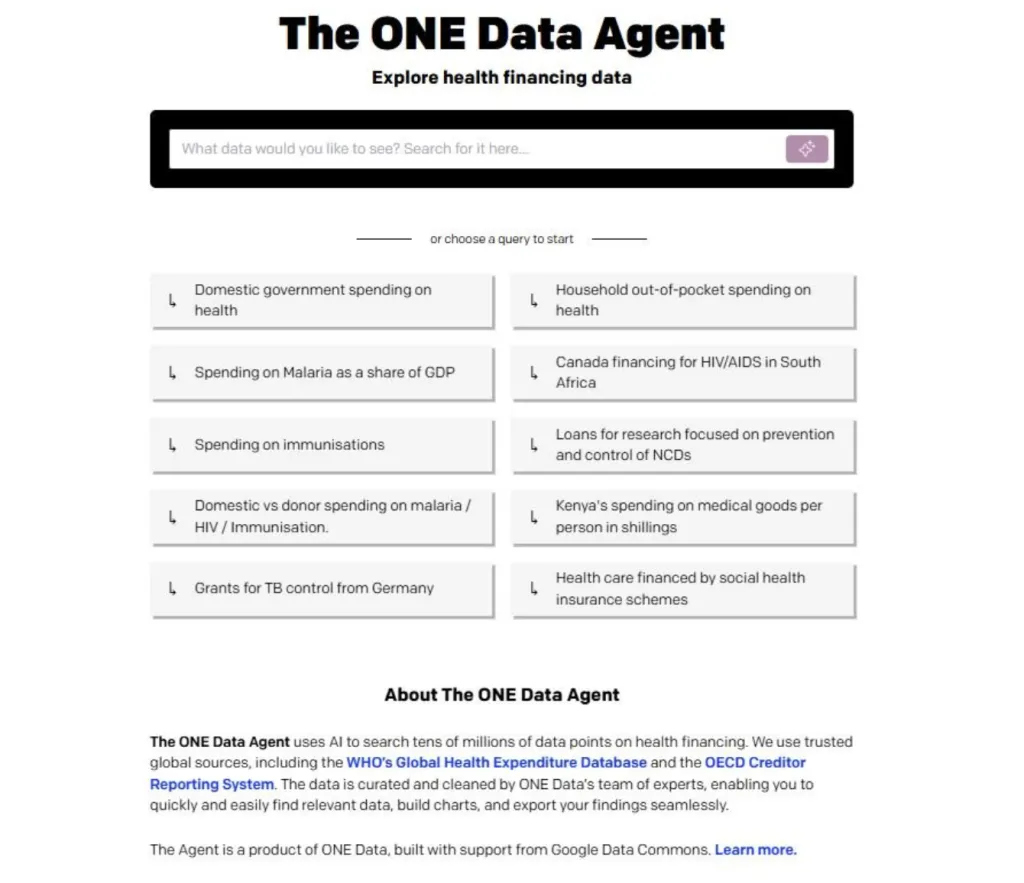
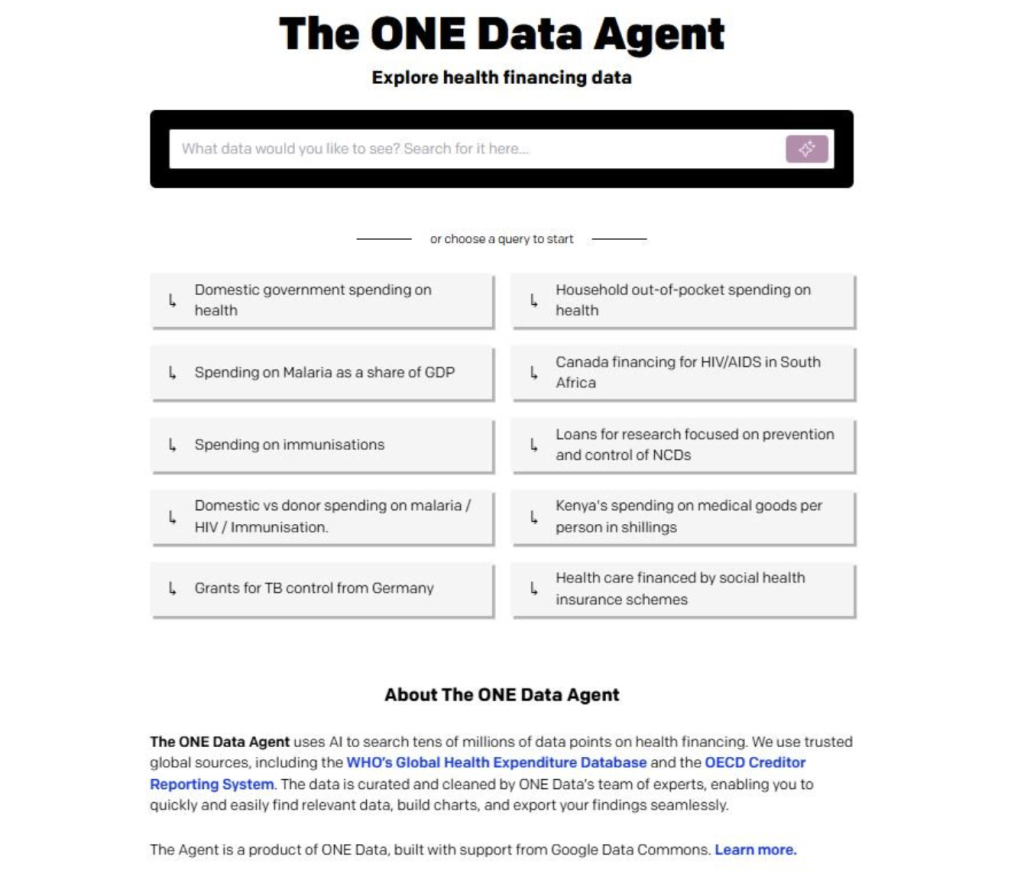
One notable application is a platform developed for the ONE Campaign, leveraging the Data Commons MCP Server to empower policy analysts. This tool allows users to query tens of millions of health financing data points using natural language, visualize the results dynamically, and export refined datasets for further analysis and reporting.

Conclusion
In essence, Google’s Data Commons MCP Server transforms a vast collection of public statistical data into a native, protocol-compliant resource for AI agents. This advancement reduces the need for bespoke integration code, maintains data provenance, and integrates smoothly with existing MCP-compatible clients like Gemini CLI and the ADK, streamlining access to authoritative public datasets.