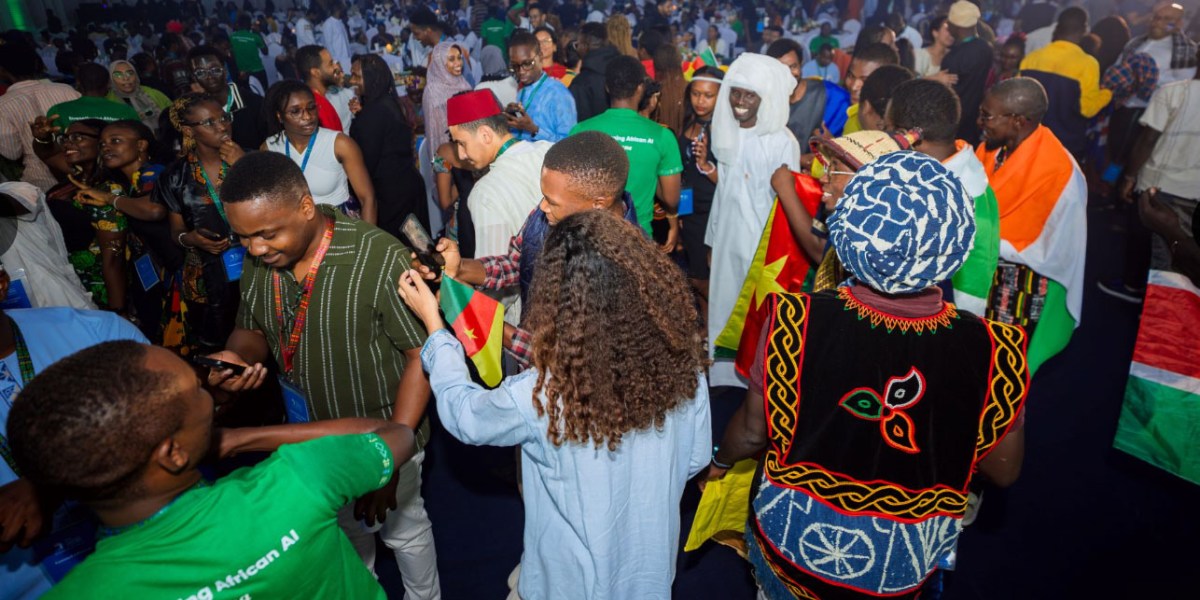
It’s August. In the capital of Rwanda, Kigali a large hall is filled with people at one of Africa’s largest gatherings of minds on AI and machine learning. The room is draped with white curtains and a giant display shows videos created using generative AI. On the speakers, a classic East African folk tune by the Tanzanian singer Saida Karaoli is played loudly.
As waiters serve sugary mocktails and arrowroot crisps, friends greet each other. A man and woman with leopard skins on their clothes chat and drink beer; many women wear handwoven Ethiopian clothing with red, green, and yellow embroidery. The crowd is alive. “The parties are always the best part of the Indaba,” Says Computer Scientist Nyalleng Morosi. Indaba is Zulu for “gathering”and Deep Learning Indaba is an annual AI conference at which Africans present their research.
Moorosi, a senior researcher with the Distributed AI research institute, has come to the event from the mountain kingdom Lesotho. She makes her way down the hall wearing her “Mama Africa’s” signature headwrap.
A few moments later, cheerful Nigerian music starts to play on the speakers. Suddenly, people gather around the stage and wave flags from many African countries. Moorosi laughs while she watches. “The community spirit at the Indaba is really strong,” she says while clapping.
Moorosi was one of the founders of the Deep Learning Indaba which began in 2017, with a core of 300 people gathered together in Johannesburg, South Africa. Since then, it has grown into a pan-African movement that includes local chapters in more than 50 countries.
Nearly 3,000 people applied for the Indaba this year; approximately 1,300 were accepted. The majority of them hail from English-speaking African nations, but I noticed this year a new influx of people from Chad and Cameroon as well as the Democratic Republic of Congo.
Moorosi told me that many attendees are hoping to be hired by a technology company or accepted into a PhD programme. The organizations I’ve seen include Microsoft Research’s AI for Good Lab as well as Google, Mastercard Foundation and the Mila Quebec AI Institute. She hopes to see more African-based ventures create jobs in Africa.
We both attended the panel discussion on AI policy in Africa that evening, just before dinner. Experts discussed AI governance, and urged those developing national AI strategy to engage more with the community. Many people raised their hands when asked how young Africans can access high-level AI policy discussions, and if Africa’s continental AI strategies are being shaped outsiders. Moorosi said in a later conversation that she would like to see African priorities (such a labor protections backed by the African Union, mineral rights or safeguards against exploitation), reflected in these strategies.
On the final day of the Indaba I asked Moorosi what her hopes were for the future of AI technology in Africa. After a long silence, she says: “I dream that African industries will adopt AI products made in Africa.” “We need to show the world our work.”
Abdullahi Tsanni, a Senegalese science writer who specializes in narrative feature stories, is a specialist in science writing.