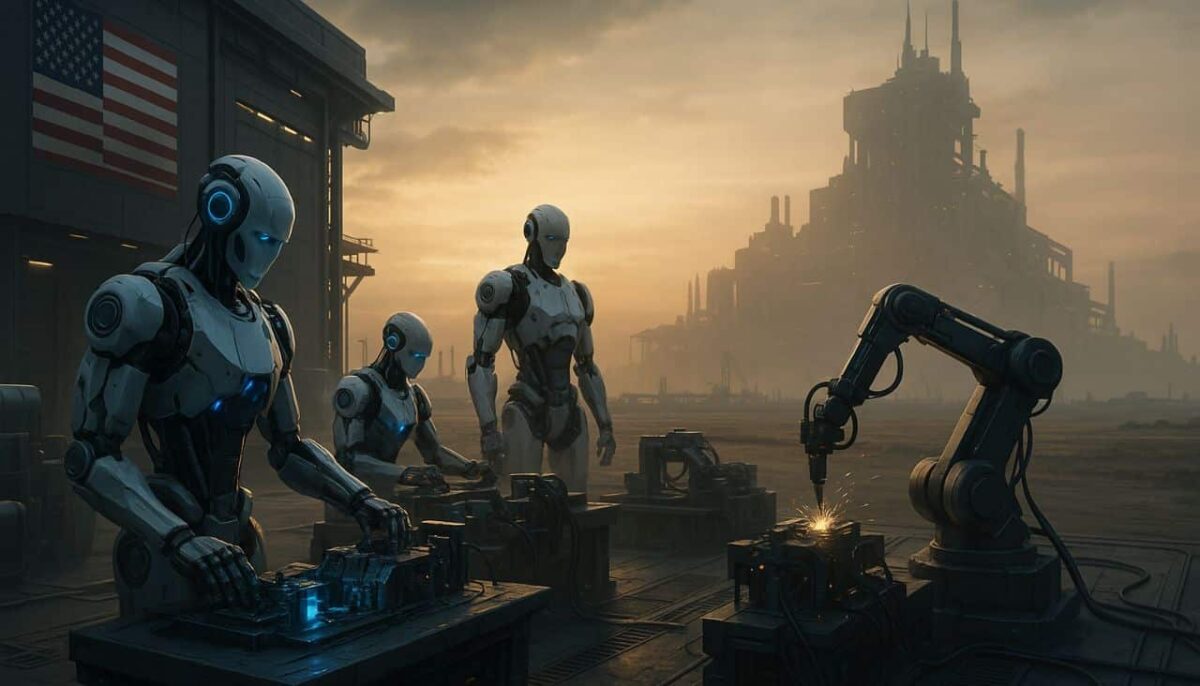
Jeff Bezos Leads Prometheus: Pioneering AI Integration in the Physical World
Overview: A New Frontier in Industrial AI
- Jeff Bezos has assumed the role of co-CEO at Prometheus, an innovative AI startup focused on applying artificial intelligence to tangible industries.
- Prometheus targets sectors such as manufacturing, robotics, heavy machinery, and other industrial fields that operate with physical components rather than digital data.
- The company aims to position itself as the United States’ strategic response to China’s rapid advancements in smart factories and industrial automation.
Prometheus: Bridging AI and Physical Manufacturing
In a significant career move, Jeff Bezos has returned to executive leadership as co-CEO of Prometheus, marking his first management role since stepping down from Amazon in 2021. Prometheus brands itself as a company dedicated to “AI for the physical economy,” focusing on embedding artificial intelligence into industries that rely heavily on engineering and materials science.
Unlike traditional AI applications that primarily manipulate digital information or “bits,” Prometheus is pioneering “AI for atoms.” This approach leverages AI to simulate physical processes, optimize factory automation, and accelerate the design and production of physical goods such as automobiles, aerospace components, electronics, and heavy machinery.
With a staggering $6.2 billion in initial funding-largely backed by Bezos-Prometheus stands as the most well-capitalized startup in this emerging sector globally. For context, Periodic Labs, another AI-driven company focused on automating scientific discovery, raised $2 billion in 2024, highlighting Prometheus’s financial advantage in this competitive landscape.
China’s Dominance in Physical AI and Industrial Automation
Despite U.S. efforts to restrict China’s access to advanced AI-compatible semiconductor chips through stringent export controls, China continues to outpace the U.S. in deploying AI within physical industries.
According to the International Federation of Robotics, China ranks third worldwide in robot density, boasting 470 robots per 10,000 manufacturing workers as of 2023, up from 402 the previous year. Remarkably, China only entered the top 10 in 2019 and has since surpassed industrial powerhouses like Japan and Germany. In contrast, the U.S. holds the 10th position with 295 robots per 10,000 employees.
Higher robot density correlates with enhanced automation, improved product quality, and faster production cycles. When combined with AI, these factories evolve into “smart” manufacturing hubs featuring AI-driven quality assurance, predictive maintenance, and autonomous control systems.
China’s vast talent pool further fuels its industrial AI leadership. Annually, China graduates over 1.5 million engineers with bachelor’s degrees, alongside 400,000 master’s and 60,000 Ph.D. holders. The U.S., by comparison, produces approximately 140,000 bachelor’s, 50,000 master’s, and 12,000 Ph.D. engineers each year. This disparity compels U.S. startups like Prometheus to aggressively recruit top talent from various sectors.
China’s Manufacturing Supremacy and Its Global Impact
- China dominates global electronics manufacturing, accounting for nearly 70% of worldwide electronics exports, while the U.S. contributes just 4%.
- By 2022, China was responsible for producing approximately 77% of all electric vehicle (EV) batteries globally, underscoring its control over critical supply chains.
- In solar energy, China’s installed photovoltaic capacity is projected to reach 329 gigawatts in 2024, representing 55% of the global total.
These figures illustrate China’s overwhelming lead in key physical industries, leaving the U.S. striving to catch up. The path forward for America likely hinges on breakthroughs in physical AI, a complex and resource-intensive endeavor.
Challenges in U.S. Robotics and AI Deployment
While China has already integrated humanoid robots like UBTECH’s Walker S2 into industrial settings-robots capable of continuous 24/7 operation with swappable batteries-the U.S. robotics scene still faces significant hurdles. For example, Marques Brownlee, a prominent technology reviewer, critiqued the NEO robot, one of America’s most advanced humanoid robots, for its limited autonomy and short battery life of just four hours. NEO requires substantial human control and can only perform a narrow range of tasks independently.
Brownlee highlighted a broader issue: many U.S. AI companies are marketing concepts rather than fully realized products, effectively using early adopters as beta testers. The gap between prototype designs and scalable, reliable industrial solutions remains substantial.
UBTECH’s Walker S2, by contrast, is already in mass production with plans to deploy 10,000 units annually by 2027 across smart factories, logistics, and automotive manufacturing, showcasing China’s advanced position in physical AI applications.
Jeff Bezos: The Visionary Driving Prometheus Forward
Jeff Bezos’s unique blend of experience and resources makes him exceptionally suited to lead Prometheus. His track record includes building Amazon’s unparalleled logistics network, pioneering warehouse automation, founding Blue Origin in aerospace, and developing Amazon Robotics.
Prometheus aims to develop sophisticated physical simulation platforms, industrial-grade AI systems, and engineering automation tools-areas where Bezos has decades of indirect involvement. His leadership not only secures substantial capital but also attracts elite talent and reassures investors about the company’s long-term prospects.
Vik Bajaj: The Technical Co-CEO Complementing Bezos
Joining Bezos as co-CEO is Vik Bajaj, whose background diverges from typical AI leaders focused on machine learning or natural language processing. Bajaj’s expertise lies in bioinformatics, biophysics, and molecular simulation. He co-founded Google’s Life Sciences division (now Verily), which specializes in integrating robotics, sensors, AI, and cloud computing within complex R&D environments.
Bajaj’s hands-on experience with long-term research and development projects complements Bezos’s strategic vision, positioning Prometheus to navigate the extended timelines and technical challenges inherent in physical AI innovation.
Long-Term Vision: Navigating the Physical AI Landscape
Unlike AI startups centered on large language models that can deliver results within months, physical AI ventures require years of research, experimentation, and refinement. The capital intensity and prolonged development cycles demand leadership with proven resilience and deep industry knowledge-qualities embodied by both Bezos and Bajaj.