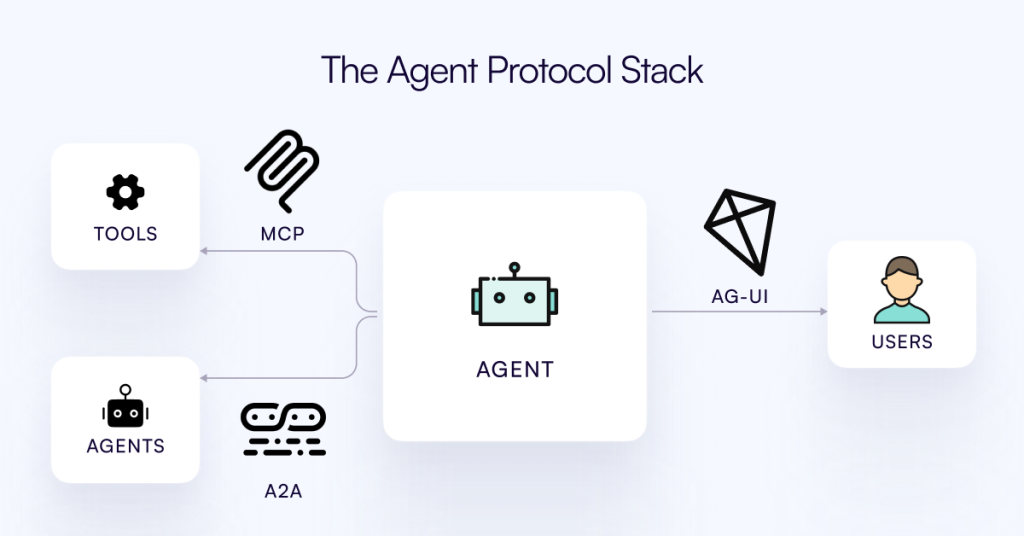
Artificial intelligence agents have transcended their original role as simple chatbots that provide straightforward answers. Today, they are sophisticated entities capable of methodical reasoning, invoking APIs, updating live dashboards, and collaborating seamlessly with human users in real time. This evolution prompts an important inquiry: what is the optimal way for AI agents to interface with user interfaces (UIs)?

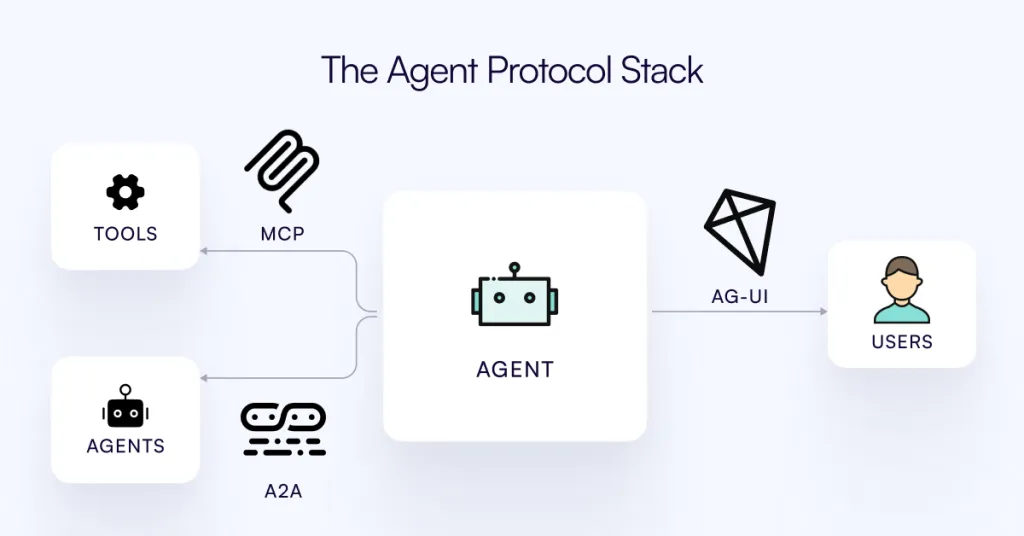
While custom APIs and ad-hoc socket connections may suffice for early-stage prototypes, they fall short when scaling complex applications. Each new project tends to reinvent the wheel-designing bespoke methods for streaming outputs, managing external tool invocations, or processing user feedback. This fragmentation highlights the need for a unified solution, which the AG-UI protocol addresses effectively.
Introducing AG-UI: A Unified Protocol for Agent-UI Interaction
AG-UI is a streaming event protocol crafted specifically to facilitate communication between AI agents and front-end interfaces. Unlike traditional approaches that return a single block of text, AG-UI enables agents to emit a continuous stream of structured JSON events, including:
TEXT_MESSAGE_CONTENTfor token-by-token streaming of responses.TOOL_CALL_START,ARGS, andTOOL_CALL_ENDto manage external function executions.STATE_SNAPSHOTandSTATE_DELTAevents to synchronize UI state with backend changes efficiently.- Lifecycle markers such as
RUN_STARTEDandRUN_FINISHEDto delineate interaction boundaries.
This event stream operates over widely supported transport layers like HTTP Server-Sent Events (SSE) and WebSockets, eliminating the need for developers to create custom communication protocols. Frontend applications subscribe once to the event stream, enabling them to render partial outputs dynamically, update visualizations in real time, and even accept user corrections during ongoing interactions.
More than a simple messaging format, AG-UI establishes a formal contract between AI agents and user interfaces. This abstraction allows backend systems and frontend designs to evolve independently, as long as they adhere to the AG-UI specification, ensuring seamless interoperability.
Robust Ecosystem: First-Party and Partner Framework Integrations

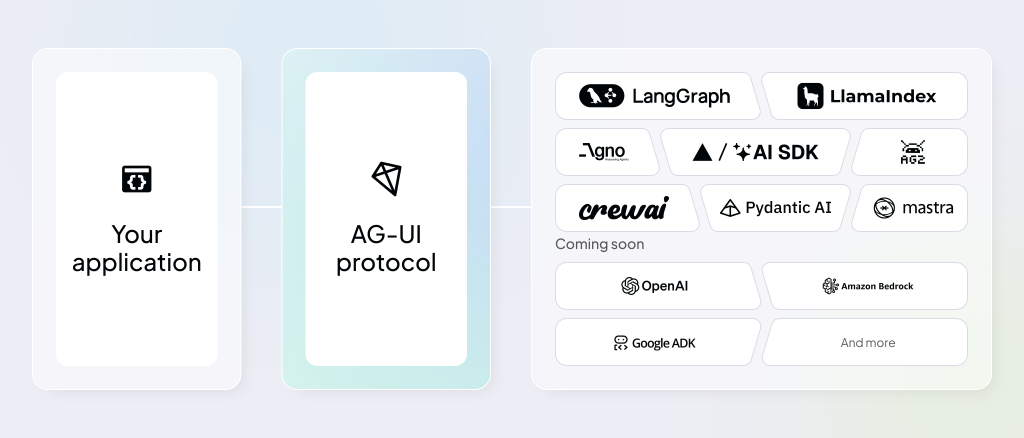
One of AG-UI’s strengths lies in its extensive integration support, which accelerates adoption by reducing manual wiring efforts. Several prominent agent frameworks have built-in AG-UI compatibility, including:
- Mastra (TypeScript): Offers native AG-UI support with strong typing, making it ideal for financial applications and data-centric copilots.
- LangGraph: Embeds AG-UI within orchestration workflows, enabling each node to emit structured event streams.
- CrewAI: Facilitates multi-agent coordination exposed to UIs through AG-UI, allowing users to monitor and direct “agent crews.”
- Agno: Provides full-stack multi-agent backends optimized for dashboards and operational tools with AG-UI readiness.
- LlamaIndex: Enhances interactive data retrieval by streaming live evidence and results to user interfaces.
- Pydantic AI: A Python SDK with integrated AG-UI support, accompanied by example applications like the AG-UI Dojo.
- CopilotKit: A frontend toolkit supplying React components that subscribe to AG-UI event streams for seamless UI updates.
Additional integrations are underway for major cloud platforms such as AWS Bedrock Agents, Google ADK, and Cloudflare Agents, broadening AG-UI’s accessibility. Language SDKs continue to expand, with Kotlin fully supported and .NET, Go, Rust, Nim, and Java versions in active development.
Practical Applications Across Industries
AG-UI is already transforming how industries like healthcare, finance, and analytics build interactive, data-driven interfaces. For example, medical professionals can monitor patient vitals updating live without refreshing pages, traders can invoke stock analysis agents and watch streaming insights inline, and data analysts can interact with LangGraph-powered dashboards that visualize reasoning processes token by token.
Beyond visualization, AG-UI streamlines automation workflows. Tasks such as data migration, research summarization, and form completion are simplified into a single SSE event stream, replacing complex custom sockets or polling mechanisms. By transmitting only STATE_DELTA patches, UIs update incrementally, reducing bandwidth consumption and eliminating disruptive reloads. This approach also enhances customer support bots, which can display typing indicators, tool execution progress, and final responses within a unified chat interface, maintaining user engagement throughout the session.
For developers, AG-UI facilitates the creation of code assistants and multi-agent systems with minimal integration overhead. Real-time suggestion features akin to GitHub Copilot are achievable by subscribing to AG-UI event streams. Frameworks like LangGraph, CrewAI, and Mastra already implement the protocol’s 16 event types, allowing backend agents to be swapped without altering frontend code. This decoupling accelerates prototyping across domains-for instance, tax software can present preliminary deduction estimates while validation runs asynchronously, and CRM platforms can autofill client information as agents deliver structured data to modern UI frameworks like Svelte combined with Tailwind CSS.
AG-UI Dojo: Hands-On Learning and Validation
CopilotKit recently launched the AG-UI Dojo, a “learning-first” collection of minimal, runnable demos designed to teach and verify AG-UI integrations comprehensively. Each demo features live previews, source code, and linked documentation, covering six essential primitives for production-grade agent UIs: streaming agentic chat with tool hooks, human-in-the-loop planning, generative UI driven by agents and tools, shared state management, and predictive state updates for real-time collaboration.
Development teams can leverage the Dojo as a practical checklist to debug event sequencing, validate payload structures, and ensure synchronization between UI and agent states before deployment, significantly reducing integration challenges and debugging time.
Future Directions and Community Engagement
The AG-UI roadmap outlines key areas of ongoing and future development, inviting community participation:
- SDK Enhancements: Continued refinement of TypeScript and Python SDKs, with plans to broaden language support.
- Developer Tooling: Improved debugging capabilities, enhanced observability, and clearer lifecycle event semantics.
- Performance Optimization: Handling of large payloads and exploration of alternative streaming transports beyond SSE and WebSockets.
- Expanded Sample Applications: Growth of the AG-UI Dojo with additional UI patterns and real-world use cases.
The open-source community actively contributes integrations, SDK improvements, documentation expansions, and demo applications. Contributions from maintainers and external developers across frameworks like Mastra, LangGraph, and Pydantic AI ensure that AG-UI evolves in alignment with practical developer needs rather than purely theoretical specifications.
Conclusion: AG-UI as the Standard for Agent-UI Communication
AG-UI is rapidly establishing itself as the go-to protocol for interactive agent frontends. By standardizing the complex interactions between AI agents and user interfaces, it enhances application responsiveness, transparency, and maintainability.
With robust first-party integrations, a vibrant community shaping its evolution, and tools like the AG-UI Dojo lowering the barrier to entry, the ecosystem is maturing swiftly. Developers can launch AG-UI-powered projects with a single command, select their preferred agent framework, and begin prototyping within minutes.
npx create-ag-ui-app@latest
# then
<choose your agent framework>

# For detailed patterns and quickstart guides, visit: go.copilotkit.ai/ag-ui-cli-blog
Frequently Asked Questions
1. What challenges does AG-UI address?
AG-UI standardizes the communication between AI agents and user interfaces by defining a clear event-driven protocol for streaming text, invoking tools, updating state, and signaling lifecycle events. This replaces fragmented, ad-hoc APIs and simplifies the development of interactive, real-time UIs.
2. Which platforms currently support AG-UI?
AG-UI is natively supported by frameworks such as Mastra, LangGraph, CrewAI, Agno, LlamaIndex, and Pydantic AI, with frontend support from CopilotKit. Integrations with AWS Bedrock Agents, Google ADK, and others are underway, alongside expanding language SDKs including .NET, Go, and Rust.
3. How does AG-UI differ from traditional REST APIs?
While REST APIs handle discrete request-response cycles, AG-UI is designed for continuous, interactive agent workflows. It supports streaming outputs, incremental state updates, tool invocations, and mid-interaction user inputs, capabilities that REST cannot natively provide.
4. What communication protocols does AG-UI utilize?
AG-UI primarily operates over HTTP Server-Sent Events (SSE) and WebSockets, with plans to explore additional transport mechanisms optimized for high throughput and binary data transmission.
5. How can developers begin working with AG-UI?
Developers can start by installing official SDKs available in TypeScript and Python or by using supported frameworks like Mastra and Pydantic AI. The AG-UI Dojo offers practical examples and UI components to experiment with event-driven agent interfaces.