How to Train Privacy-Preserving Health Models on User Devices
Imagine you are a software engineer at a leading health technology company, such as Fitbit or Apple Health. Every day, millions of users generate highly sensitive data through their wearable devices-tracking metrics like heart rate, sleep quality, step counts, and exercise routines. Your goal is to develop a predictive model that assesses health risks or offers tailored workout recommendations. However, strict privacy regulations like GDPR and HIPAA prohibit transferring any raw user data off their devices.
At first glance, this constraint might seem insurmountable. How can you build an effective model without centralizing the data? The solution lies in reversing the traditional approach: instead of collecting data to train the model, you send the model to the data.
Introducing Federated Learning: Training Models Without Data Centralization
Federated Learning (FL) is an innovative machine learning paradigm that enables model training across decentralized devices while keeping user data local. Instead of uploading sensitive information such as heart rate logs or sleep patterns to a central server, the global model is dispatched to each user’s device. The model then trains locally on the private data, and only the resulting model updates-never the raw data-are encrypted and transmitted back to a central server. These updates are aggregated securely to refine the global model, ensuring compliance with privacy laws and safeguarding user confidentiality.
Types of Federated Learning Architectures
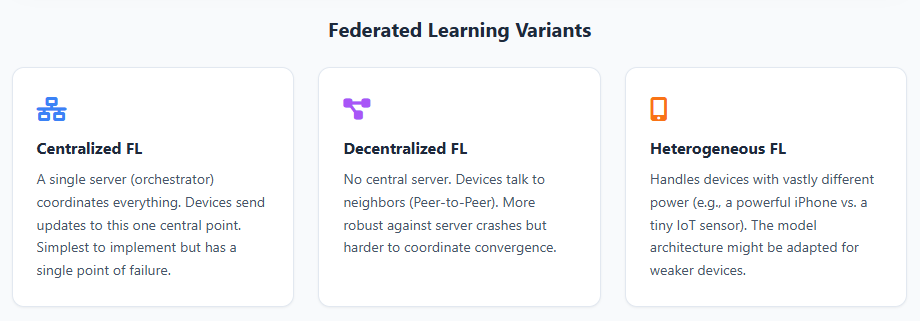
- Centralized Federated Learning: A central server orchestrates the training process and aggregates updates from all devices.
- Decentralized Federated Learning: Devices communicate directly with each other to share model updates, eliminating a single point of failure.
- Heterogeneous Federated Learning: Tailored for environments where devices vary widely in computational power, such as smartphones, smartwatches, and IoT sensors.
Step-by-Step Federated Learning Workflow
- A global model is initialized and sent to users’ devices.
- Each device trains the model locally using its own private health and fitness data.
- Only the encrypted model updates-not the underlying data-are sent back to the server.
- The server aggregates these updates to produce an improved global model.
Key Challenges in Implementing Federated Learning for Health Data
1. Limited Device Resources
Wearable devices and smartphones have constrained processing power, memory, and battery life. Training machine learning models must be optimized for efficiency, running only during idle times or when the device is charging to avoid disrupting user experience.
2. Aggregating Diverse Model Updates
Combining updates from millions of devices is complex. Algorithms like Federated Averaging (FedAvg) help merge these updates, but variability in device participation and network conditions can cause delays or incomplete data, complicating model convergence.
3. Handling Non-Independent and Identically Distributed (Non-IID) Data
User data is inherently heterogeneous, reflecting individual lifestyles and habits:
- Some users engage in daily running, while others prefer walking or no exercise.
- Resting heart rates vary widely due to age, fitness level, and health conditions.
- Sleep patterns differ based on work schedules, cultural factors, and personal routines.
- Exercise types range from yoga and strength training to cycling and high-intensity interval training (HIIT).
This diversity leads to skewed local datasets, making it challenging for the global model to generalize effectively.
4. Intermittent Device Connectivity and Availability
Devices may frequently go offline, run out of battery, or lack Wi-Fi connectivity. Training must be scheduled to occur only under optimal conditions-such as when the device is charging and connected to a stable network-limiting the number of active participants at any given time.
5. Communication Overhead
Transmitting model updates can consume significant bandwidth and battery power. Techniques like update compression, sparsification, and selective parameter sharing are essential to minimize communication costs.
6. Ensuring Robust Security and Privacy
Although raw data remains on the device, model updates can still leak sensitive information if not properly protected. Encryption, secure aggregation protocols, and differential privacy mechanisms are critical to prevent adversaries from reconstructing personal data from gradients or updates.
Conclusion: Federated Learning as a Privacy-First Solution for Health Tech
Federated Learning offers a powerful framework to harness the vast amounts of health data generated by wearable devices while respecting user privacy and regulatory requirements. By training models locally and aggregating updates securely, companies can build personalized, accurate health risk predictors and workout recommendation systems without ever accessing raw user data. As device capabilities improve and privacy-preserving techniques advance, federated learning is poised to become the standard for ethical, scalable health AI applications.