

Meta’s WorldGen: Revolutionizing Generative AI for Interactive 3D Environments
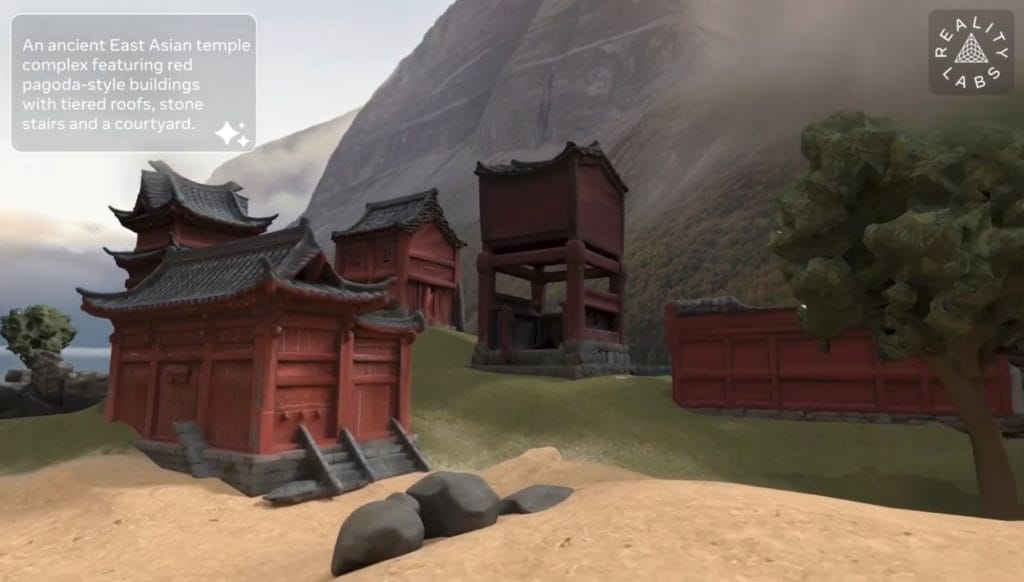
Meta is pioneering a transformative shift in generative AI applications by moving beyond static 3D imagery to crafting fully interactive, navigable virtual worlds through its innovative WorldGen system.
Overcoming the Challenges of 3D Content Creation
One of the most significant hurdles in developing immersive spatial computing experiences-ranging from consumer gaming and virtual reality to employee training simulations-has been the time-consuming and labor-intensive process of 3D modeling. Traditionally, creating a detailed, interactive environment demands weeks of work by specialized artists and developers.
WorldGen promises to drastically reduce this bottleneck by generating complete, traversable 3D worlds from a single text description in about five minutes, according to Meta’s latest technical disclosures.
From Visuals to Functionality: The Core of WorldGen’s Innovation
Many existing text-to-3D generation models focus heavily on photorealistic visuals but fall short in delivering functional interactivity. Techniques like Gaussian splatting produce stunning scenes for video presentations but lack the essential physical properties-such as collision detection and realistic navigation-that enable user interaction in gaming or simulation contexts.
WorldGen takes a different approach by emphasizing “traversability.” It simultaneously generates a navigation mesh (navmesh), a simplified polygonal map that defines walkable areas, alongside the visual elements. For example, a prompt like “futuristic cityscape” results not only in detailed buildings but also in a coherent layout where streets and pathways are accessible and free of obstacles.
This capability is crucial for enterprise applications, such as virtual factory floor layouts or hazardous environment safety training, where accurate physics and navigation data are non-negotiable.
Seamless Integration with Industry-Standard Game Engines
WorldGen outputs assets that are “game engine-ready,” compatible with widely used platforms like Unity and Unreal Engine. This compatibility enables development teams to incorporate generative AI into existing production pipelines without requiring specialized rendering hardware, which is often necessary for other methods like neural radiance fields.
The Four-Phase Workflow Behind WorldGen
Meta’s WorldGen is designed as a modular AI pipeline that mirrors conventional 3D world-building processes, broken down into four distinct stages:
- Scene Planning: A large language model (LLM) interprets the user’s text prompt to create a logical spatial layout, placing key structures and terrain features to form a “blockout” – a rough 3D blueprint ensuring physical coherence.
- Scene Reconstruction: The system generates initial geometry conditioned on the navmesh, preventing illogical placements such as objects blocking pathways or emergency exits.
- Scene Decomposition: Using AutoPartGen, WorldGen identifies and separates individual objects within the scene, distinguishing elements like trees from the ground or crates from warehouse floors. This modularity allows for post-generation editing without compromising the entire environment.
- Scene Enhancement: The final phase refines the assets by producing high-resolution textures and improving geometry details, ensuring visual fidelity even at close inspection.
Practical Considerations and Current Limitations
WorldGen produces standard textured meshes, avoiding vendor lock-in and enabling easy handoff to human developers for further refinement. For example, a logistics company could rapidly prototype a VR training environment and then customize it with in-house artists.
Generating a fully textured, navigable scene takes approximately five minutes on capable hardware, a dramatic improvement over traditional multi-day environment blocking workflows.
However, the current version has constraints. It generates scenes from a single reference viewpoint, limiting the scale of worlds to relatively compact areas (around 50×50 meters). Expanding to vast open worlds requires stitching multiple generated regions, which can introduce visual inconsistencies.
Additionally, WorldGen currently treats each object as unique without reusing models, potentially leading to inefficiencies in memory usage compared to hand-optimized assets that replicate objects like chairs multiple times. Future updates aim to support larger environments and reduce latency.
How WorldGen Stands Out Among Emerging 3D AI Technologies
Comparing WorldGen to competitors highlights its unique strengths. For instance, World Labs’ Marble system uses Gaussian splatting to create highly photorealistic scenes, but these often lose quality when viewed from different angles or distances beyond a few meters.
By focusing on mesh-based geometry, WorldGen ensures consistent geometric integrity, physics, collision detection, and navigation support-features essential for interactive applications rather than mere visual content.
Implications for Industry and Creative Professionals
The advent of tools like WorldGen opens new avenues for organizations to streamline their 3D content creation. Companies should evaluate their workflows to identify stages-such as initial “blockout” and prototyping-where generative AI can accelerate iteration without replacing final production quality.
Technical artists and level designers will need to adapt by shifting from manual vertex placement to crafting precise prompts and curating AI-generated assets. Training programs focusing on “prompt engineering for spatial design” and post-generation editing will become increasingly important.
While WorldGen’s outputs are compatible with standard engines, the generation process demands significant computational resources. Organizations must assess whether on-premises infrastructure or cloud-based rendering solutions best fit their needs.
Generative AI as a Catalyst, Not a Replacement
Ultimately, generative AI in 3D content creation serves as a powerful enabler for foundational world-building and asset population. By automating these initial stages, enterprise teams can allocate more resources toward developing complex interactions and business logic that deliver real value.






