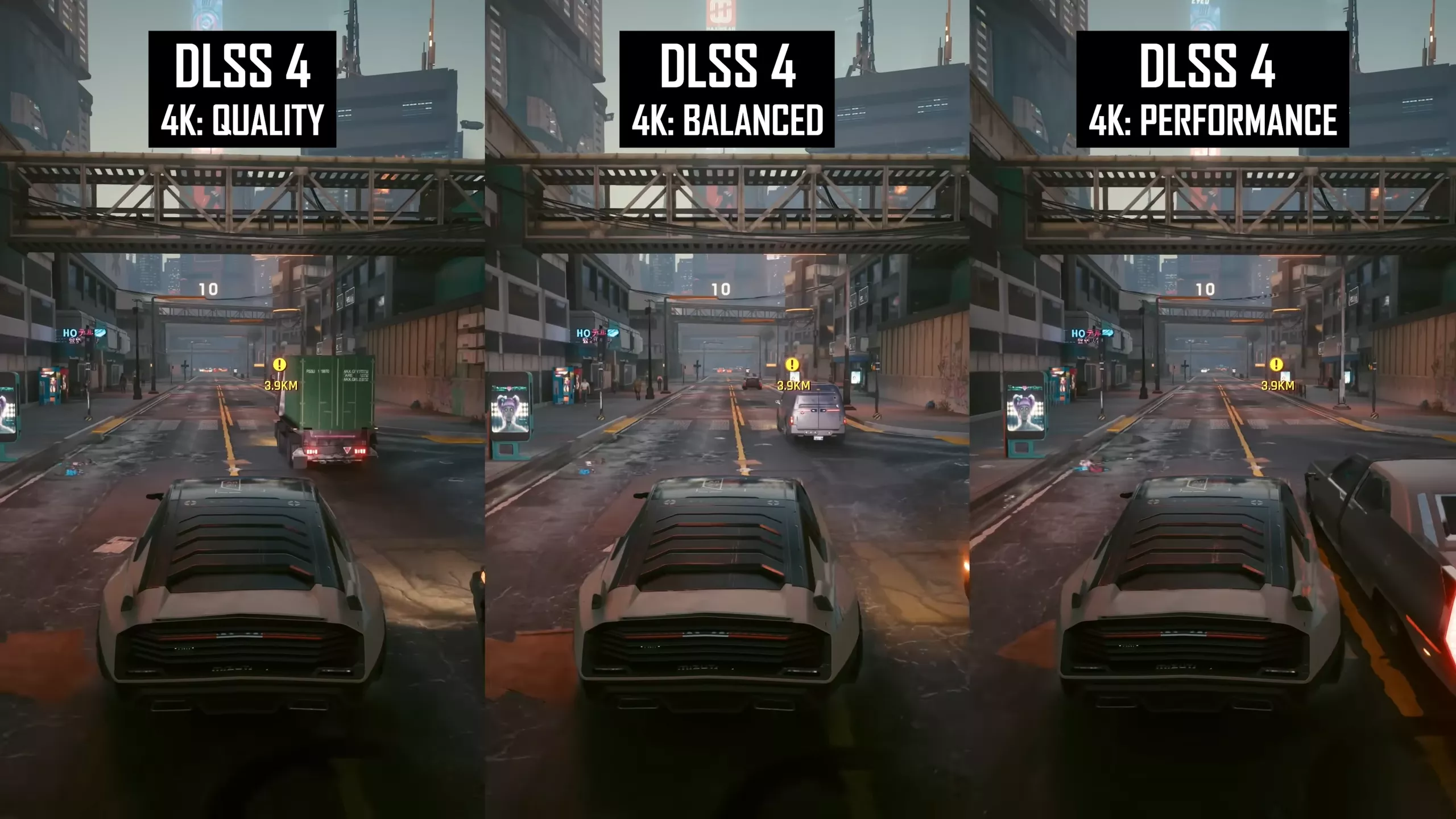
Most gamers will choose the Quality mode when enabling DLSS Upscaling. This is the setting that offers the best balance between image quality and improved frame rate. Nvidia’s DLSS 4 has brought significant improvements to all presets including the Balanced and Performance modes, which are often overlooked.
This video and breakdown analysis will show you how each of the main DLSS 4 settings performs in a variety gaming scenarios. Does lowering the Quality setting still have a significant visual cost? Lower modes have become more popular for many setups.
Each DLSS step down – from Quality to Balanced, to Performance – typically gives you a performance boost of 10 to 15%, especially at higher Resolutions (from our conclusion).
We’ve tested DLSS 4 at 4K, 1440p, and 1080p on a GeForce RTX 5090, locked to 60 frames per second. To ensure consistency, we disabled effects like motion blur and chromatic aberration, and applied the same sharpening settings across every sample. The results might surprise anyone still clinging to Quality mode by default.
Texture Quality
DLSS 4’s ability to eliminate TAA blur and preserve full texture quality while moving through the game world is one of its most impressive features. This gives DLSS 4 a more sharper presentation compared to the previous versions and native rendering. Check out the HUB below for a better representation.
For gamers, the good news is that this is a technology aspect that is universal and applies to all presets. The texture quality and blurriness are the same whether you choose 4K Quality, 4K Performance, 1080p or 1080p performance. This version of DLSS does not add blur when you lower the preset for Performance. This makes the lower settings more viable.
The main impact on texture quality in lower DLSS mode is the slight amount of graininess introduced when moving. However, the ability of DLSS reconstruct textures is impressive. There is no texture quality loss when using Performance or Balanced as compared to Quality at 4K. At 1440p and 720p, we only noticed a few differences between Performance and Quality.
In this regard, Balanced is a very viable option at lower resolutions. If overall blur has been one of your main reasons for avoiding lower DLSS settings, DLSS4 should make you reconsider that decision.
Image Stability
We were also very impressed with the stability of DLSS 4 and it applies to all presets. There is little difference between the Performance and Quality modes at 4K, making the lower modes suitable for many gaming scenarios. Check out the HUB below for a better representation on image quality comparisons:
We noticed a slight degradation of fine details at times, such as pixel-level wires and lines. However, even in fast motion, like driving a vehicle, the 4K Performance mode held up well. You won’t notice a significant difference from Quality.
The results were different at 1440p and a 1080p, where some fine details are lost in the lower modes that render the image below 1080p. The reconstruction of wires moving is not particularly impressive at these lower resolutions, but there’s a slight quality loss when switching from Quality to Performance. There is more aliasing along the edges. At 4K, these modes did a good job of preserving these elements. However, at 1440p or 1080p it’s best to stick with the higher quality modes.
Despite this, the general stability of an image is not significantly different between modes at 1080p. Even in the Performance mode you won’t notice any major shimmering or sizzling problems with DLSS 4, unless there are fine elements on the screen. The faster the motion, the more likely it is that you will see issues.
It’s not like FSR 3 where the image is unstable and gets worse when you turn down the upscaling.
Disocclusion
When the upscaling is turned down, the quality of disocclusion is affected. The disocclusion artifacts become more visible at each step down in resolution, with longer blur trail and more pixelation surrounding moving objects. Check out the HUB below for a better representation.
The reason for this is that when an object disoccludes the background it reveals will be rendered at a lower quality using the Performance mode as compared to Quality mode. This brief moment of low-resolution rendering can be noticed, especially around the character in a 3rd person game or a weapon swaying in a 1st person game. What is disocclusion
? Disocclusion is the moment in computer graphics when a previously concealed part of a scene becomes apparent as objects move. If a character walks by a wall and then turns around, the section behind them suddenly becomes visible. Upscaling algorithms such as DLSS must reconstruct the newly exposed area with limited data. This can cause visual artifacts like blurring, pixelation or ghosting, particularly in lower quality modes.
In some of the examples where disocclusion was particularly noticeable, such as The Last of Us Part I using the Performance mode in comparison to the Quality mode, creates a grainier path around Joel’s moving head. Balanced is a step up from Performance, but not quite as good as the Quality mode. The degree to which you are sensitive to these issues will determine whether or not you reduce the upscaling.
This issue is more noticeable at 4K, but it gets worse at 1440p or 1080p. The Performance mode at 1080p therefore has worse disocclusion effects than at 4K. Lower modes at lower resolutions are less suitable for this, but it depends on the game. It’s not an issue with titles like Indiana Jones because disocclusion doesn’t appear in every frame. Some third-person titles, like Dragon Age: The Veilguard, handle it better.
Hair Quality
Since hair quality is closely related to image stability, DLSS tends handle this well in all three main quality modes. Hair quality is not much different between Quality and Performance at 4K. The only difference is in the finest hair strands, which are less stable in Performance mode. This can be seen in Dragon Age: Veilguard’s Character Editor. In general gameplay, you won’t notice any difference in hair quality. Check out the HUB below for a better comparison of image quality.
It’s quite similar at 1440p and in 1080p to what we saw under the stability section. Balanced is very similar to Quality, and it retains the same level of detail and stability. Performance can look grainy when in motion, particularly when hair strands move. Performance mode can look ugly in third-person titles like Horizon Zero Dawn where your character is always exposed. But it will be more usable in titles with less hair.
Particles
The quality of particles is simple. Lowering DLSS mode, especially at high resolutions, has a minimal impact on particle quality. These elements remain stable even when lower modes are used. Check out the HUB Video below for a better representation on image quality comparisons:
It is important to use this for games that involve rain. At lower modes, however, we see the same challenges as with disocclusion. Performance, such as in Horizon Zero Dawn, produces a grainier picture behind the snow compared to Quality. This is more noticeable at low resolutions, like 1440p.
Sometimes, when using pixel or near-pixel level particles (the spores from The Last of Us, for example), using a lower mode of DLSS reduces the quality of those particles, increases pixelation and can make large clouds of spores a little blurrier. You’ll notice this only to a significant degree when using the Performance Mode.
Transparency
Lowering DLSS mode affects transparency in motion, particularly those that contain fine details. Holograms with fine lines will appear more pixelated in the Performance mode when compared to the quality mode, especially for lower resolutions such as 1080p. Check out the HUB bel ow for a better representation on image quality comparisons:
While stationary, this is not a big issue, but elements which move or rotate on their own, or due to character movement, can cause problems at lower resolutions.
The same issue occurs when transparencies have fine patterns. For example, in this Cyberpunk sample, different DLSS modes produce different pattern artifacts. This kind of pixel-level detail doesn’t play well with lowering the rendering resolution and trying an upscale.
But not all transparencies are affected in the same way. Fire, for instance, looks great at 4K, whether you use Quality or Performance mode. When the resolution is reduced to 1080p however, the occasional grain or pixelation will become noticeable.
Foliage
Alongside disocclusion and other areas, the quality of foliage is noticeably reduced when DLSS is run in a lower mode. Lower modes make grass look grainier, especially when there is a combination between character movement and wind movement. Check out the HUB below for a better representation and comparison of image quality.
You can see this even at 4K if you switch from Quality mode to Balanced or Performance. It’s more noticeable, however, at lower resolutions such as 1080p. Even the Quality mode at 1080p can produce grainy, splotchy grass. This only gets worse if you use the Performance mode. The reduction in grass quality in many games is the most noticeable. Many games today include high density grass, which can cover large areas of the screen.
DLSS 4 handles grass much better than previous versions of this technology. So, even the Performance mode is an upgrade in some cases. The Quality mode is a better choice for 4K because the grass looks cleaner. Performance mode appears more upscaled.
While trees, branches and leaves tend to perform better than grass, it can be tricky for upscalers. Even at lower resolutions there was a much smaller difference in the quality of the trees between the different modes. However, you may still see some issues with stability.
Reconstruction of fine branch details is the most likely problem to occur on trees without leaves. The super thin branches may appear more aliased in lower modes than higher modes.
Fences
Fences depend on two areas for their quality: disocclusion, and fine detail reconstruction. It’s not surprising that fence quality is worse in the Performance and Balanced modes compared with Quality. Both areas suffer quality reductions when using lower DLSS modes. This isn’t always evident at higher resolutions such as 4K but can be more apparent at 1080p when using the Performance mode. Check out the HUB below for a better representation on image quality comparisons:
In Spider-Man 2, where we have overlapping fences, the higher modes have less grain and aliasing because they can handle the rapid disocclusion which occurs when in motion. As a result, Quality has a higher resolution overall appearance. In Starfield, the higher modes resolved the fine mesh details and created less shimmering in movement, though there were visible issues across most configurations tested.
When we are dealing with a fence that is different from the one in The Last of Us, higher upscaling mode will be more resistant to artifacts. We can see this on the fence towards the end of the run, when viewing Performance mode. This is a problem with fine line detail in motion, and can be seen on things like metal stair railings and stairs.
Stationary
You won’t notice much of a difference between the two modes when stationary. It is not worth comparing upscalers this way as each mode can accumulate data over multiple frames and resolve an image of high quality. Check out the HUB below for a better representation on image quality comparisons:
Performance mode is just as good as Quality mode or DLAA for screenshots. Standing still is not the way you play most games. It’s important to move a little when deciding which upscaler settings will work best for your gaming session.
What DLSS 4 mode should you use? It’s interesting to compare three of the main DLSS quality modes, because it shows just how little difference there is. In previous versions, lowering DLSS to Performance mode usually resulted in an unstable image with lots of problems in motion.
This is why most people only enabled upscaling on the Quality mode. Image quality was poor, especially for popular resolutions such as 1440p. With DLSS 4, lower modes, like Balanced and performance, are more usable depending on the game or resolution.
With DLSS 4 depending on the resolution and game, lower modes such as Balanced and Performance can be used more than before.
Several important aspects of image quality remain largely unchanged when using a lower DLSS settings. DLSS 4 does not become blurrier when switching between Quality and Performance. The overall image stability is also similar. DLSS 4 delivers a sharp, high-resolution image without annoying shimmering and sizzling artifacts.
However, there are a few areas in which lower DLSS modes may decrease image quality. These include disocclusions, grass rendering, fine details reconstruction, and transparency.
When you switch to Performance mode, these elements will appear grainier and with a lower resolution. This is noticeable depending on the games.
For example, in Star Wars Outlaws which features wind-blown grass that is impressive, the lower modes will make the grass look more pixelated when you move. Disocclusion in The Last of Us is more apparent when using Performance. In a first-person title like Starfield with different types environments, the visual difference between Quality and Performance will be much smaller. All of this means that the best DLSS 4 modes really depend on the game. In titles with a lot of grass or strong effects of disocclusion, using a high render resolution (and thus a higher DLSS) helps reduce noise. All of this means that the best DLSS 4 modes really depends on the games. In games with a lot of grass or strong effects of disocclusion, a higher render mode (and therefore higher DLSS) can help reduce noise and grain.
Some players still prefer native render, especially when visual issues are prominent in the games they enjoy. In these cases, DLSS 4 DLAA offers excellent image quality.
You can also increase the level of scaling in other situations and still get good results. Across all the titles we tested with DLSS 4, we changed our preferred mode based on the game. Some titles look and feel better with Performance, while others are perfectly fine with Quality.
In general, DLSS 4 Performance or Balanced is the best option for 4K output. At 1440p it’s best to stick with Quality or Balanced. At 1080p we tend to lean towards Quality, although in some games Balanced can still work well. Performance mode is less useful below 4K. We don’t recommend this setting.
In all scenarios, it is evident that less upscaling results in better image quality. We did not see any instances where DLSS Quality 4 looked better than DLSS Balanced. It’s important to find the right balance of FPS and visuals, since more upscaling will boost performance.
Each DLSS step down – from Quality to Balanced, to Performance – gives you a performance boost of 10 to 15%, especially when you’re using higher resolutions.
If you are CPU limited, make sure you don’t do unnecessary upscaling. If switching from Balanced to Quality does not give you any performance gain, then you are probably CPU-bound, or at least not limited by render quality. If you’re not limited by render resolution, there is no reason to drop to a lower DLSS setting to get more frames.
Shopping Shortcuts:
- Nvidia Geforce RTX 5060 16GB on””false”” href=””https://www.amazon.com/s?k=Nvidia+GeForce+RTX+5060+Ti+16GB&crid=QGSU2DMCWCQ6&sprefix=nvidia+geforce+rtx+5060+ti+16gb%2Caps%2C178&ref=nb_sb_noss_1&tag=httpwwwtechsp-20″ ” rel=””sponsored” ” target=””_blank” “> Amazon
- Nvidia RTX RTX5070 Ti on Amazon
- Nvidia RTX5080 on Amazon
- Nvidia RTX5090 on Amazon