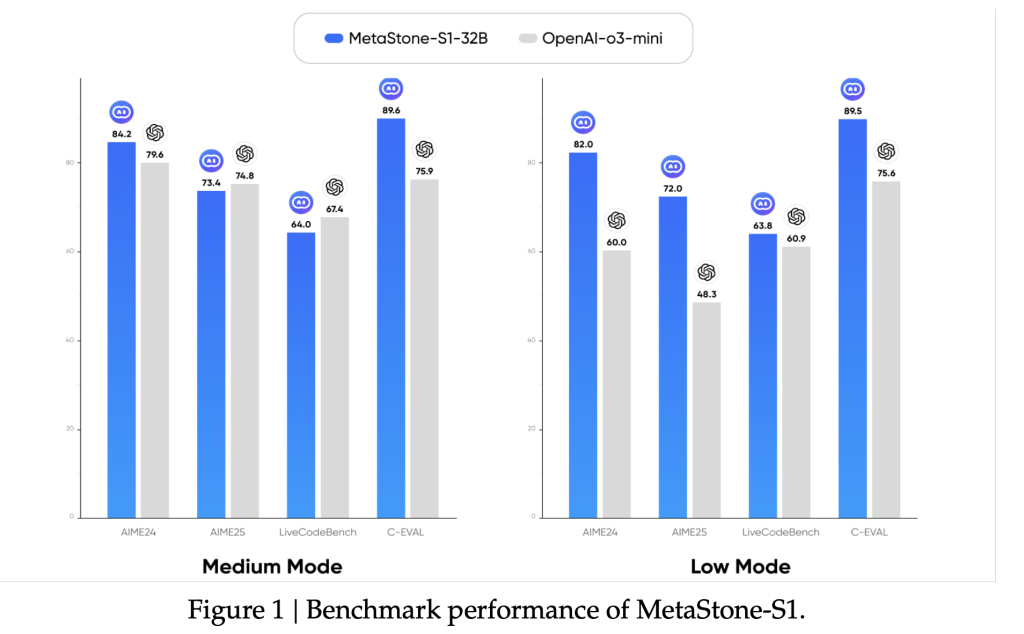
Researchers from MetaStone-AI & USTC introduce a reflective generative model, MetaStone-S1, which attains OpenAI o3-mini’s performance through a new Reflective Generative Form.
Key Innovations
Reflective Generative Form
- Unified Policy and Reward Modeling: MetaStone-S1 integrates the policy model (for generating reasoning trajectories) and the step-level Process Reward Model (PRM) into a single architecture, using shared parameters. This implementation requires only a lightweight addition (as little as 53M parameters for the verifier within the 32B main model), dramatically reducing computational costs compared to conventional standalone PRMs.
- Self-Supervised Process Reward Model (SPRM): The SPRM eliminates the need for expensive, process-level labeled data. It leverages a self-supervised loss function that uses only the final answer’s correctness to judge the quality of intermediate reasoning steps, supported by a dynamic weighting mechanism to filter out noisy labels.
Test-Time Scaling (TTS) Redefined
Traditional LLMs often improve via parameter scaling during training. MetaStone-S1 takes a distinct approach—TTS—by boosting inference performance through increased computational depth rather than simply increasing model size:
- Internal TTS: Extends chain-of-thought for deeper, sequential problem solving, but can incur substantial compute costs.
- External TTS: Generates multiple reasoning paths in parallel and selects the best using PRMs. This usually requires extra models and separate labeling.
- MetaStone-S1’s Approach: Combines both paradigms into a single architecture, offering efficient and accurate trajectory selection with minimal additional resource requirements.
Performance and Benchmarking
MetaStone-S1 is available in three sizes (1.5B, 7B, and 32B parameters). The largest, MetaStone-S1-32B, matches or outperforms leading proprietary and open-source models, including OpenAI o3-mini, on key reasoning and mathematics benchmarks.


Each size demonstrates strong scaling properties and efficient parameter usage. For example, MetaStone-S1-1.5B outperforms models of comparable size on math tasks, while the 7B and 32B sizes scale effectively with both capacity and TTS strategy.
Efficiency and the “Aha Moment”
- Minimal Overhead: The SPRM’s integration adds just a fraction of parameters compared to traditional PRMs (for example, 26M vs. 72B), yielding state-of-the-art results across tasks.
- Aha Moment: Training analysis reveals a distinct point where the model begins accurately scoring correct versus incorrect reasoning paths, leading to improved discrimination and final performance.
- Scaling Law: MetaStone-S1’s performance grows logarithmically with the computation budget (model size × reasoning tokens), plateauing around Best-of-32 sampling—an efficient trade-off for deployment.
Flexible Reasoning Modes
To balance between performance and resource use, MetaStone-S1 offers three TTS inference modes:
- Low (k=2): Fastest inference for quick responses.
- Medium (k=8): Better accuracy with moderate compute.
- High (k=32): Maximum depth for challenging tasks.
Conclusion
With its novel reflective generative structure, MetaStone-S1 unifies problem solving and solution verification within a single, efficient framework. By reaching OpenAI o3-mini’s performance with dramatically fewer resources, it demonstrates that innovation in LLM architecture can rival brute-force scaling—opening new avenues for AI reasoning advancement and accessibility
| Check out the , and . All credit for this research goes to the researchers of this project. Ready to connect with 1 Million+ AI Devs/Engineers/Researchers? See how NVIDIA, LG AI Research, and top AI companies leverage MarkTechPost to reach their target audience |