Revolutionizing Video Soundtracks: Tencent’s Breakthrough in AI-Generated Audio
Tencent’s Hunyuan laboratory has unveiled an innovative artificial intelligence system that transforms silent or poorly soundtracked videos into immersive audiovisual experiences. This cutting-edge AI listens attentively to video content and produces high-fidelity audio perfectly synchronized with the on-screen action, elevating the realism of generated videos.
Bridging the Audio-Visual Gap in AI Video Generation
Many AI-generated videos captivate with their visuals but fall short in delivering authentic soundscapes, often leaving viewers with a sense of emptiness. In traditional filmmaking, Foley artists meticulously craft ambient sounds-like footsteps, rustling leaves, or distant thunder-to enrich scenes and enhance immersion. Replicating this nuanced sound design through AI has long been a formidable challenge.
Previous automated attempts frequently produced generic or mismatched audio, failing to capture the intricate details that bring scenes to life. This shortfall largely stemmed from an imbalance in how AI models processed input data, favoring textual prompts over the actual video content.
Addressing Modality Imbalance: Tencent’s Strategic Approach
One critical issue Tencent identified is “modality imbalance,” where AI systems disproportionately rely on text descriptions rather than the visual cues within videos. For example, if a video depicts a bustling city street with honking cars and pedestrian chatter, but the accompanying text only mentions “city ambiance,” the AI might generate generic background noise, neglecting specific sounds like footsteps or car engines. This results in an audio track that feels disconnected from the visuals.
Moreover, the scarcity of high-quality paired video and audio datasets has hindered the training of robust models capable of producing rich, synchronized soundtracks.
Three Pillars of Tencent’s AI Audio Innovation
- Extensive High-Quality Dataset Creation: Tencent compiled an enormous dataset comprising over 100,000 hours of video, audio, and descriptive text. They implemented an automated filtering system to exclude low-quality clips-such as those with prolonged silence or degraded audio-ensuring the AI learns from premium content.
- Advanced Multimodal Architecture: The AI model was engineered to prioritize visual-audio synchronization before integrating textual context. This two-step process enables the system to precisely align sounds with visual events-like the exact moment a door closes-while also capturing the scene’s overall atmosphere and mood.
- Representation Alignment Training (REPA): To enhance audio fidelity, Tencent employed a training technique that continuously compares the AI’s output with features extracted from a professional-grade, pre-trained audio model. This method guides the AI toward generating clearer, richer, and more stable soundtracks, akin to having an expert sound engineer supervise the learning process.
Demonstrated Excellence: Tencent’s AI Outperforms Competitors
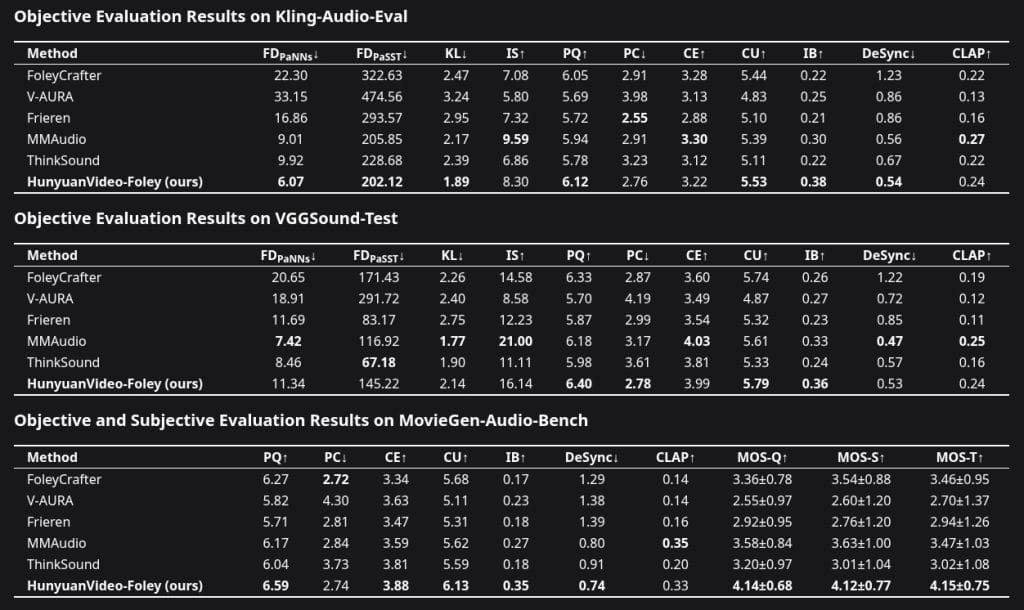
In rigorous evaluations, Tencent’s Hunyuan Video-Foley system consistently outshone other state-of-the-art AI audio generation models. Not only did objective metrics confirm superior performance, but human evaluators also rated its audio as more natural, better synchronized, and contextually appropriate.
These improvements were evident across diverse test datasets, showcasing the AI’s ability to faithfully reproduce complex soundscapes that align perfectly with visual cues.


Implications for Content Creators and the Future of Automated Sound Design
Tencent’s breakthrough narrows the gap between silent AI-generated visuals and fully immersive audiovisual content. By automating the intricate art of Foley sound creation, this technology promises to empower filmmakers, animators, game developers, and digital creators with tools to produce professional-grade soundtracks effortlessly.
As AI continues to evolve, such advancements could revolutionize how multimedia content is produced, making high-quality audio-visual synchronization accessible at scale and reducing reliance on manual sound design.