(
).
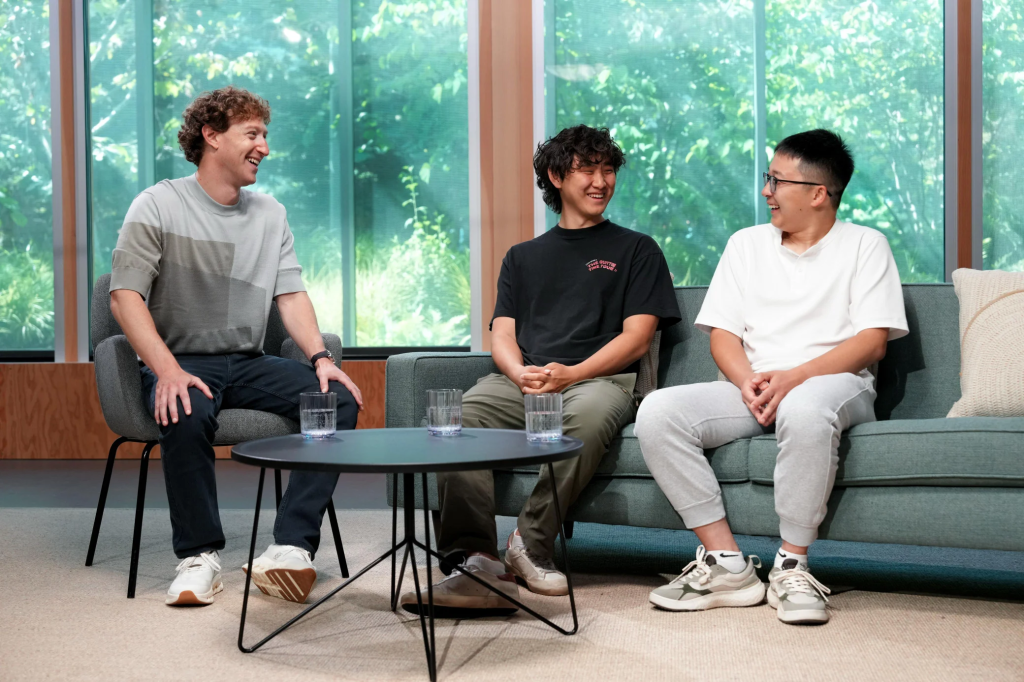
Mark Zuckerberg sits beside former Scale AI CEO Alexandr Wang and new Superintelligence Labs Chief Scientist Shengjia Zhao. Credit: Mark Zuckerberg/Meta
Subscribe to our weekly newsletters and get only the information that matters to enterprise AI, security, and data leaders. Subscribe Now Meta has appointed Shengjia Zhouas a former OpenAI researcher. Meta Superintelligence Labs (MSL), a newly-created Meta Superintelligence Labs, has appointed co-creator GPT-4as its Chief scientist. The announcement was made on Friday
I am very excited to be the chief scientist of meta super-intelligence laboratories. I am looking forward to working with the amazing team to build asi [artificial superintelligence] to empower people. Let’s build!” Zhao writes in His own Threads post.
The term “artificial superintelligence” in the AI industry is used to describe systems that are more powerful and capable today than any other, even beyond the smartest human, making them difficult for humans to control.
AI Impact Series Returns To San Francisco – 5 August
Are you ready for the next phase of AI? Join leaders from Block GSK and SAP to get an exclusive look at the ways autonomous agents are reshaping workflows in enterprise – from end-to-end automated to real-time decision making.
Reserve your seat now as space is limited. https://bit.ly/3GuuPLF
Zhao’s strong background in commercial AI
Zhao was a key contributor to the development of GPT-4 and GPT-4o according to arXiv papers and system cards listing him as co-author. He is also known for his work in academia on generative models and faire representations. His papers have been widely cited at venues such as NeurIPS and ICML.
Zhao is joining Meta during a high-stakes hire blitz in the AI industry. Meta has been stealing researchers from OpenAI and Apple, Google and Anthropic in the last few months as part of its multi-billion dollar bet on superintelligence. CNN reported.
Meta invested $14.3 billion into Scale AI recently, acquiring a 49 percent stake and bringing in Wang to lead superintelligence efforts. Nat Friedman, the former CEO of GitHub, has also joined the team. Multiple reports claim that the company offered compensation packages of up to $300 million to $100 million over four years to attract top AI talent. According to a claim made by the founder of a rival AI company, Meta offered $1.25 billion in compensation over four years (19459042) –roughly $302 million per year (19459042]–to a single candidate. The candidate declined. Other insiders claim that Meta’s senior AI scientists are receiving 10 million dollars or more per year while the first-year compensation for some new hires is reported to be 100 million dollars.
Aspirations to lead the AI frontier
According to Zuckerberg, the company will “invest hundreds and billions of dollars in compute to build superintelligence”using its own capital. He said that the Llama 4 launch underscored the importance for elite talent. “You can have thousands of GPUs but if you do not have the right team developing a model, it does not matter.”
The Meta’s fundamental AI group (FAIR), led by acclaimed scientist Yann leCun, will continue to be separate from the lab.
Meta Superintelligence Labs is a new AI effort that focuses on product and mission, and aligns ASI with human needs.
Meta’s superintelligence push comes after a rocky rollout of the latest open-source models.
In April 2025, the company released its Llama 4 family of models. It positioned it as a step forward in multimodal reasoning. The release has been unable to gain traction due to the rise of powerful Chinese rivals such as DeepSeek and Qwen.
Meta was criticized by researchers and developers for its poor performance in the real world, confusion over benchmark results, and inconsistent deployment quality.
Some have accused Meta of “benchmark gaming” and of using unreleased, optimized versions of Llama 4 in order to boost public perception. Meta has denied this claim. Internal sources blamed bugs and fast rollout timelines for the issues. But the episode has cast doubt on Meta’s generative artificial intelligence credibility as it embarks upon its most ambitious project yet.
Jim Fan is a former Stanford collaborator of Zhao, and now Nvidia’s Director of Robotics, and Distinguished Scientist. He said of Shengjia: “Shengjia’s one of the brightest and most humble scientists I know.” Very bullish on MSL!” (19659031]This move highlights Meta’s aggressive spending strategy to secure a dominating position in what they see as the next foundational platform for technology — one that may eclipse the mobile Internet. ASI, according to Zuckerberg, is not a moonshot. It’s the next frontier and Meta intends on leading.
Want to impress your boss? VB Daily can help. We provide you with the inside scoop on what companies do with generative AI. From regulatory shifts to practical implementations, we give you the insights you need to maximize ROI.
Read our privacy policy
Thank you for subscribing. Click here to view more VB Newsletters.
An error occured.