Sentient AI has introduced ROMA, an innovative open-source meta-agent framework designed to facilitate the creation of efficient multi-agent systems. ROMA organizes agent workflows into a hierarchical and recursive task tree structure, where parent nodes decompose complex objectives into manageable subtasks. These subtasks are passed down as contextual information to child nodes, and their solutions are subsequently aggregated as results ascend back up the hierarchy. This design ensures that the contextual flow remains transparent and fully traceable throughout the transitions between nodes.
Core Framework: Decompose → Strategize → Implement → Synthesize
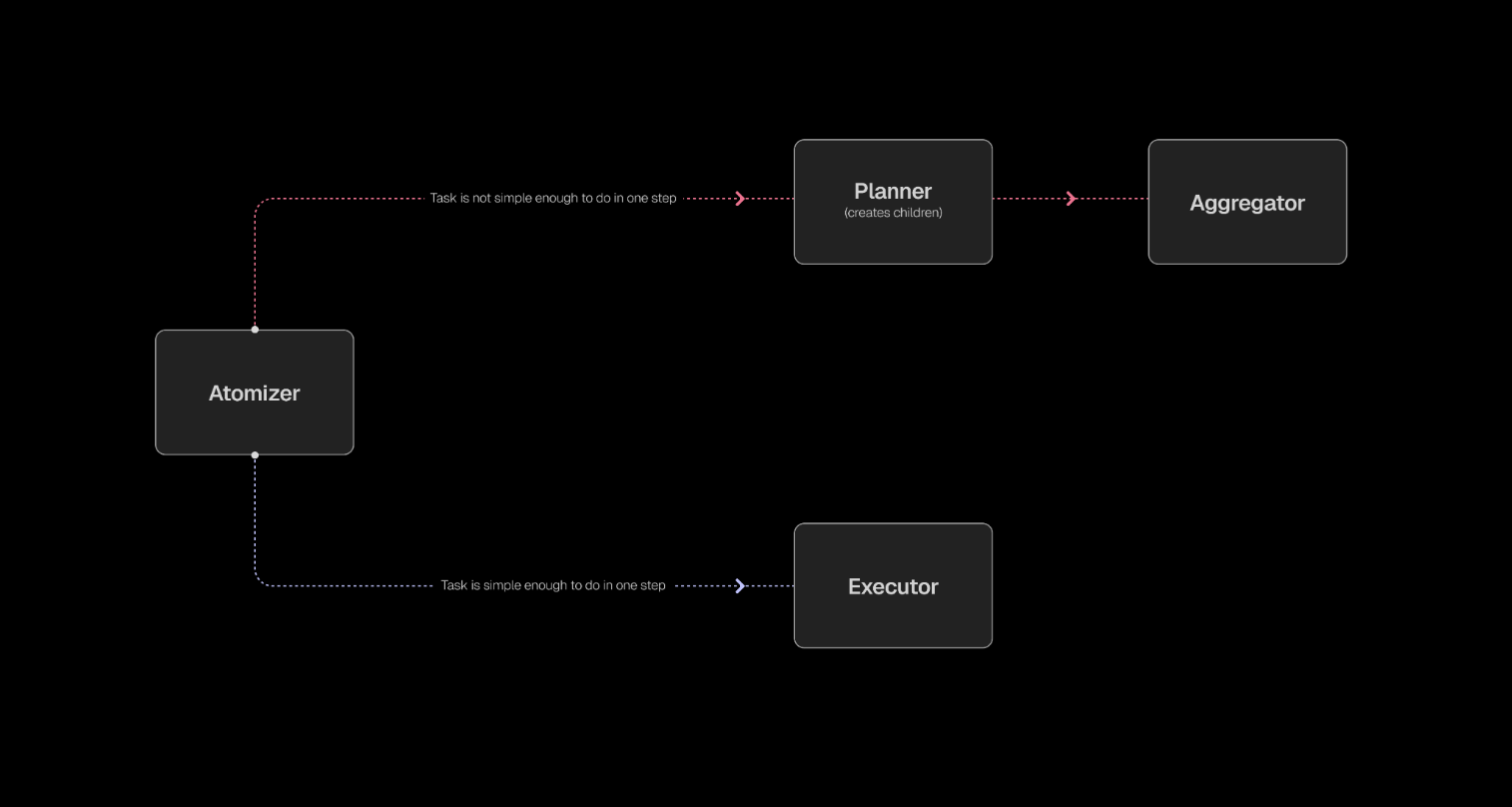
At the heart of ROMA lies a streamlined, recursive control cycle. Initially, a node atomizes the incoming request, determining whether it is atomic or composite. For composite tasks, a planner breaks the goal into smaller subtasks. If the task is atomic, an executor carries it out using a large language model (LLM), an external tool or API, or even a nested agent. Finally, an aggregator consolidates the outputs from child nodes to form the parent node’s response. This recursive loop continues for each subtask, creating a dependency-aware execution tree that runs independent branches concurrently while maintaining sequential order for dependent subtasks.
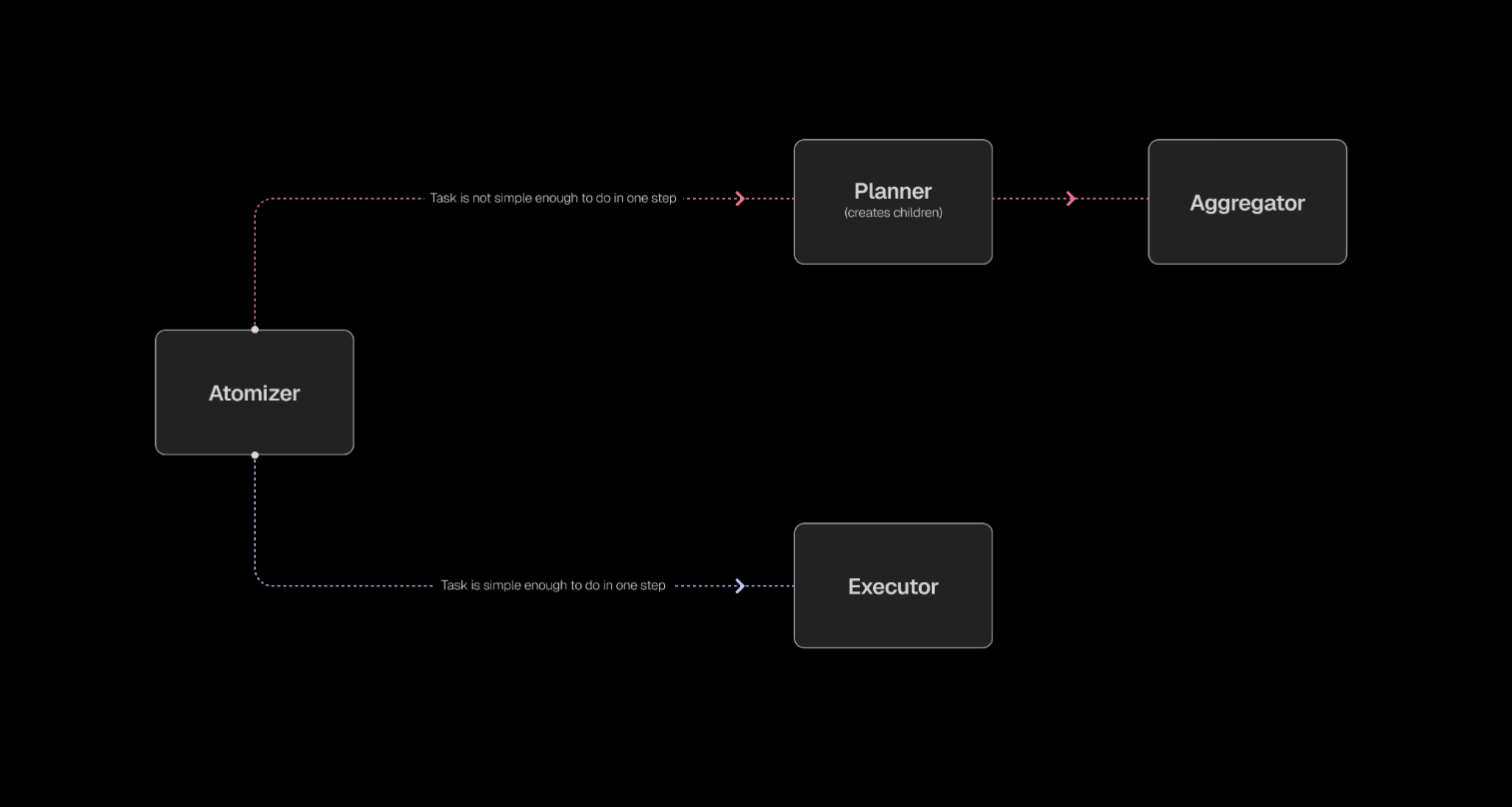

Information flows downward as tasks are subdivided and upward as results are synthesized. ROMA also supports human-in-the-loop checkpoints at any stage, allowing for plan validation or fact verification. Additionally, it offers comprehensive stage-level tracing-capturing inputs and outputs at each node-enabling developers to debug, optimize prompts, tools, and routing strategies with full visibility into every transition. This feature effectively bridges the observability gap commonly found in agent frameworks.
Developer Ecosystem and Technology Stack
ROMA offers a straightforward setup.sh script for quick deployment, supporting both Docker-based installation (recommended) and native environment setup. It includes flags for seamless integration with the E2B sandbox environment (--e2b, --test-e2b). The technology stack comprises a Python 3.12+ backend utilizing FastAPI or Flask, a React and TypeScript frontend with real-time WebSocket communication, and LLM compatibility through LiteLLM, which supports any provider. Code execution is sandboxed via E2B, ensuring secure and isolated runtime environments.
Data management supports enterprise-grade S3 mounting using goofys FUSE, with built-in path injection safeguards and secure AWS credential handling. This architecture allows for flexible swapping of leaf-level skills while the meta-framework orchestrates the task graph and dependencies.
During development, ROMA can be connected to closed or open LLMs, local models, deterministic tools, or other agents without modifying the meta-layer. Inputs and outputs are rigorously defined using Pydantic, ensuring structured, auditable data flows throughout execution and tracing.
The Significance of Recursive Task Structuring
ROMA’s design revolves around a hierarchical, recursive task tree where parent nodes systematically break down complex goals into subtasks, passing relevant context downward and aggregating child node results as they return upward. This recursive decomposition confines context to the essential information each node requires, effectively preventing prompt bloat. The stage-level tracing enabled by structured Pydantic I/O ensures the entire process is transparent and fully auditable, transforming potential black-box failures into diagnosable events.
Moreover, independent sibling tasks can be executed in parallel, while dependency edges enforce necessary sequential execution. This approach transforms the selection and orchestration of models, prompts, and tools into controlled, observable components within the plan-execute-aggregate cycle.
Performance Evaluation: ROMA Search Agent
To demonstrate ROMA’s capabilities, Sentient developed ROMA Search, an internet search agent built atop the ROMA framework without relying on domain-specific heuristics. On the SEALQA (Seal-0) benchmark-a dataset designed to challenge multi-source reasoning-ROMA Search achieved an accuracy of 45.6%, outperforming competitors such as Kimi Researcher (36%) and Gemini 2.5 Pro (19.8%).
Additionally, ROMA Search attained state-of-the-art results on the FRAMES benchmark, which tests multi-step reasoning, and delivered near top-tier performance on SimpleQA, a factual retrieval task. While these vendor-reported results should be interpreted cautiously until independently verified, they underscore ROMA’s competitive edge in both reasoning-intensive and fact-based applications.
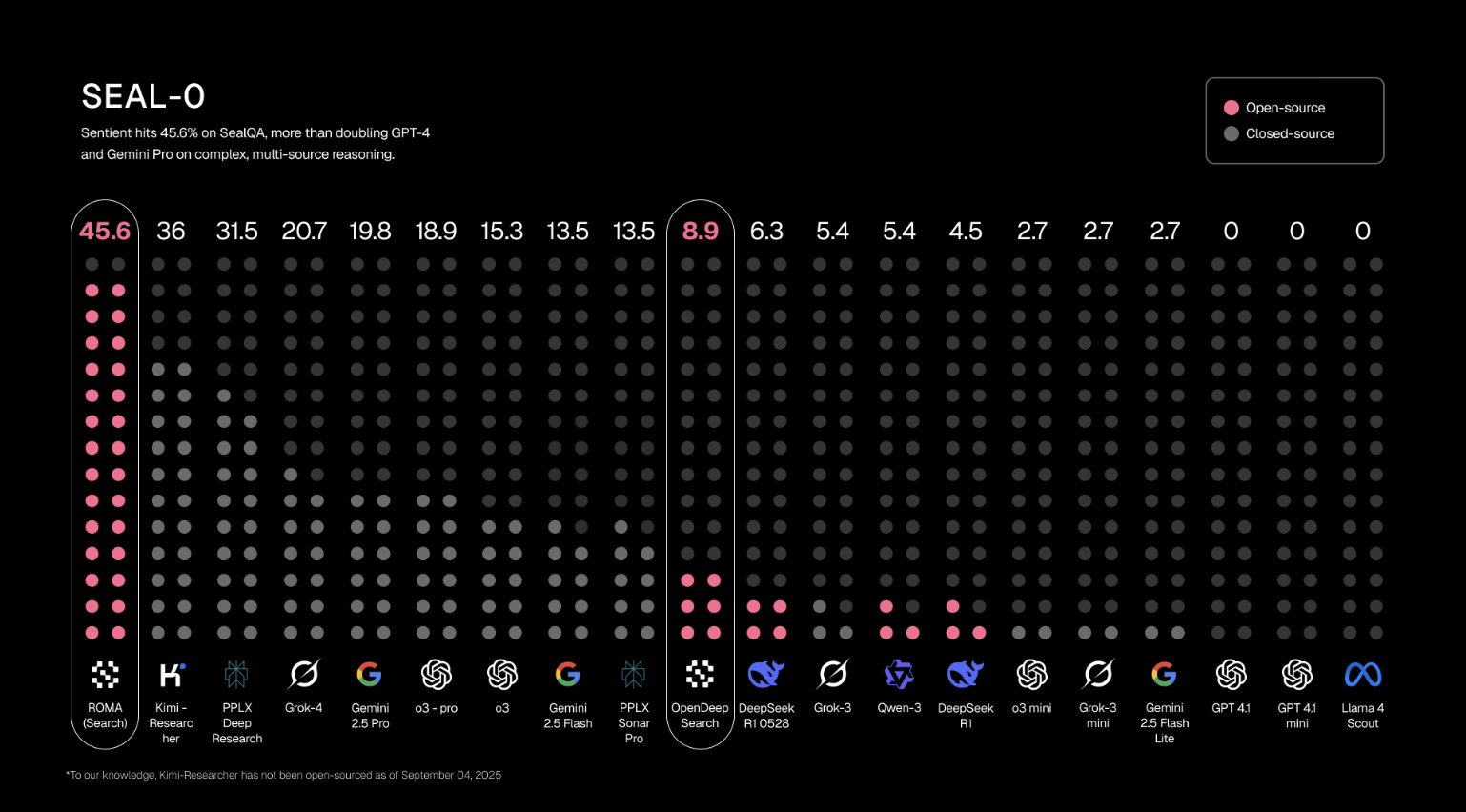

For context, SEALQA focuses on search-augmented reasoning where web results may be inconsistent or noisy. Seal-0 specifically targets questions that challenge existing systems, aligning well with ROMA’s emphasis on robust task decomposition and verification.
Positioning ROMA in the AI Agent Landscape
ROMA serves as a foundational framework for open-source meta-agents by providing a hierarchical, recursive task tree that decomposes goals into subtasks, passes contextual information to child agents or tools, and aggregates results transparently. Its design prioritizes observability through detailed stage tracing and supports human-in-the-loop interventions for critical checkpoints.
The modular node architecture allows developers to integrate any model, tool, or agent, leveraging parallel execution for independent subtasks. This makes ROMA particularly well-suited for complex, multi-step workflows such as financial data analysis, automated research, and creative content generation, where explicit context management and traceable execution are essential.
Insights and Future Outlook
Unlike typical “agent wrappers,” ROMA offers a disciplined recursive scaffold characterized by the sequence: Atomize → Plan → Execute → Aggregate. Each step is meticulously traced, enabling parallelism where feasible and enforcing sequential order when necessary. Early results from ROMA Search are encouraging and align with the framework’s objectives of developer control, clear task graphs, typed interfaces, and transparent context flow.
With an Apache-2.0 license and a robust implementation that includes FastAPI/React tooling, LiteLLM integration, and sandboxed execution environments, ROMA provides a practical and scalable foundation for building long-horizon agent systems with measurable and inspectable behaviors.