MIT Graduate Student Alex Kachkine spent nine months restoring a damaged baroque Italian picture. He had plenty of time to wonder if he could speed up the process. Last week, MIT News He announced his solution: A technique that uses AI generated polymer films to restore damaged paintings physically in hours, rather than months. The research was published by Nature.
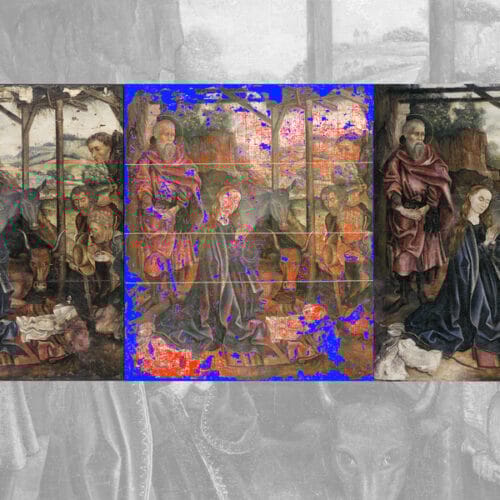
Kachkine’s method works by printing “mask” transparent”mask”that contains thousands of precisely matched color regions that conservators apply directly to a original artwork. These masks, unlike traditional restorations, can be removed at any time. It’s a reversible procedure that doesn’t permanently alter a painting.
“Because there’s a digital record of what mask was used, in 100 years, the next time someone is working with this, they’ll have an extremely clear understanding of what was done to the painting,” Kachkine said to MIT News. Figure 1 in the paper. WITH
Nature reported up to 70% of institutional art collections are hidden from the public view because of damage. This is a large amount cultural heritage that is sitting in storage. Conservators use traditional restoration methods to restore paintings. They carefully fill in damaged areas, one by one, while mixing exact colors for each area. This can take from weeks to decades. The work is highly skilled and requires both artistic talent as well as deep technical knowledge. However, there are not enough conservators to deal with the backlog.
A mechanical engineering student conceived of the idea on a cross-country trip to MIT in 2021, after gallery visits revealed that much art was hidden due to damage or restoration backlogs. He was able to see both the problem as well as the potential of a technological solution, since he restores paintings for a hobby.
Kachkine chose an arduous test case to demonstrate his method: a 15th century oil painting that needed repairs in 5,612 different regions. An AI model identified the damage patterns and generated 57 314 different colors that matched the original work. The restoration process took 3.5 hours, which is 66 times faster than the traditional hand-painting method.
Alex Kachkine developed the AI-printed technique. Credit: MIT.
Noteably, Kachkine did not use generative AI models such as Stable Diffusion and the “full-area application” generative adversarial network (GANs) to perform the digital restoration. According to the Nature article, these models would cause “spatial distortion” which would prevent proper alignment of the restored image with the damaged original.