AMD Surges Ahead in the Premium CPU Market as Intel Faces Steep Challenges
Market Dynamics: AMD’s Rising Dominance Versus Intel’s Waning Grip
While Intel continues to command approximately 75% of consumer CPU unit sales as of Q2 2025, AMD is rapidly closing the gap by capturing a larger share of revenue and outperforming Intel in key performance metrics. AMD’s Ryzen 9000 series and innovative X3D processors have propelled the company to achieve a 27.8% revenue share in the consumer segment, marking a 9.8% year-over-year increase. This indicates that AMD’s products command higher margins and greater value despite selling fewer units.
In the desktop CPU arena, AMD’s revenue share has surged to 39.3%, with unit sales growing by 9.2% year-over-year, reflecting the strong market reception of its latest offerings. Notably, Intel still outsells AMD by a ratio of 2:1, a significant shift from 2023’s 4:1 and 2016’s 9:1 ratios, underscoring AMD’s impressive market penetration over the past decade. If this trajectory continues, AMD could surpass Intel in unit sales within the next five years.
Intel’s Struggles: Innovation Stagnation and Strategic Missteps
Intel’s recent setbacks stem from a combination of missed technological waves and internal challenges. The company failed to capitalize on the mobile computing revolution and has lagged in the burgeoning AI chip market. In July 2025, Intel’s CEO publicly admitted that the company no longer ranks among the top 10 semiconductor firms globally, highlighting a significant decline in competitive standing.
This scenario echoes the downfall of Nokia, which lost its market leadership by failing to adapt swiftly to the smartphone era. Similarly, Intel’s slow response to evolving market demands has allowed competitors like AMD and Nvidia to seize critical opportunities. Nvidia, in particular, has leveraged the AI boom to become a dominant player with a market capitalization nearing $4 trillion, and rumors suggest it may soon enter the CPU market, further intensifying competition.
Performance and Reliability: A Comparative Look at Intel and AMD CPUs
Examining flagship processors reveals Intel’s Core i9-285K trailing behind AMD’s Ryzen 9 9950X3D in several benchmarks. According to recent tests by Tom’s Hardware and other reviewers:
- The Ryzen 9 delivers approximately 34% higher frame rates (195.8 FPS vs. 144.9 FPS) in gaming scenarios, even outperforming Intel’s mid-range models.
- Power consumption during intensive workloads is lower on the Ryzen 9 (178W-228W) compared to Intel’s 285K (219W-325W), indicating better energy efficiency.
- AMD’s AM5 platform offers extended support through 2027, surpassing Intel’s LGA1851 socket lifespan.
- The Ryzen 9 boasts a 16% higher base clock speed, with both CPUs sharing similar boost clocks.
- AMD’s processor features a significantly larger L3 cache (144MB total) compared to Intel’s offering, enhancing performance in cache-sensitive applications.
Beyond specifications, numerous users have reported stability issues with Intel’s latest high-end CPUs, including system freezes and failures to resume from sleep mode, even under optimal cooling conditions. In contrast, AMD’s Ryzen 9 9950X3D has demonstrated superior reliability and faster compile times in demanding Linux workloads, further solidifying its appeal among professionals.
Intel’s Financial and Operational Challenges
Intel’s difficulties are reflected in its financial results and workforce reductions. The company reported a $2.9 billion net loss in Q2 2025 and announced plans to cut 24,000 jobs, reducing its core staff from 99,500 to 75,000 by the end of 2024. Additionally, Intel is shuttering its automotive division due to weak demand and has canceled ambitious “mega fab” projects in Germany and Poland, which would have employed over 5,000 workers.
U.S. Government’s Strategic Investment in Intel
In a bold geopolitical move, the U.S. government acquired a 10% stake in Intel for $8.9 billion in April 2025. This investment is part of a broader strategy to reduce American dependence on Taiwan Semiconductor Manufacturing Company (TSMC), which currently controls about 64% of the global contract chip manufacturing market, valued at $165 billion as of 2024.
Given Taiwan’s geopolitical volatility and China’s territorial claims, the U.S. aims to bolster domestic semiconductor production to safeguard its technology supply chain. The CHIPS Act, enacted during the Biden administration, allocates $52 billion in incentives to encourage local chip manufacturing, with Intel’s U.S.-based foundry playing a central role in this initiative.
However, establishing competitive semiconductor fabrication facilities is a complex, capital-intensive endeavor requiring advanced machinery and a highly skilled workforce. Even with substantial funding, experts estimate that the U.S. will need at least a decade to achieve self-sufficiency in chip production.
Implications of Government Ownership and Future Outlook
The government’s stake in Intel grants the company preferential access to funding and political support, potentially influencing industry dynamics. While this backing may help Intel navigate its current challenges, questions remain about its ability to innovate rapidly, regain consumer confidence, and effectively compete with AMD and Nvidia over the next ten years.
Intel’s historical financial strength and investor confidence have waned, but with strategic government involvement, the company could revitalize its manufacturing capabilities and product portfolio. This intervention underscores Intel’s importance as a strategic asset to the U.S. technology ecosystem.
Conclusion: A Pivotal Moment for Intel and the Semiconductor Industry
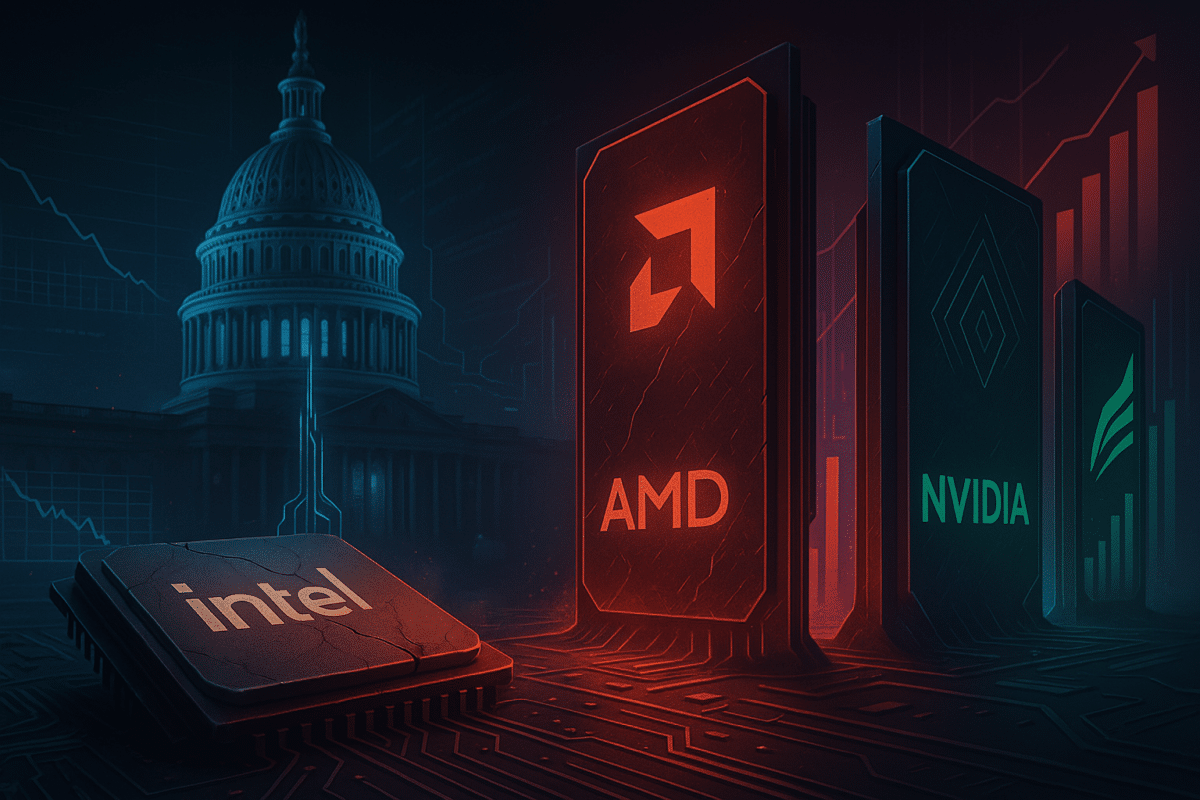
Intel stands at a crossroads, grappling with internal setbacks and fierce competition from AMD and Nvidia. Meanwhile, AMD’s innovative processors and growing market share signal a shift in the high-end CPU landscape. The U.S. government’s investment in Intel reflects broader geopolitical concerns and a commitment to securing domestic semiconductor production.
Although Intel’s path to recovery is uncertain and will require significant time and resources, the company’s legacy and strategic importance ensure it remains a key player in the evolving semiconductor arena. The coming years will be critical in determining whether Intel can reclaim its former dominance or continue to cede ground to its rivals.
About the Author
Cedric Solidon is a seasoned technology journalist with over 20 years of experience covering advancements in computing, cybersecurity, and digital innovation. A graduate of the University of the Philippines with a degree in Journalism, Cedric has contributed to leading tech publications and collaborated with global technology firms. His writing focuses on making complex technological concepts accessible and relevant to a broad audience, bridging the gap between technical expertise and everyday usability.