Every Thursday, Delve Into AI provides nuanced insight on the AI trajectory of the continent. This column examines how AI impacts culture, policy, business, and vice versa. Learn more about the people, questions, and projects that are shaping Africa’s AI Future. Please let us know what you think about the column Please fill out this form
Chika Yinka Banjo did not always dream of establishing an artificial intelligence and robots research laboratory. She has been overseeing a research lab at the University of Lagos since 2018. The lab fosters research and development in AI and Robotics. She received an undergraduate degree in mathematics, computer science, and robotics from the Federal University of Technology in Imo State, in 1999. She then pursued a Master’s degree in computer science at University of Port Harcourt, after finding her first degree too theoretical.
She said, “You can study computers without ever touching a computer. But I still loved it because that’s my passion,” she recalled.
Her second master’s degree in mathematical sciences did not excite her any more than her first one, so she was awarded a full scholarship to the African Institute of Mathematical Sciences in South Africa. She then went on to earn a Ph.D. degree in computer science from Stellenbosch University in South Africa, one of the top universities in South Africa. She graduated in 2015 and returned to Nigeria. “I believe I can give something back to the younger generation.”
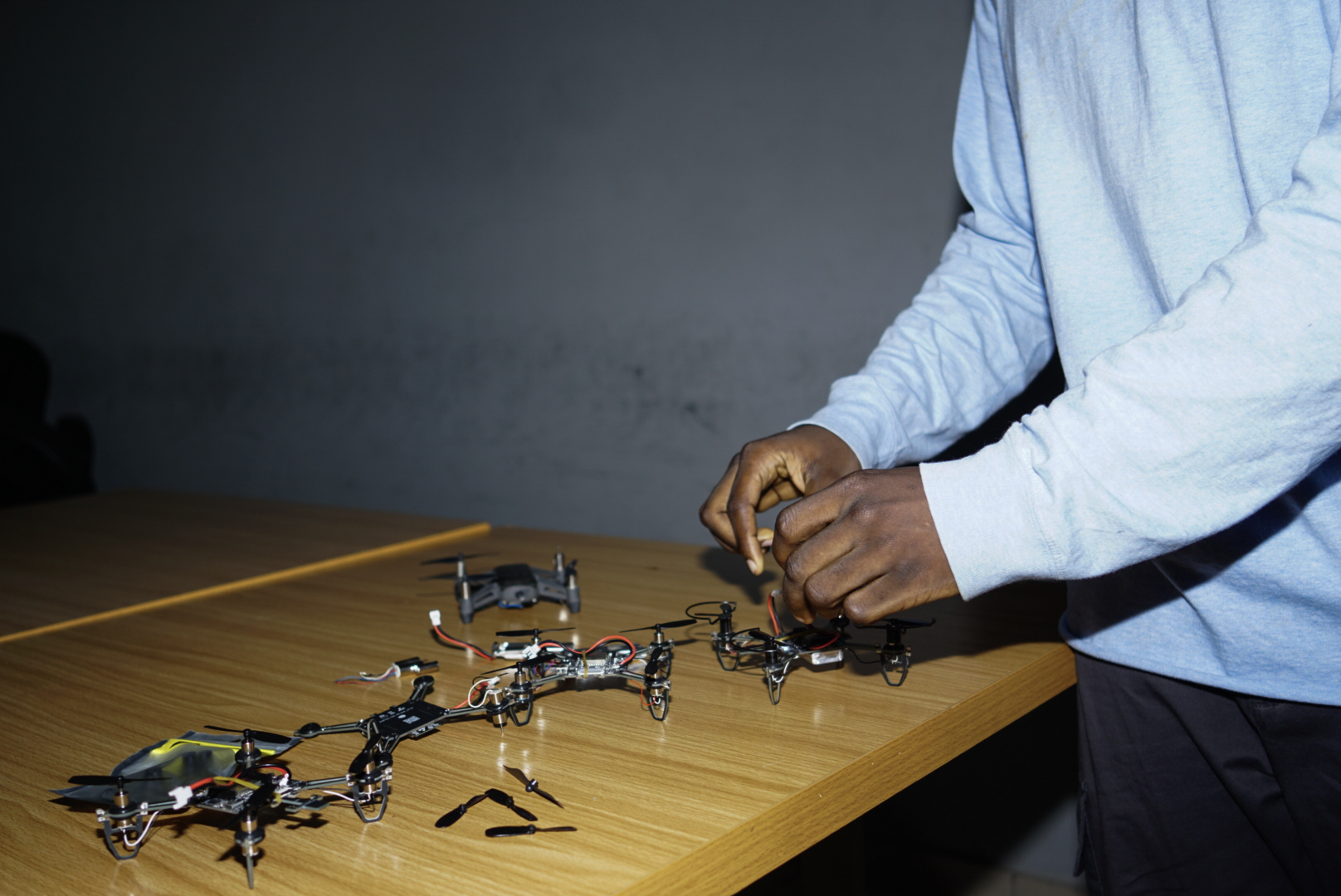
Image source: Maryam Shittu / Big Cabal Media.
Returning and giving it back
With a grant from Canada’s International Development Research Centre (IDRC), a
The lab began as a small office in the Computer Science Department of the University of Lagos and later became a workspace within the Central Research Laboratory. The vision is to become a world-renowned institute that fosters R&D in AI, robotics and AI. Since 2018, the lab has sponsored and won awards in national and international robotics contests, including the First Tech Challenge. The lab offers free summer programs to teenagers to help them develop the skills they need to explore robotics and AI applications. This year, the Massachusetts Institute of Technology (MIT) funded the Lagos-based NaijaCoder programan intensive training for secondary school students.
Victory Yinka Banjo, a recent MIT grad and one of the program organizers, said that they were not only trying to train students as software engineers. The skills they learn here are useful in research, science, computation, and other areas. You can’t do AI right now without them.
Research priorities and access to funding
Dr. Yinka Banjo wants to focus on more applied research to build solutions for Nigerians and the broader African region, but funding is scarce. She said that the majority of lab funders are more interested in extracurricular activities for teenagers and younger children. “I don’t know why. With all the grant applications we have written, the ones with children in them are the ones that get funded.”
But the funding for more research focused work is crucial to the success of labs such as AIRLAB who ultimately want to build AI solution that can be applied local. This research-focused financing is also crucial for national goals to be a global leader “in harnessing AI’s transformative power.”
There’s no government supporting us. She said that if you ask them there is no money and I can’t fault them because they have money marked for different things. “The essence of the whole thing is to go out and look for funding.”
Q2 2025, IDRC and UK Foreign, Commonwealth, and Development Office funded the lab to establish a research initiative focused AI for education. The main goal of the project is to create AI-powered learning assistants that can be used in low-connectivity and underserved environments on the African continent.
Previous research projects in the laboratory, which focused on developing AI applications in agriculture, healthcare, and other areas, were largely sponsored by foreign countries. This external funding allows the lab to access talent that will support its larger goals, which was a challenge for the lab.
Dr. Banje Said, Banje Said, “People who are talented are getting funding to travel.” “So, when we want do research, we have a struggle.” Since 2021 Nigerian students are increasingly looking abroad for higher education. The US and Canada are the top destinations. In Canada, the number of applications from Nigerian students increased to 46,000 in 2023. This is a 260% rise from 2021.
The good news is that people know that Nigerians have intelligence. We started writing research grants because funding is what keeps the smart ones around,” she said.
Talent choosing to stay
Mariam Muhammed has been selected to join the AIRLAB in the role of a Ph.D. student on the AI for Education Project. She began to think about her next steps after completing her master’s degree in computer science at the University of Lagos in 2024.
She said, “I was considering opportunities outside of the university and I had even started to prepare applications.” “I stopped immediately when I saw this opportunity because I felt this was exactly what I wanted to be doing.”
Muhammed earned an undergraduate degree in Electrical Engineering and a postgraduate certificate in Education seven years later. She spent the majority of her time in the industry after school, developing software for startups in foreign markets building AI-supported personalised education solutions. She wants to do research and create contextual AI solutions that are useful for Nigerians, and Africans.
She is confident that the external funding for the project will allow more stakeholders to hold the lab accountable for research outcomes. This is different from traditional Ph.D. programmes in Nigeria. She said that the funding was a sign of structure. “I would say that in Nigeria there are not as much funded Ph.D. options if you compare it to more developed countries.”
Outside the lecture room.
Owolala Olaoluwasubomi, a fourth-year mechanical engineer undergraduate student He is completing an industrial training program that lasts six months.
He said, “I didn’t just want to work somewhere. I wanted to be somewhere I could learn and grow.” “At the laboratory, you don’t just work for them, but you also work on yourself.” You can do more than just go to class. He plans to build an arm that can operate remotely. He hopes to eventually pursue graduate studies abroad to further develop his research interests.
In Nigeria, we aren’t that advanced in robotics and AI. He explained that he didn’t believe there were as many opportunities in Nigeria as there are elsewhere, simply because of our technological advancement.
Looking ahead
Right away, Nigerian researchers, such as Dr. Yinka Banjo, are still struggling with securing the necessary government funding to sustain and initiate impactful AI projects. When compared with peers, the gap between AI rhetoric about regional or global dominance and available resources is glaring. Consider Egypt, where the government is investing in the establishment of the country as a “regional research collaboration centre”. The AI strategy for 2025-2030 aims to increase the output to 6,000 AI-related publications per year. This focus on research has had some positive results. The country now has the highest-ranked AI university in Africa. Six of South Africa’s universities are ranked in the top 10 . The University of Ibadan is the highest-ranking Nigerian institution, ranking 50th in Africa. UNILAG, the home of AIRLAB, is ranked 74th.
These countries, which invest in AI research, have also seen some the largest funding rounds of AI startups. Egyptian-founded AI-focused companies are at the top. AIRLAB’s research, while limited, has a significant impact on the broader AI eco-system. Victor Famubode is an AI Policy expert. He said that some of the people working in these labs will one day want to start a company. “The milestone that they’ve reached in their research could be used to develop a product for the market.”
Please let us know what you think of this column, and any other topics that you would like us to explore related to AI in Africa. Fill out thisformhereMark your calendars for
! Moonshot by TechCabal will be back in Lagos, October 15-16! Join Africa’s leading founders, tech leaders, and creatives for 2 days of keynotes. Early bird tickets are now 20% off — don’t sleep! moonshot.techcabal.com