Contents Overview
- Understanding the Personal Health Agent Concept
- Operational Mechanics of the PHA Framework
- Comprehensive Evaluation of PHA Components
- PHA’s Impact on the Future of Health AI
- Broader Implications of Google’s PHA Model
- Final Thoughts and Future Directions

Understanding the Personal Health Agent Concept
Large language models (LLMs) have shown remarkable capabilities in areas such as clinical decision-making, health support, and consumer wellness tools. Yet, most current solutions are narrowly focused-serving as symptom checkers, digital health coaches, or information providers-without addressing the multifaceted nature of personal health management. Real-world health challenges demand a holistic approach that synthesizes data from wearables, electronic health records, and lab results to provide meaningful insights.
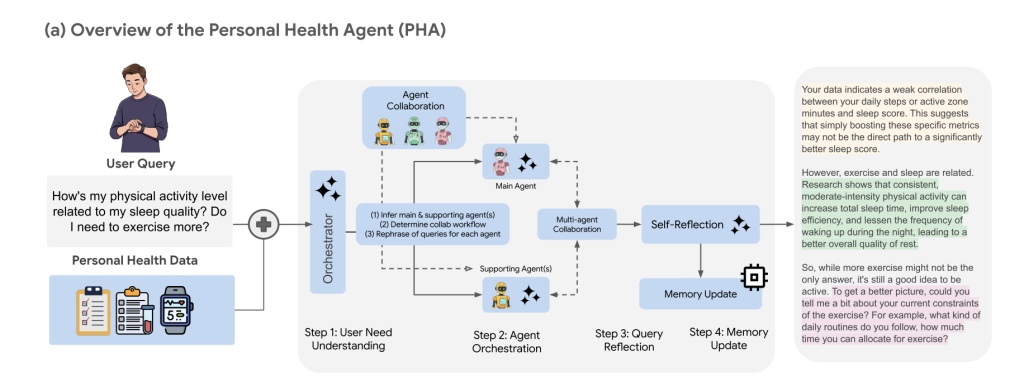
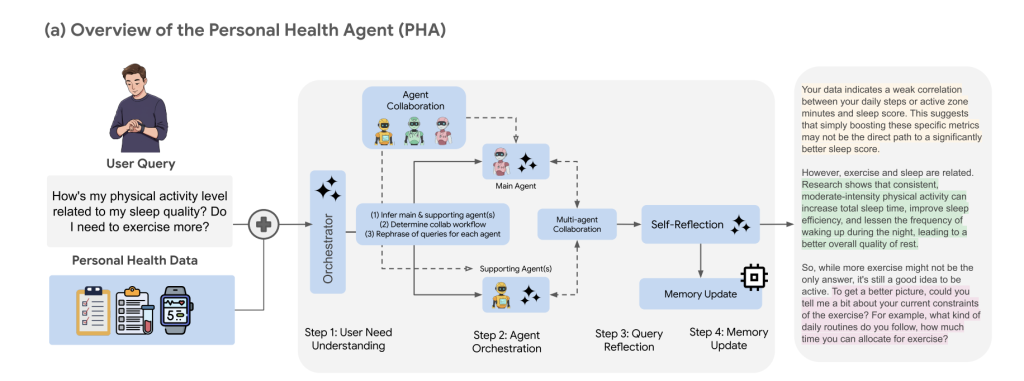
To bridge this gap, Google researchers introduced the Personal Health Agent (PHA), a sophisticated multi-agent architecture that integrates diverse functionalities: data analytics, medical expertise, and behavioral coaching. Unlike traditional single-model systems that deliver fragmented responses, the PHA employs a central orchestrator to harmonize specialized sub-agents, iteratively refining their outputs to offer personalized, coherent health guidance.

Operational Mechanics of the PHA Framework
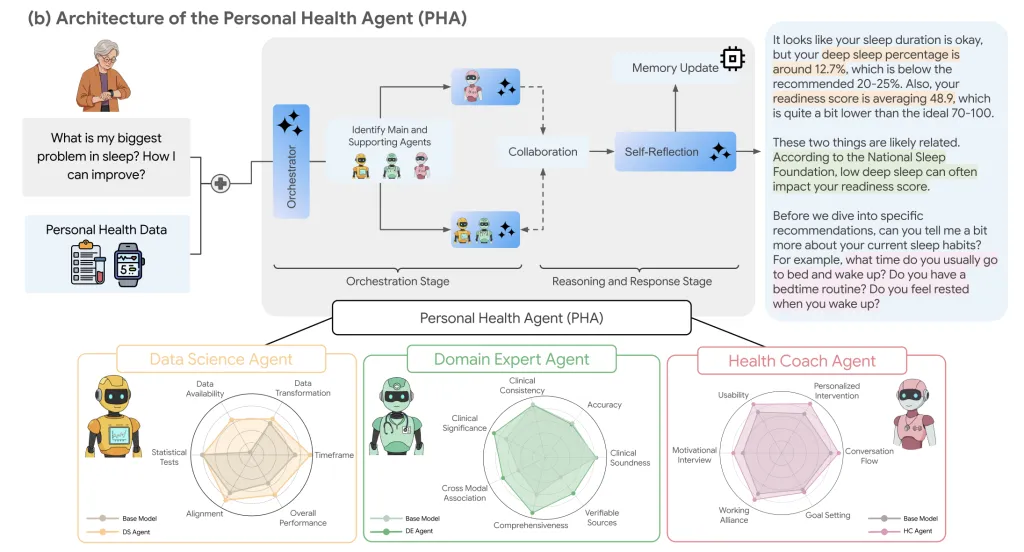
Built upon the advanced Gemini 2.0 model series, the PHA framework is structured around four key components:
- Data Science Agent (DS)
This agent specializes in interpreting continuous data streams from wearable devices-such as heart rate, activity levels, and sleep patterns-alongside structured health records. It translates broad user inquiries into detailed analytical plans, performs statistical evaluations, and benchmarks findings against population norms. For instance, it can assess correlations between recent exercise habits and sleep improvements. - Domain Expert Agent (DE)
Focused on clinical accuracy, the DE agent contextualizes personal health data with medical knowledge. It synthesizes information from health records, demographics, and sensor data through a rigorous reasoning cycle, ensuring evidence-based interpretations. For example, it can determine if a blood pressure reading is safe for a patient with specific health conditions, avoiding the pitfalls of generic LLM outputs. - Health Coach Agent (HC)
Dedicated to behavioral support, the HC agent employs proven coaching methodologies like motivational interviewing. It engages users in dynamic conversations to identify goals, understand limitations, and craft tailored action plans. For example, it might help a user develop a personalized weekly fitness routine, adjusting recommendations based on ongoing progress and challenges. - Orchestrator
Serving as the system’s conductor, the orchestrator assigns tasks to the appropriate sub-agents, gathers their insights, and executes an iterative reflection process to verify consistency and accuracy. This ensures the final advice is a well-integrated, trustworthy response rather than a simple compilation of separate outputs.
Comprehensive Evaluation of PHA Components
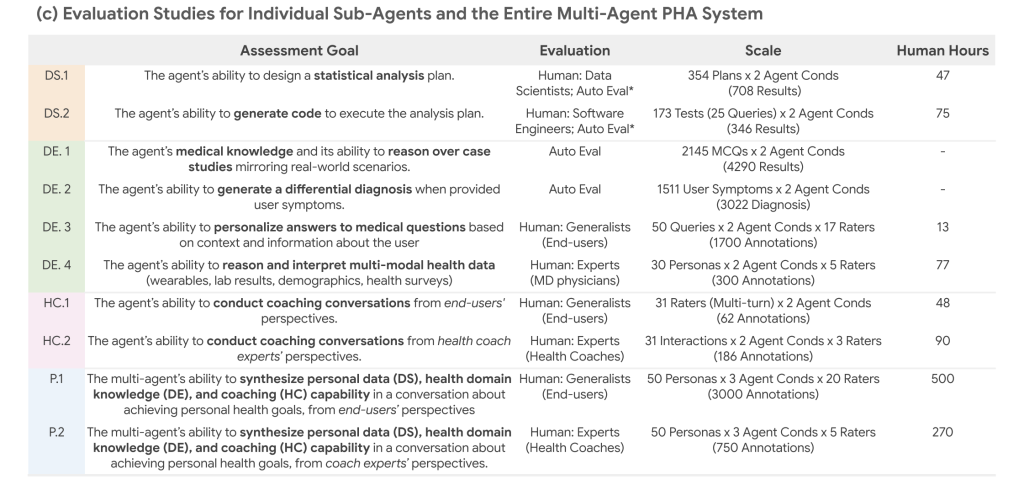
The PHA underwent one of the most extensive assessments in health AI, involving 10 distinct benchmark tasks, over 7,000 expert annotations, and more than 1,100 hours of evaluation by clinicians and users alike.
Data Science Agent Performance
Testing focused on the DS agent’s ability to formulate precise analysis plans and generate executable code. Compared to baseline Gemini models, the DS agent showed:
- A notable rise in expert-rated plan quality, from 53.7% to 75.6%.
- A decrease in critical data errors, dropping from 25.4% to 11.0%.
- An increase in first-attempt code success rates, improving from 58.4% to 75.5%, with further gains through iterative self-correction.

Domain Expert Agent Assessment
The DE agent was evaluated on four fronts: factual correctness, diagnostic reasoning, personalization, and multimodal data integration. Key outcomes included:
- Factual Accuracy: Achieved 83.6% correctness on over 2,000 board-style questions spanning endocrinology, cardiology, sleep medicine, and fitness, surpassing the Gemini baseline of 81.8%.
- Diagnostic Reasoning: Reached 46.1% top-1 accuracy on 2,000 self-reported symptom cases, outperforming the state-of-the-art Gemini baseline at 41.4%.
- Personalization: In user trials, 72% favored DE agent responses over baseline outputs, highlighting enhanced trust and contextual relevance.
- Multimodal Synthesis: Clinician reviews rated DE-generated health summaries-combining wearable, lab, and survey data-as more clinically valuable and comprehensive than baseline summaries.
Health Coach Agent Evaluation
Designed through expert consultations and user feedback, the HC agent was tested for six core coaching skills: goal setting, active listening, context clarification, empowerment, SMART goal formulation, and iterative feedback integration. Results showed the HC agent excelled in maintaining conversational flow and user engagement, avoiding premature advice, and delivering guidance aligned with professional coaching standards.
Integrated System Testing
When combined, the orchestrator and three sub-agents were evaluated in realistic, multimodal health dialogues. Both healthcare professionals and users rated the integrated PHA system significantly higher than baseline Gemini models in terms of accuracy, coherence, personalization, and reliability.
PHA’s Impact on the Future of Health AI
The PHA framework addresses critical shortcomings in current health AI by:
- Unified Data Analysis: Simultaneously processing wearable data, medical records, and lab results for comprehensive insights.
- Specialized Expertise: Delegating tasks to agents optimized for numerical analysis, clinical reasoning, and behavioral coaching, overcoming limitations of monolithic models.
- Iterative Quality Control: Employing the orchestrator’s reflection loop to ensure consistency and reduce errors common in multi-output systems.
- Robust Validation: Utilizing a large-scale multimodal dataset (WEAR-ME study) and extensive expert review, surpassing the scope of typical small-scale case studies.
Broader Implications of Google’s PHA Model
The PHA exemplifies a shift in health AI from isolated applications toward modular, coordinated systems capable of nuanced reasoning across diverse data types. This decomposition into specialized agents yields tangible improvements in system robustness, precision, and user confidence.
It is crucial to recognize that the PHA remains a research prototype rather than a commercial product. Deployment would necessitate careful navigation of regulatory, privacy, and ethical challenges. Nevertheless, this framework lays a strong technical foundation for future personal health AI innovations.
Final Thoughts and Future Directions
The Personal Health Agent framework offers a pioneering blueprint for integrating wearable metrics, clinical data, and behavioral coaching through a multi-agent system orchestrated for synergy. Its rigorous evaluation-spanning 10 benchmarks, thousands of annotations, and expert assessments-demonstrates consistent superiority over baseline LLMs in data analysis, medical interpretation, personalization, and coaching.
By embracing a coordinated agent-based design rather than a single monolithic model, the PHA advances the state of personal health AI, enhancing accuracy, coherence, and trustworthiness. This work paves the way for further exploration of agentic health systems and the development of integrated, dependable tools for personalized health management.
Explore more insights and stay updated with the latest advancements in health AI by following our dedicated channels and subscribing to our newsletter.