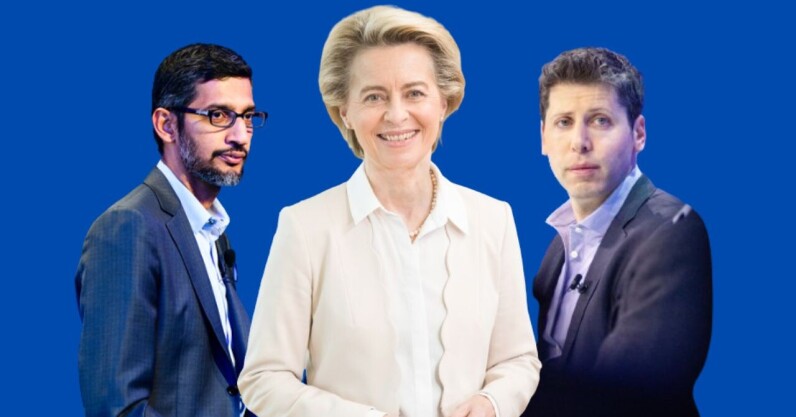
The US has pursued AI development largely with minimal regulatory oversight. Europe has taken a very different approach. The Data Protection Act (DPA), the GDPR and the AI Act (which is aligned with local laws and unions) have set Europe on a different path.
According to a recent joint study by the (19459028]International Labour Organisation (ILO) and Poland’s National Research Institute, Europe is the most vulnerable region to AI. It is also the second most exposed after Asia. The impact of AI in Europe, a region that faces a significant shortage of skilled workers, has become a pressing issue.
Adam Maurer, COO of Connecting Software, a tech firm operating in Europe, said to TNW that it is too early to predict where the AI wave will lead us. We’ve only seen a small fraction of its capabilities, which is both exciting and frightening.
In the past few years, Big Tech firms have often carried out mass-layoffs, both because of revenue concerns and because they believe AI can perform many of the tasks of employees at all levels, Maurer explained.
While some AI-driven layoffs targeted low performers, others were problematic. They had a negative impact on the business at Klarna.
Klarna is a fintech company in Sweden that replaced 700 employees with AI and fired them. It recently announced it would hire humans again. The CEO of the company admitted that he made a mistake when replacing workers with AI.
Maurer stated that AI would replace certain jobs. “On the flip side, I believe it will make other jobs much more valuable.”
The impact on jobs in the EU will be determined by labour laws and regulations. Tech leaders believe that they can lead to a future of AI that is beneficial for both workers and business.
The conversation among executives
Maurer stated that there may be an expectation for the EU step in and regulate job relocation. He argued, however, that this would slow down growth and discourage new businesses from doing business within the union.
However, not all business leaders agree. Volodymyr Kubytskyi, the head of AI for MacPaw, a Ukrainian company that develops solutions for Apple devices, says that displacement will occur, but it is not due to AI.
Kubytskyi said to TNW that “AI disrupts traditional logic and processes of the work.” “The real question is: Can we redesign work processes before the outdated system collapses?” To prevent this system from collapsing leaders must stop thinking about AI as a quick win or cost-saving device, he said.
Kubytskyi said that the AI Act is necessary to establish a baseline in the industry but it does not account for possible job disruptions, which is a hole in the regulatory landscape. “The AI Act needs to be updated in order to account for this. However, it is unlikely that this will occur soon,” he said.
Roman Eloshvili, founder of ComplyControl, a UK compliance firm, told TNW that the AI Act focuses on safety, transparency and ethics but falls short in terms of socio-economic impact. “So, amendments will be necessary,” he said.
I expect that over time some of them will appear to address workforce issues more effectively, such as mandates on employer-led upskilling, or protections for workers who are displaced. Is it too soon to amend the law or is it still too early? Kris Joneswho leads the engineering department in Belfast for iVerify believes it is too early to make any changes. He said that the AI Act’s framework is already a delicate balance, balancing protecting fundamental rights with allowing innovators to breathe.
Changing the regulation isn’t the only policy idea that executives have discussed. Jones told TNW member states had other levers they could pull. “One idea that has been floated is an ‘AI token’ tax,” said Jones.
An AI token tax would allow governments to generate revenue by AI usage that produces income. These funds would be redistributed via measures such as reskilling or support for affected sectors. Dario Amodei CEO of Anthropic recently
told Axios that the concept could offset the inevitable loss of millions of white-collar entry-level jobs due to AI. Amodei stated that “measures like this can cushion any job shocks, without putting a blanket cap on innovation.”
Is it inevitable that there will be clashes between European trade unions and labour?
European trade unions and labour organizations have been ignored in the debate on AI job displacement. Many of them have made official statements about AI.
The ETUC, which represents over 45 million European workers and is hosting the Paris AI Summit on February 2025, has issued an open letter highlighting the dangers of AI. It warned that efforts to ensure AI had “a positive impact on the labour market, quality jobs, or society” would be canceled if AI was monopolised by tech companies.
In August of the previous year,UK Unionsincluding Accord and Unite had called for regulations protecting workers from AI. They also suggested reskilling programmes for workers, reminded businesses of their transparency obligations and stressed the need for union consultative meetings. They stated that they would protect workers’ rights from AI-driven hiring or firing, and defend IP rights for creative professionals.
When asked by tech firms if they expected companies to face challenges in Europe with regards to labour laws and unions, the majority said yes. Eloshvili, from ComplyControl, said: “Undoubtedly.” “European worker protections are robust and active unions present a safeguard as well as challenges for AI integration.” “Firms who try to impose AI without dialogue risk conflict and backlash.” “When businesses and workers work together, AI can be a powerful tool to improve working conditions,” said Eloshvili.
Kubytskyi, from MacPaw, agreed that there will be challenges on this front. He described the pushback by unions and workers’ organisations as “understandable”. He said that “clarity, structure, communication, and organization are essential.” Kubytskyi believes that conflict can also be avoided if you integrate new [AI] agent into existing workflows, without involving people. To prevent this, we must show people what AI is, what guardrails exist, and why they will benefit the team.
Jorge Rieto CEO of Dataco, a big data and AI consultancy, agrees. “Strategic AI deployments are the most effective,” he said. He added that careful analysis was needed to determine which tasks should be delegated to AI.
Flipping script to develop AI in the ‘European Way’
Jones, from iVerify, explained that regulations, unions, and worker’s rights in Europe aren’t necessarily obstacles and could be beneficial.
According to him, companies should integrate responsible AI, bias checking, explainability, as well as human oversight loops, into each product cycle. Jones explained that this would allow companies to transform the AI Act into a competitive advantage.
Jones stated that “Europe cannot sit out the AI wave. The Bay Area is home to roughly half of all unicorns in the world and receives 80% of GenAI funds, while a large part of the European workforce has aged and a quarter are unable to find work.”
Europe faces competition not only from the usual suspects – Asia and the US – but also from Latin America where heavy investments in technology are underway. Mahesh Raja of Ness Digital Engineering (which operates innovation centers in the UK and Czechia) highlighted how this lack similar investment is hurting businesses. ” 53 percent small- and mid-size businesses reported that the initial costs of AI implementation were higher than expected. He said that we need to address the adoption issues arising from legacy IT infrastructures, and improve the time-to value for this emerging technology.
But Europe’s strict regulations can become a premium label for banks, healthtechs and any sector that values privacy and trust.
Jones said, “Europe shouldn’t copy Silicon Valley.” He believes that the continent’s strength lies in a combination factors, such as upskilling and STEM Ph.D. graduates per capita. The privacy-first, safe AI leadership – solidified by regulation – can bolster this package.
Jones said that Europe should focus on AI augmentation, skill-building and a more inclusive approach to AI. Otherwise, we will fall further behind. “But do it Europe’s way. Leverage our ethical governance and deep industrial know-how. And cross-border talent pools instead of importing Valley’s blitz and break culture wholesale.”