Contents Overview
Advancing AI Capabilities in Biomedical Science
The landscape of artificial intelligence in biomedical research is undergoing rapid transformation, driven by the need for intelligent systems that excel across diverse domains such as genomics, clinical diagnostics, and molecular biology. These AI agents are expected not only to retrieve information but to navigate complex biological challenges, analyze patient datasets, and derive actionable insights from extensive biomedical repositories. Unlike generic AI models, these specialized agents must integrate with domain-specific instruments, understand intricate biological frameworks, and emulate the investigative processes of human researchers to effectively contribute to cutting-edge biomedical studies.
Bridging the Gap to Expert-Level Biomedical Reasoning
Reaching the level of expertise required for advanced biomedical tasks remains a formidable challenge. While many large language models perform adequately on straightforward data retrieval or pattern detection, they often falter when confronted with multi-layered reasoning, diagnosing rare diseases, or prioritizing genetic variants. These tasks demand more than access to data-they require nuanced contextual interpretation and specialized judgment. This discrepancy highlights a critical question: how can AI systems be trained to think and reason like biomedical experts?
Limitations of Conventional AI Training Methods
Traditional strategies, such as supervised learning on curated biomedical datasets or retrieval-augmented generation that anchors outputs in scientific literature, have notable shortcomings. These methods often depend on fixed prompt templates and rigid response patterns, limiting their flexibility. Additionally, many models struggle to effectively utilize external biomedical tools, and their reasoning processes tend to break down when encountering unfamiliar biological data structures. Such fragility undermines their reliability in dynamic, high-stakes biomedical environments where precision and interpretability are paramount.
Introducing Biomni-R0: Reinforcement Learning for Biomedical Intelligence
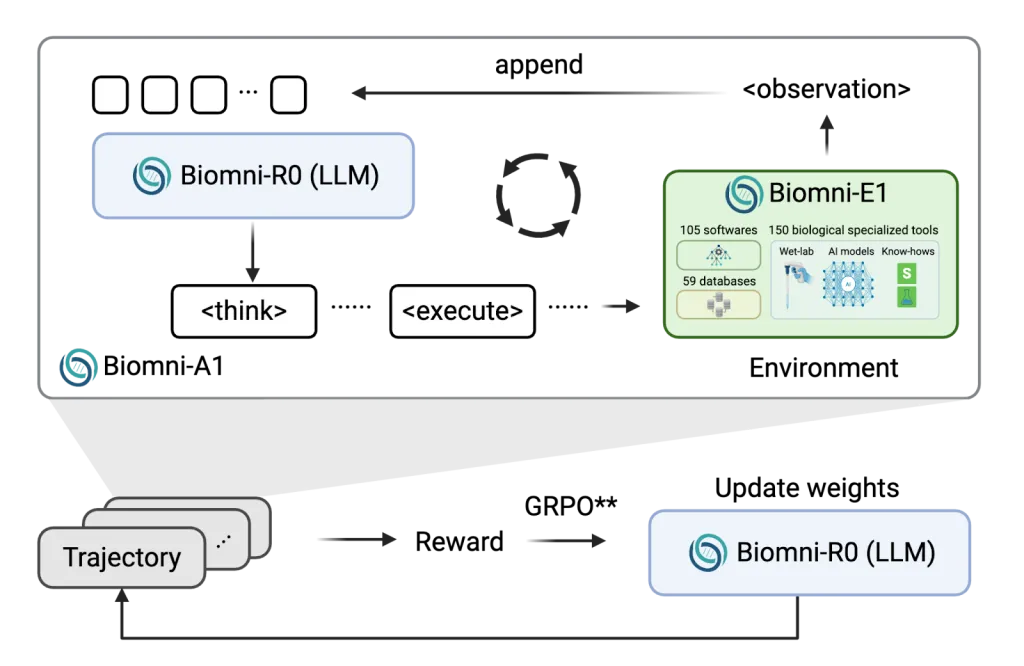
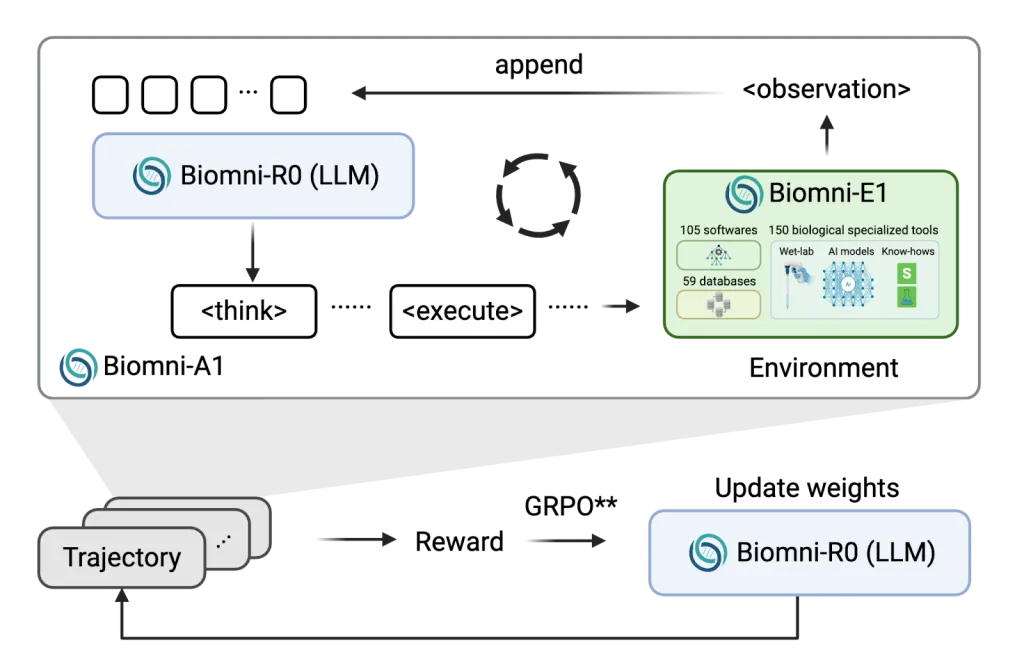
A collaborative effort between researchers at Stanford University and UC Berkeley has yielded a novel class of models named Biomni-R0. These models, including Biomni-R0-8B and Biomni-R0-32B, leverage reinforcement learning (RL) within a biomedical-specific training environment. By combining Stanford’s Biomni agent platform with UC Berkeley’s SkyRL reinforcement learning framework, the team crafted an RL setup tailored to biomedical reasoning, incorporating expert-annotated tasks and innovative reward mechanisms designed to enhance both accuracy and reasoning structure.
Innovative Training Framework and Architecture
The training methodology unfolds in two distinct phases. Initially, supervised fine-tuning (SFT) is applied using high-quality reasoning trajectories generated by Claude-4 Sonnet, refined through rejection sampling to instill structured reasoning capabilities. Subsequently, the models undergo reinforcement learning, optimizing for dual objectives: correctness (e.g., accurate gene identification or diagnosis) and adherence to structured response formats (e.g., proper use of <think> and <answer> tags).
To maximize computational efficiency, the researchers implemented asynchronous rollout scheduling, mitigating delays caused by external tool interactions. Furthermore, the models were enhanced to process extended contexts of up to 64,000 tokens, enabling them to sustain complex, multi-turn reasoning dialogues essential for biomedical problem-solving.

Benchmarking Biomni-R0 Against Leading Models
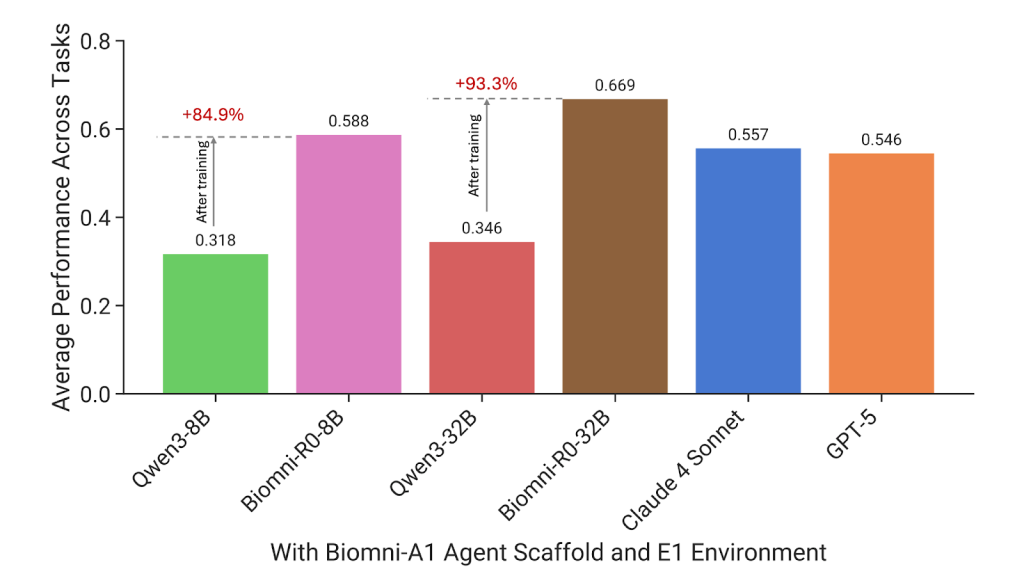
The results demonstrate remarkable improvements. The larger Biomni-R0-32B model achieved an impressive score of 0.669, nearly doubling the baseline model’s 0.346. Even the more compact Biomni-R0-8B scored 0.588, surpassing much larger generalist models such as Claude 4 Sonnet and GPT-5. Across ten biomedical tasks, Biomni-R0-32B led in seven, while GPT-5 and Claude 4 each topped only two and one tasks, respectively. Notably, in the domain of rare disease diagnosis, Biomni-R0-32B scored 0.67, vastly outperforming Qwen-32B’s 0.03-a more than 20-fold increase. Similarly, in genome-wide association study (GWAS) variant prioritization, the model’s performance surged from 0.16 to 0.74, underscoring the advantage of specialized biomedical reasoning.

Scalability and Precision in Biomedical AI Systems
Developing large-scale biomedical AI agents involves managing resource-intensive processes, including external tool executions, database queries, and code evaluations. To address this, the system architecture separates environment execution from model inference, enabling scalable deployment and minimizing GPU idle time. This design accommodates tools with varying response times without compromising throughput. Additionally, the RL-trained models consistently generate longer, well-structured reasoning sequences, which strongly correlate with enhanced task performance, highlighting that comprehensive and organized reasoning is a hallmark of expert-level biomedical intelligence.
Summary of Key Insights
- Biomedical AI must excel in deep, multi-step reasoning across fields like genomics, diagnostics, and molecular biology, beyond simple data retrieval.
- The primary challenge lies in achieving expert-level accuracy in complex tasks such as rare disease identification and gene prioritization.
- Conventional training approaches often lack the robustness and flexibility needed for dynamic biomedical applications.
- Biomni-R0 introduces a novel reinforcement learning framework with expert-informed rewards and structured output, enhancing reasoning quality.
- The two-stage training process-supervised fine-tuning followed by reinforcement learning-effectively boosts model performance.
- Biomni-R0-8B delivers strong results with a smaller footprint, while Biomni-R0-32B sets new performance standards, outperforming larger models on most tasks.
- Reinforcement learning fosters the generation of extended, coherent reasoning chains, a key indicator of expert cognition.
- This research paves the way for next-generation biomedical AI agents capable of automating intricate research workflows with high precision and reliability.