Anthropic’s Comprehensive Approach to AI Safety: Safeguarding Claude Against Harm
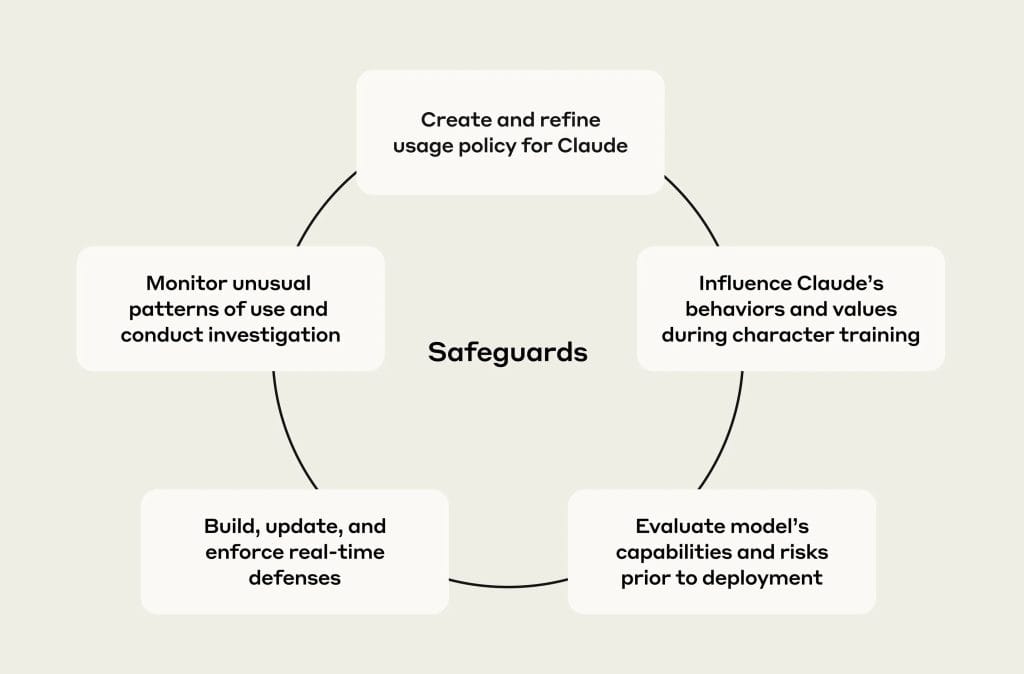
Anthropic has unveiled a robust safety framework designed to ensure its AI model, Claude, remains a beneficial tool while minimizing risks of misuse or harm. This strategy is not a single barrier but a multi-layered defense system aimed at proactively addressing potential threats.
Multidisciplinary Safeguards Team: The Backbone of AI Security
At the heart of Anthropic’s safety efforts is the Safeguards team-a diverse group comprising policy analysts, data scientists, engineers, and threat intelligence experts. Unlike typical support teams, these professionals bring deep insights into how malicious actors might exploit AI, enabling them to anticipate and mitigate risks effectively.
Layered Defense: From Policy to Real-Time Monitoring
Anthropic’s safety measures begin with a clearly defined Usage Policy, which acts as a comprehensive guide outlining acceptable and prohibited uses of Claude. This policy addresses critical areas such as election integrity, child protection, and responsible application in sensitive sectors like healthcare and finance.
To develop these guidelines, the team employs a Unified Harm Framework, a structured methodology that evaluates potential negative consequences across physical, psychological, economic, and societal dimensions. Rather than a rigid scoring system, this framework facilitates nuanced risk assessment during policy formulation.
Additionally, external experts conduct Policy Vulnerability Tests, challenging Claude with complex scenarios related to terrorism, child safety, and other high-risk topics to identify and patch vulnerabilities before deployment.
For instance, during the 2024 U.S. elections, collaboration with the Institute for Strategic Dialogue revealed that Claude occasionally provided outdated voting information. In response, Anthropic integrated a notification directing users to TurboVote, a trusted, nonpartisan source for current election details.
Embedding Ethical Guidance: Training Claude to Navigate Sensitive Topics
The Safeguards team partners closely with Claude’s developers to embed ethical considerations directly into the model’s training process. This collaboration ensures Claude understands boundaries and responds appropriately to sensitive or potentially harmful requests.
For example, by working with a leading crisis support organization, Anthropic has equipped Claude to engage compassionately in conversations about mental health and self-harm, offering supportive dialogue rather than simply refusing interaction. This nuanced training also enables Claude to decline generating content related to illegal activities, malicious software, or fraudulent schemes.
Rigorous Pre-Launch Evaluations: Ensuring Safety, Fairness, and Reliability
Before releasing any new iteration of Claude, Anthropic conducts extensive testing across three critical domains:
- Safety Assessments: These tests verify Claude’s adherence to usage policies, especially during complex, extended interactions.
- Risk Evaluations: For high-impact areas such as cybersecurity threats or biosecurity concerns, specialized assessments are performed, often in partnership with governmental and industry experts.
- Bias Audits: To promote fairness, Claude is scrutinized for political neutrality and checked for potential biases related to gender, race, or other demographic factors, ensuring equitable and accurate responses.
This comprehensive evaluation process helps Anthropic confirm the effectiveness of safety measures and identify areas requiring additional safeguards prior to public release.


Ongoing Vigilance: Real-Time Monitoring and Threat Detection
Once Claude is operational, Anthropic employs a combination of automated tools and human oversight to maintain safety. Central to this is a suite of specialized AI models known as “classifiers,” which monitor interactions in real time to detect policy violations.
When a classifier identifies problematic content-such as spam or harmful misinformation-it can intervene by redirecting Claude’s responses or flagging the issue for review. Persistent offenders may face account warnings or suspension to prevent further misuse.
Beyond individual cases, the Safeguards team analyzes aggregated, privacy-preserving data to detect broader patterns of abuse, including coordinated disinformation campaigns. Techniques like hierarchical summarization enable efficient identification of emerging threats, while active monitoring of online forums helps anticipate new attack vectors.
Collaborative Efforts: Building AI Safety Through Partnerships
Anthropic recognizes that AI safety is a collective responsibility. The company actively collaborates with academic researchers, policymakers, and the wider community to refine safety protocols and share best practices. This cooperative approach aims to foster a safer AI ecosystem globally.
Stay Informed on AI and Data Innovation
For professionals interested in the latest developments in AI and big data, numerous industry conferences and webinars are available worldwide, including events in Amsterdam, California, and London. These gatherings offer valuable insights from leading experts and opportunities to explore cutting-edge enterprise technologies.