Revolutionizing Playtime: The Rise of AI-Enabled Talking Toys for Children
For generations, children have cherished their stuffed animals as companions and confidants. Today, this timeless interaction is evolving as innovative companies integrate advanced chatbots and voice assistants into plush toys, enabling them to engage in real-time conversations with kids.
China Leading the Charge in AI Toy Innovation
China stands at the forefront of this burgeoning industry. A recent forecast by the Shenzhen Toy Industry Association in collaboration with JD.com anticipates the AI toy market in China will exceed ¥100 billion (approximately $14 billion) by 2030, outpacing growth in nearly all other consumer AI sectors. Data from the Chinese corporate registry Qichamao reveals that over 1,500 AI toy enterprises were active in the country as of October 2025, underscoring the sector’s rapid expansion.
Innovative Products Transforming Traditional Toys
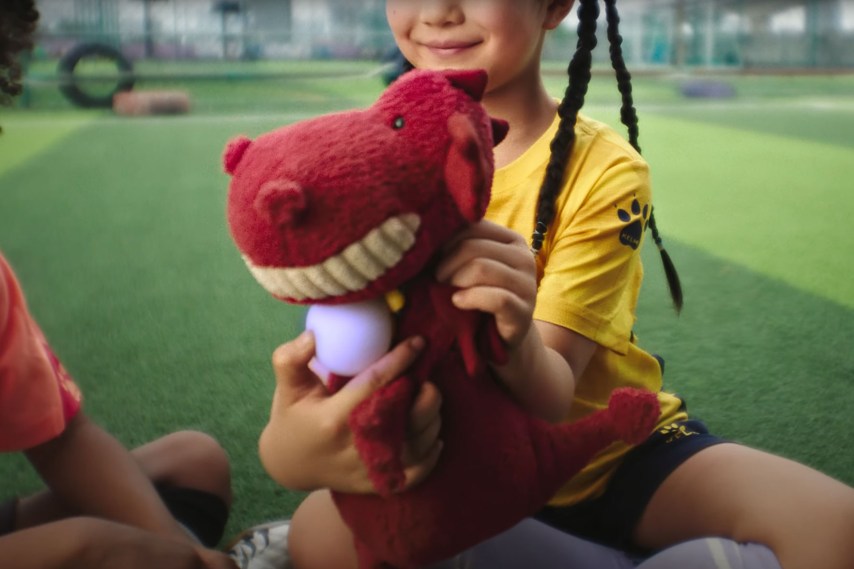
Among the newest innovations is BubblePal, a compact device roughly the size of a Ping-Pong ball that attaches to a child’s favorite stuffed animal, bringing it to life with speech. Accompanied by a smartphone app, parents can select from 39 distinct characters, ranging from Disney’s Elsa to the iconic Chinese figure Nezha. Priced at $149, BubblePal has sold 200,000 units since its launch in mid-2024. Developed by the Chinese firm Haivivi, the toy leverages DeepSeek’s sophisticated large language models to power its conversational abilities.
Another notable player, FoloToy, offers a unique twist by enabling parents to personalize plush toys-such as bears, bunnies, or cacti-by training them to mimic their own voice and speech patterns. FoloToy reported sales exceeding 20,000 AI-enhanced toys in the first quarter of 2025 alone, nearly matching its total sales for the entire previous year, with projections aiming for 300,000 units by year-end.
Global Expansion and Market Dynamics
Chinese AI toy manufacturers are not limiting themselves to domestic markets. BubblePal debuted in the United States in December 2024 and has since expanded availability to Canada and the United Kingdom. Similarly, FoloToy’s products are now sold in over ten countries, including Brazil, Germany, and Thailand. According to Rui Ma, a technology analyst at AlphaWatch.AI, the appeal of AI toys in China is amplified by the country’s well-established market for educational electronics tailored to children-a niche less developed in many other regions. FoloToy’s CEO, Kong Miaomiao, notes that outside China, their customer base primarily consists of early adopters intrigued by AI technology.
Historical Context: From Educational Gadgets to AI Companions
The AI toy surge builds upon decades of child-focused consumer electronics in China. Since the 1990s, companies like BBK have popularized devices such as electronic dictionaries and “study machines,” marketed as educational tools for young learners. These hybrid toys combine storytelling, interactive reading, and simulated companionship, setting the stage for today’s AI-driven playmates.
Competition Intensifies: Western Brands Enter the AI Toy Arena
The global market is heating up as American companies join the race. Musician Grimes collaborated on Grok, a plush toy designed to converse with children and adapt to their personalities. Meanwhile, toy industry giant Mattel is partnering with OpenAI to integrate conversational AI into iconic brands like Barbie and Hot Wheels, with product launches anticipated later this year.
Parental Perspectives: Balancing Enthusiasm with Real-World Challenges
Despite the excitement surrounding AI toys, parental feedback from China reveals a mixed reception. Many appreciate the screen-free design and robust parental controls, yet some report that the AI’s performance can be inconsistent, causing children to lose interest quickly.
Penny Huang, a mother in Beijing, purchased a BubblePal for her five-year-old daughter, who is primarily cared for by grandparents. Huang hoped the toy would alleviate her child’s loneliness and reduce her dependence on adults’ smartphones. However, the initial fascination faded rapidly.
“The responses are often too lengthy and verbose. My daughter quickly becomes impatient,” Huang explains. “The interaction doesn’t feel immersive-more like a disjointed voice that sometimes seems out of sync.”
Similarly, Hongyi Li, another parent using BubblePal, encountered issues with voice recognition. “Children’s speech tends to be fragmented and unclear. The toy frequently interrupts or misinterprets my child’s words. Additionally, it still requires pressing a button to activate, which can be challenging for toddlers,” Li notes.
Reflecting her disappointment, Huang recently listed her BubblePal for resale on Xianyu, a popular secondhand marketplace. “It’s just another toy that my daughter plays with for a few minutes before losing interest. Ultimately, she prefers using my phone,” she admits.
The Future of AI Toys: Opportunities and Obstacles
As AI technology continues to evolve, the potential for interactive toys to enrich children’s play and learning experiences is immense. However, developers must address current limitations such as natural language understanding, response timing, and user-friendly interfaces to sustain engagement. With ongoing advancements and growing global interest, AI-powered toys are poised to become a staple in children’s lives worldwide.