Cybersecurity’s Enduring Struggle: Insights from Google Cloud’s Asia Pacific Leadership
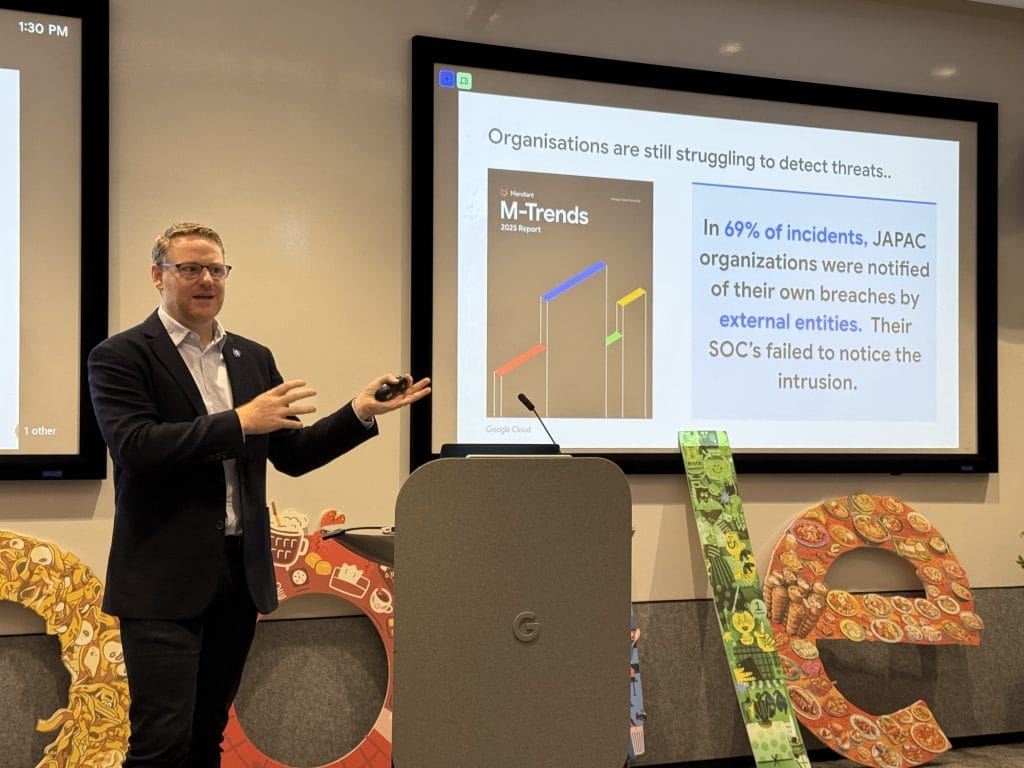
At Google’s modern Singapore headquarters, Mark Johnston, Director of the Office of the CISO for Asia Pacific at Google Cloud, delivered a sobering message to a gathering of technology journalists. Despite five decades of cybersecurity advancements, defenders continue to lag behind attackers. Highlighting data from Japan and the broader Asia Pacific region, Johnston revealed that in nearly 70% of breach incidents, organizations only learned about their compromises through external notifications-underscoring a critical failure in breach detection capabilities.
Reflecting on Half a Century of Cyber Defense Challenges
Johnston traced the roots of this persistent problem back to 1972, referencing cybersecurity pioneer James P. Anderson’s early observation that “systems we rely on do not adequately protect themselves.” This fundamental issue remains unresolved despite technological progress. Google Cloud’s threat intelligence further confirms that over three-quarters of breaches originate from basic security lapses such as misconfigurations and stolen credentials-vulnerabilities that have plagued organizations for decades. For instance, a recent zero-day vulnerability in Microsoft SharePoint, a widely used enterprise tool, was actively exploited, illustrating how even common software remains a frequent target.
The Escalating AI Battle: Cyber Defenders Versus Threat Actors
Kevin Curran, a cybersecurity professor and IEEE senior member, characterizes the current environment as a “high-stakes AI arms race.” Both defenders and attackers are leveraging artificial intelligence to gain an edge. On the defensive side, enterprises deploy generative AI and automation to sift through massive datasets in real time, identifying anomalies and potential threats. Conversely, attackers harness AI to automate phishing campaigns, generate malware, and scan for network weaknesses, amplifying their reach and efficiency. This dual-use dilemma, termed the “Defender’s Dilemma” by Johnston, highlights the challenge of maintaining an advantage in cyberspace.
Leveraging AI for Proactive Defense: Google Cloud’s Strategic Initiatives
Google Cloud is actively working to shift the balance in favor of defenders by integrating AI across multiple facets of cybersecurity. Their approach includes using generative AI for vulnerability detection, threat intelligence gathering, secure software development, and rapid incident response. A standout example is Project Zero’s “Big Sleep” initiative, which employs large language models to uncover security flaws in open-source code. Johnston shared that this AI-driven tool recently identified 47 vulnerabilities in a single month, marking a significant leap from traditional manual analysis to semi-autonomous security operations powered by AI systems like Gemini.
From Manual to Autonomous Security: Navigating the Automation Spectrum
Google Cloud envisions a four-stage evolution in security operations: Manual, Assisted, Semi-autonomous, and fully Autonomous. In the semi-autonomous phase, AI handles routine tasks while escalating complex issues to human experts. The ultimate goal is autonomous AI systems capable of managing the entire security lifecycle independently. However, this progression introduces new risks. Johnston acknowledged the potential for AI tools themselves to be targeted and manipulated, emphasizing the current lack of robust frameworks to verify the integrity of AI-driven security agents. Curran also cautions against over-reliance on AI, advocating for clearly defined human oversight roles to prevent complacency and vulnerabilities.
Mitigating AI’s Unpredictability: Practical Safeguards in Deployment
One of the challenges with AI in cybersecurity is its occasional generation of irrelevant or inappropriate outputs, which can pose significant risks in customer-facing applications. Johnston illustrated this with an example where an AI system might mistakenly provide medical advice in a retail context, potentially confusing customers and harming brand reputation. To counteract this, Google Cloud developed Model Armor, an intelligent filtering layer that screens AI responses for sensitive information, context relevance, and brand alignment. Additionally, Google addresses the growing issue of “shadow AI” – unauthorized AI tools operating within corporate networks – by deploying sensitive data protection technologies that monitor multiple cloud environments and on-premises systems.
Resource Constraints Amid Rising Threats: The Asia Pacific Security Landscape
Johnston highlighted a critical tension faced by CISOs in the Asia Pacific region: escalating cyber threats coinciding with limited budgets. While attack volumes increase, many organizations struggle to allocate sufficient resources to respond effectively. This surge in “noise,” even if not always sophisticated, demands more time and effort, straining security teams. Consequently, leaders seek partnerships and AI-driven solutions that can enhance defense capabilities without necessitating significant staff expansion or budget increases.
Unanswered Questions and the Road Ahead
Despite promising advancements, several uncertainties remain. Johnston noted that while AI has not yet been used to launch novel attack types, adversaries are employing it to scale existing methods, creating new opportunities for exploitation. He also acknowledged that AI-driven incident reporting, though faster by approximately 50%, still faces accuracy challenges, paralleling human error rates. Looking forward, Google Cloud is preparing for future threats by implementing post-quantum cryptography across its data centers, anticipating the eventual impact of quantum computing on current encryption standards.
Balancing Innovation with Prudence: The Future of AI in Cybersecurity
The integration of AI into cybersecurity offers transformative potential but also introduces significant risks. While AI enhances vulnerability detection, threat analysis, and automated responses, it simultaneously equips attackers with more powerful tools. As Curran advises, organizations must adopt comprehensive, proactive cybersecurity strategies that combine advanced technology with human expertise. Johnston emphasizes cautious, incremental adoption of AI solutions, advocating for low-risk implementations that maintain human oversight and uphold fundamental security practices.
The ongoing AI revolution in cybersecurity will favor those who skillfully blend innovation with careful risk management rather than those who rely solely on cutting-edge algorithms.