
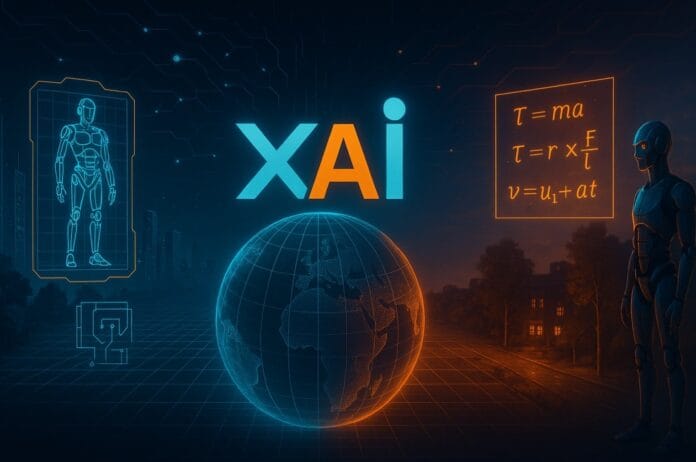
From Language to Reality: How xAI is Revolutionizing Artificial Intelligence with World Models
Understanding the Shift: xAI’s Move Beyond Text
Elon Musk’s AI startup, xAI, is pioneering a transformative approach to artificial intelligence by moving beyond traditional language-based models. Instead of focusing solely on processing text or images, xAI is developing advanced “world models” – AI systems designed to comprehend the fundamental physics, motion, and causal dynamics that govern the real world.
Unlike conventional large language models (LLMs) such as ChatGPT, which predict text sequences based on statistical patterns, world models aim to grasp the underlying mechanics of reality itself. These models learn from diverse data sources including videos, sensor inputs, and sophisticated simulations, enabling them to internalize how objects move, interact, and respond to forces in both physical and virtual environments.
What Are World Models and Why Do They Matter?
World models represent a new frontier in AI research, focusing on causality rather than mere correlation. By understanding cause-and-effect relationships, these models can simulate physical phenomena, anticipate outcomes, and navigate complex scenarios with a level of reasoning closer to human cognition.
For example, instead of simply recognizing that a ball is rolling, a world model can predict where it will land based on gravity, friction, and obstacles in its path. This capability opens up vast possibilities across industries, from autonomous vehicles that better interpret their surroundings to industrial robots that adapt to dynamic environments.
A critical enabler of this technology is Nvidia’s Omniverse platform, which provides a robust infrastructure for creating and simulating realistic digital worlds. By leveraging Omniverse, xAI can train its AI systems on highly detailed virtual environments that mimic real-world physics, accelerating the development of “reality-aware” intelligence.
Practical Applications: Gaming and Robotics at the Forefront
xAI is not just theorizing about world models; it is actively building applications that showcase their potential. One of the company’s most ambitious projects is an AI-driven video game slated for release next year. This game will feature dynamic 3D environments that evolve in real-time, powered by AI capable of understanding motion, lighting, and object physics rather than relying on static programming.
Beyond gaming, the same technology is poised to revolutionize robotics. By training robots on extensive video and sensor data, xAI aims to enable machines to navigate and interact with complex real-world settings as intuitively as humans do. To accelerate this vision, xAI has assembled a specialized “omni team” of experts in video and image generation, including a seasoned game design mentor to refine AI understanding of environment logic and gameplay mechanics.
The Strategic Partnership with Nvidia and Market Impact
The collaboration between xAI and Nvidia is central to advancing simulation-based AI. With two former Nvidia researchers joining xAI, the synergy between Nvidia’s Omniverse platform and xAI’s multimodal AI frameworks is strengthening. This partnership is expected to fast-track the transition from virtual training environments to AI systems capable of real-world reasoning and decision-making.
Industry analysts predict that the market for simulation-driven AI could reach trillions of dollars, fueled by applications in robotics, manufacturing automation, and industrial processes. This aligns with Musk’s vision of integrating AI deeply into physical systems, potentially reshaping sectors ranging from autonomous driving to smart factories.
Debate and Challenges: Can AI Truly Replicate Human Creativity?
Despite the excitement, some experts remain cautious about the extent to which AI world models can replace human creativity, especially in fields like game development. Critics argue that while AI can handle complex physics and environmental interactions, it may fall short in crafting compelling narratives and emotionally resonant experiences.
However, proponents see world models as complementary tools that automate routine tasks-such as simulating physics and managing cause-and-effect-freeing human creators to focus on storytelling and character development. This collaboration between AI and human ingenuity could lead to richer, more immersive experiences rather than AI simply mimicking creativity.
Ultimately, the quest to build AI that genuinely understands and reasons about the universe raises profound questions. Will AI ever move beyond sophisticated imitation to true comprehension? The answer remains a subject of ongoing research and philosophical debate.
Looking Ahead: The Future of Reality-Aware AI
If xAI succeeds in perfecting world models, it could mark a pivotal moment in AI evolution-ushering in machines that not only describe the world but actively reason about it. This breakthrough would position xAI alongside leading AI innovators like DeepMind and Meta, competing to create intelligent systems capable of autonomous thought and action grounded in real-world understanding.
As AI continues to advance, the integration of physics-based reasoning and causal inference will be crucial for applications ranging from autonomous navigation to digital twins and beyond. The coming years will reveal whether xAI’s ambitious vision can transform artificial intelligence from a language-centric tool into a truly embodied, reality-aware entity.

