
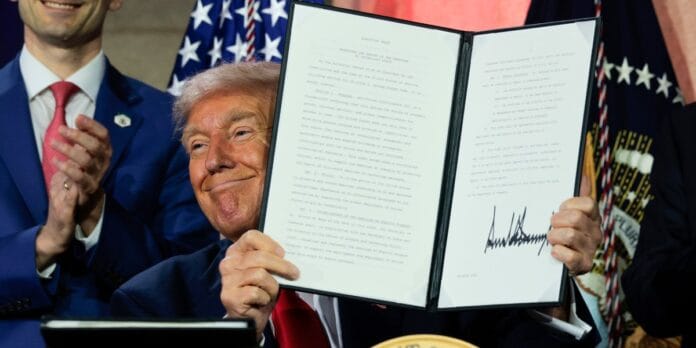
A variety of executive orders and announcements from the White House have painted a vision for America’s AI Future–crushing the competition with China, eradicating “woke” AI models which suppress conservative speech, and launching power-hungry AI Data Centers. Details are scarce.
Last week, the White House released its AI Action Plan. It is intended to correct this. The plan contains many points that are not new and you may have heard about the major ones already. Trump wants to increase the building of data centers through a reduction in environmental regulations, withhold funding for states that pass “burdensome AI regulation” and only contract with AI companies that have models that are “free of top-down ideologic bias.” Here are the three most important issues.
Trump escalates his fight with the Federal Trade Commission.
The Federal Trade Commission is supposed to help Americans who are scammed. As I wrote last weekend, the FTC, under President Biden, increasingly targeted AI companies who overhyped their accuracy, as well deployments of AI that it found to be harmful to consumers.
According to the Trump plan, the FTC will take a new look at all actions taken by the previous administration to eliminate “onerous” regulations that are preventing AI’s growth. The administration could even try to repeal some FTC actions. This would weaken an important AI watchdog agency. But it’s only the latest in a series of escalating attacks by the Trump administration on the FTC. Continue reading my story.
The White House is veryconfident about AI for science.
In the opening of the AI Action Plan, it describes a future in which AI will do everything from “unraveling old scrolls that were once thought to be unreadable” to making advances in science and mathematics.
This type of unbounded enthusiasm about AI for scientific discoveries echoes what technology companies promise. Some of this optimism is grounded in fact: AI’s role predicting protein structure has led to real scientific wins. (And just last week, Google DeepMind launched a new AI designed to help interpret ancient Latin carvings.) The idea that large language model–basically very good text prediction machines — will help improve the accuracy of text is a myth. Act has less merit to date.
The plan shows the Trump administration is willing to give money to labs that are trying to make this a reality. However, it has also worked to reduce the funding provided by the National Science Foundation to human scientists who are now struggling with their research. The White House’s message on deepfakes seems confused
Compared to President Biden’s AI executive orders, the new plan is largely devoid of anything relating to making AI safer.
There is one notable exception, however: a section of the plan that addresses the harms caused by deepfakes. In May, Trump passed legislation to protect the public from sexually explicit deepfakes that are not consented to. This is a growing problem for celebrities as well as everyday people, especially with the advent of generative video. The law was supported by both parties.
The White House is now concerned about the problems deepfakes can pose to the legal system. The White House says that fake evidence could be used by both plaintiffs and defendants to deny justice. It asks for new standards to detect deepfakes and for the Department of Justice create rules. Legal experts that I have spoken to are more concerned about a different issue: Lawyers are adopting AI-based models that make mistakes, such as citing cases which do not exist, and judges may miss this. The action plan does not address this issue.
Also, it’s worth noting that President Trump shared just days before releasing the plan that targets “malicious fakes” a fake AI generated video of former president Barack Obama getting arrested in the Oval Office.
The AI Action Plan confirms what President Trump, and those in his circle, have been signaling for years: AI is the defining political and social weapon of our times. They believe that AI can help them win anything from culture wars and geopolitical conflict. They argue that the right AI will help them defeat China. Government pressure can force leading companies to remove “woke” ideologies from their models.
While the plan includes some crowd-pleasers, such as cracking down on fake news, it also reflects how tech companies have cosyed up to Trump’s administration. The fact that the plan contains almost no provisions that challenge their power shows just how successful their relationship with Trump is. This story was originally published in The Algorithm – our weekly newsletter about AI. Sign up to receive stories like this first in your inbox by clicking here.

