
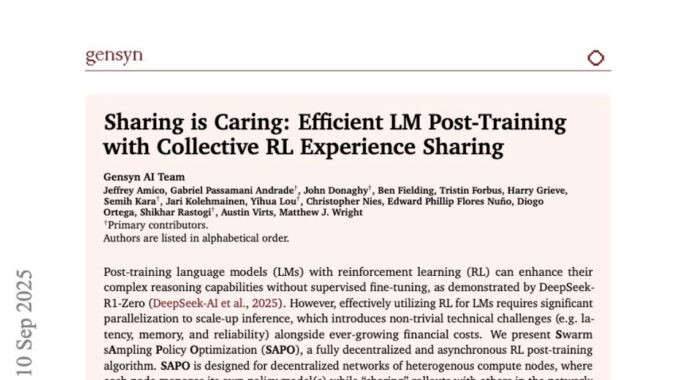
Enhancing language models through reinforcement learning (RL) can significantly boost their reasoning capabilities without relying on supervised fine-tuning, as exemplified by innovations like DeepSeek-R1-Zero. However, scaling RL training presents a major hurdle: it demands extensive centralized infrastructure, which not only creates performance bottlenecks but also escalates operational expenses. Traditional methods depend on synchronized GPU clusters and meticulously engineered systems that are both costly and prone to failure.
Decentralizing Reinforcement Learning: Introducing Swarm Sampling Policy Optimization (SAPO)
The Gensyn AI Team addresses these limitations with a novel approach called Swarm Sampling Policy Optimization (SAPO). Unlike conventional RL frameworks that require centralized control, SAPO empowers a distributed network of heterogeneous compute nodes to collaboratively train models by sharing experiences. Each node independently manages its own policy model and training data, removing the necessity for synchronized weight updates or uniform hardware setups.
Reevaluating RL and Multi-Agent Training Paradigms
Prevailing RL fine-tuning techniques, such as Reinforcement Learning with Human Feedback (RLHF) and Reinforcement Learning from Verified Rewards (RLVR), typically rely on centralized policy updates using algorithms like Proximal Policy Optimization (PPO). While effective, these methods inherently limit scalability due to their dependence on tightly coordinated infrastructure.
In response, multi-agent training strategies have gained traction, focusing on three core principles: collaborative debate (where multiple agents iteratively refine outputs through interaction), role specialization (assigning distinct functions to different agents), and autonomous self-improvement (leveraging bootstrapped reasoning). Although promising, these approaches often still require orchestrated synchronization, which can hinder flexibility and scalability.
SAPO offers a fresh perspective by combining the trial-and-error reward optimization of traditional RL with the distributed nature of multi-agent systems-without the overhead of synchronized policy updates or centralized rollout generation. By enabling nodes to exchange experiences asynchronously across a decentralized network, SAPO harnesses the advantages of multi-agent collaboration while minimizing coordination complexity.
Inside the SAPO Mechanism: Decentralized Collaborative Learning
At its core, SAPO functions through a decentralized swarm of nodes that independently generate and share rollout data over discrete time intervals. Each node maintains its own verifiable task dataset and policy model, allowing it to produce responses autonomously. A critical aspect of this framework is that tasks must be verifiable-meaning their outcomes can be algorithmically validated for accuracy, ensuring reliable feedback for reinforcement learning.
This decentralized architecture not only enhances scalability by leveraging diverse and distributed computational resources but also increases robustness by eliminating single points of failure common in centralized systems. For example, in a network of edge devices or geographically dispersed servers, SAPO can facilitate continuous model improvement without the need for expensive, tightly coupled hardware clusters.
Expanding Horizons: Practical Implications and Future Directions
With the growing demand for scalable AI training solutions, SAPO’s decentralized approach aligns well with emerging trends in distributed computing and federated learning. Recent studies indicate that decentralized RL frameworks can reduce training costs by up to 40% while maintaining or improving model performance compared to centralized baselines.
Moreover, SAPO’s reliance on verifiable tasks opens avenues for applications in domains requiring high reliability, such as autonomous systems, financial modeling, and healthcare diagnostics. By enabling models to learn collaboratively across diverse environments without centralized oversight, SAPO paves the way for more resilient and adaptable AI systems.

