
What Big Tech’s Band of Execs will Do in the Army (19459000)
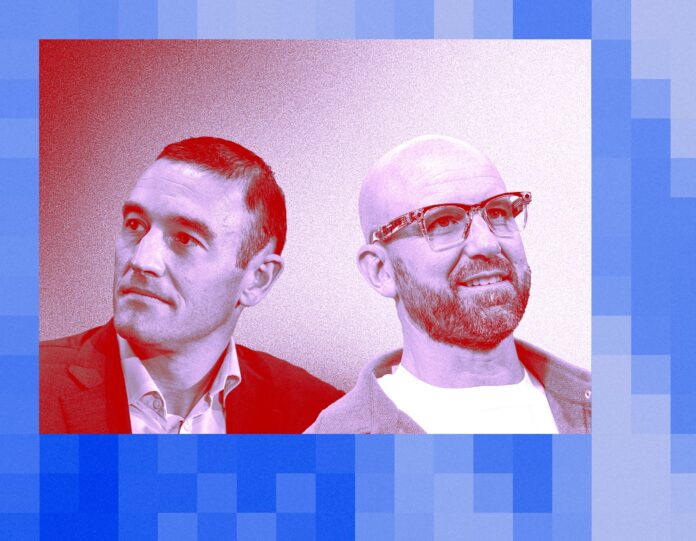
I read I questioned the veracity of a tweet that four notable Silicon Valley executives, including Meta CTO Andrew “Boz” Bosworth, were inducted into a United States Army Reserve special detachment. In 2025, it’s hard to tell the difference between satire and truth. This is partly due to social media sites that Bosworth’s firm owns. It was indeed true. According to an Official press releasestates that they are now in the Army, specifically Detachment: the Executive Innovation Corps. Boz is now lieutenant colonel Bosworth.
Kevin Weil is OpenAI’s Head of Product; Bob McGrew is a former OpenAI Head of Research now advising Mira Murati’s company. Thinking Machines Lab (19459117) ; and Shyam, the CTO at Palantir. These middle-aged tech executives were sworn in wearing camo fatigues as if they had just wandered from some Army base near Kandahar to join a corps named after an HTTP Status Code. Colonel David Butler, the communications adviser to Army chief of Staff, told me that their dress uniforms were not yet ready. In a press statement, the Army stated that Detachment is part of an initiative to transform the military. This initiative “aims to make it leaner and smarter while also making the force more lethal.”
Photo: Leroy Council/DVIDS.
This is not Donald Trump’s fault. The program has been under development for more than a year. It was the brainchild Brynt parsmeteris the first chief talent officer at the Pentagon. Parmeter, who was a combat veteran and headed veteran support at Walmart, before joining the Department of Defense 2023, was pondering ways to bring in experienced technologists to update a militia that wasn’t tech-savvy enough when he met Sankar during a conference in early last year. He says the idea was to create an “Oppenheimer-like” situation where senior executives can serve immediately, while maintaining their current jobs.
The two men worked together on a plan that would bring in people such as Sankar, a vocal supporter of the Valley’s recent embracement of the military and proclaiming the US to be in ” The Wall Street Journal reported that the United States is in an “undeclared state of emergencies” which requires a military overhaul based on technology. When The Wall Street Journal Sankar, who wrote aboutthis upcoming program last October, vowed to “be first in line.”
As a sign that the Valley is no longer afraid to admit that its creations are linked to boosting deadly force within the military, the programme was fast-tracked, and it’s now in operation. Weil told us that ten years ago, this would have probably gotten him canceled. “It is a much more positive world when people see this and say, ‘Oh wow, that’s important.’ Freedom is not free. They will not have to go through basic training like other reservists. However, they will receive less intensive fitness and shooting training. The reservists will also be able to work remotely for some of their 120 hours per year, which is a benefit not available to other reservists.
According to the Army, these men won’t be sent into battle, and therefore, they won’t be risking their life in potential theaters in Iran, Greenland or downtown Los Angeles. Their mission is to use this undeniable experience to educate their superiors and colleagues in the military about how to best utilize cutting-edge technology for efficiency. Deadly force
One would assume that the Army would have conducted a thorough study of the specific talent required for this pilot programme and selected the best candidates from an open call. This did not happen. Sankar recruited the other three future officers, all of whom were male. This by coincidence or intention seems to satisfy the Anti-dei Bentof today’s military–and they all accepted. According to Butler, “Lieutenant colonel Sankar said ‘I want to wear the uniform. And I have three other guys willing to go with me.'” Weil confirms that he joined after a request from Sankar. (Parmeter said to me that since this is a pilot program with an unknown outcome, a closed process was appropriate.)
Clearly, the four new officers genuinely want to serve their country. Weil, who I’ve known for years, told me that when Sankar explained the program, “I was just like, ‘Yes, I want to help–that sounds amazing.'” But during a wave of widespread unease over privileges of tech elite–did you see those disgusting billionaire bros on that show Mountainhead?–special arrangements for well-off digital achievers seems tone-deaf.
My big question is whether these men could have provided the same assistance from the private sector. Parmeter and Butler both cited precedent of cases where top executives were directly commissioned, including a top railway executive in 1917, the head of a gas and electric company in 1944 and the General Motors Company presidentin 1942. But those were full-time roles during world wars. Parmeter also reminded me that many currently serving reservists are already in the tech industry, including, he claimed, some generals at Google(!). Presumably none of them, however, began their military careers as senior officers, and they presumably do not receive special dispensation to perform some of their service from home.
Another program, the Defense Digital Service gives tech workers a chance to lend expertise to the Pentagon full time for up to two years. What’s more, Parmeter conceded that the military already has a trusted adviser program, where civilians could work part or full time on projects. “That’s obviously still going on, and that’s something that is useful,” he says. “But in this case, we wanted to go beyond that.”
The Army says that there is no conflict of interest in having these privately employed officers provide advice on high-tech subjects. They will have no say in what contracts the Army makes with the private sector. The expertise they offer, however, seems inseparable from the sectors of AI, VR, and data mining at the center of their companies’ business models. Maybe it’s just bad timing, but the month before Bosworth was sworn in, Meta announced a dealwith Anduril, a defense contractor cofounded by former fired employee Palmer Luckey, to pursue military contracts.
Around the time lieutenant colonel Weil raised a hand beside Boz, OpenAI announced a $200 million defense contract : it’s also working with Anduril to develop an air defense system. Sankar’s employer Palantir has billions of dollars worth of government deals, including a $759 million Army contractfor advanced AI systems. (Thinking Machines Lab, which McGrew advises, is still in semi-stealth, so there’s no news of its plans for military contracts.) Also, while these soldiers are serving in a personal capacity, their employers will undoubtedly benefit from the inside-the-perimeter knowledge that they will gather while simultaneously working on military contracts.
Lieutenant Kevin Weil, OpenAI’s head of product and Army Chief of Staff Gen. Randy A. George
Photograph: Leroy Council/DVIDS
OK, so what will they do? Parmeter provides a hypothetical scenario: the commander of the Indo-Pacific region is figuring out how to address threats in the Far East over the next five to 10 years. They might ask Detachment 201 to tell them how the future state of machine learning and AI would affect security in that context. Or, the new officers might operate more tactically, advising how soldiers could use new tools to understand battlefield conditions.
This kind of sounds like … consulting. Weil argues, however, that advice coming from an actual officer would be more seriously heeded: “There’s nothing wrong with being a contractor,” he says. “But if we’re off supporting an exercise somewhere, it’s different that we’re wearing the same uniform, having taken the same oath.”
A more serious consequence might come from these men having dual loyalty when setting policy at their private companies. Companies like Meta, Open AI, and Thinking Machines Lab are helping create superintelligence that could profoundly impact the world. OpenAI is among those companies that prohibit their models from being used to harm others, and that includes developing weapons. But the mission of the US military is exactly the opposite. Working inside the Army, these recruits are explicitly charged with making the technologies more lethal–in fact, in a hearing this very week Army secretary Daniel P. Driscoll told senators that the Army Transformation Initiative, which involves Detachment 201, will eliminate programs that do not contribute to lethality.
Who will these officers be serving when they make those determinations? (Weil emphatically tells me that his service is a personal matter, and in any case there are plenty of uses for AI in the military that don’t involve killing.) When I brought this issue up to Parmeter, he said that when determining the direction of future AI at their companies, the officers’ wider perspective would be a plus. Then again, Parmeter did mention Oppenheimer, who created the atom bomb.
Bottom line: Sankar, Bosworth, Weil, and McGrew are soldiers now, even if critics are already accusing them of being rich tech bros cosplaying the real thing. Considering the optics, they would do well to avoid any chest-thumping. Weil displayed humility when I spoke to him. But an op-ed Sankar wrote in the Free Pressto explain his motives hit a sour note. Though much of it set out the benefits of a private tech industry in sync with the military, and his family’s inspiring American immigrant story (which might not have happened under current Trump policies), he veered into self-aggrandizement. “None of these men need to pad their resume,” he wrote of his Detachment 201 blood brothers and, by implication, himself. “None have free time between fatherhood, demanding day jobs, and a dozen other demands. But all feel called to serve.”
Forgive me for thinking that their sacrifices rank in the bottom rung of what the vast majority of soldiers experience. In our conversation, Weil, again, was humble about becoming an instant senior officer, a rank given to reflect his achievements in private life. “I’m still a little bit sensitive to the title, because there’s so many people that have given their lives or spent their lives dedicated to this,” he told me. “So I want to earn the title.”
I have no idea how their Army-mates will regard them, but all who hold lower ranks, including life-long soldiers and veterans of combat, will be required to salute the Detachment 201 lieutenant colonels on sight. According to Butler, these overnight officers haven’t yet mastered the art of crisply returning those salutes. “They’ve got a bit of work to do,” he told me.
Time Travel
Weil is correct when he says that a decade ago, Silicon Valley would have condemned him for accepting his post. He was working for Facebook as Instagram’s head of product during the time that Luckey was tossed out of the company for supporting Donald Trump and lavishingly expressing his fondness for the military. In my book Facebook: The Inside Story I describe how in 2016 Palmer Luckey alienated Mark Zuckerberg and the Facebook workforce–by acting like Zuckerberg would act in 2025. All is copacetic now as the two are partners in developing VR technology for today’s military.
Luckey was a political conservative, supporting the right wing with the same enthusiasm he devoted to fast food, cosplay photos with his girlfriend, and soldering artisanal computer peripherals. He was a huge admirer of the military. [Brendan] Iribe [cofounder of Oculus] remembers that he once got a call saying Luckey had driven a tank on the Facebook campus. The police had been called. The vehicle was Luckey’s Humvee, repurposed from military service with toy machine guns attached to the postings. [The orange-colored guns were clearly not operational.] To Facebook’s workers though, it might as well have been a nuclear bomb. Luckey defused the situation and wound up posing for pictures with the cops, but the incident was a black mark on his record. “Here at Facebook, you can’t drive Humvees with guns–military vehicles–onto the lot and have the police show up,” says Iribe. “That’s not what we’re focused on here.”
Ask Me One Thing
Madhu on Bluesky asks, “If all of us adopted AI to write our medical clinic notes, how will that impact our carbon footprint?”
Thanks for the question, Madhu. You are correct in implying that AI large language models consume considerable electricity. Writing medical clinic notes probably isn’t the biggest worry, though. The actual numbers are fuzzy, maybe intentionally. But according to Nature, for a chatbot to find something, it consumes 23 to 30 times the energy of a Google search. And it’s going to get worse.
For instance, consider AI agents, which nearly everyone agrees are the next step for LLMs. I recently learned that compared to simple prompts and outputs, tasks where LLMs essentially query the world to fulfill and verify people’s requests have jaw-droppingly higher power demands. Nvidia CEO Jensen Huang has estimated that reasoning-based agentic AI will require 100 times the computation, and thus the power consumption, of the current paradigm. As you suspect, this will not be great for the environment.
Submit your questions in the comments below, or send an email to [email protected]. Write ASK LEVY in the subject line.
End Times Chronicle
In a “__S.148__ __S.149__ __S.150__ __S.151__ __S.152__

