
Published: 25 November 2025
Estimated Reading Time: 4 minutes
Unitree G1 Robot Masters Real-World Basketball Layup with Advanced AI
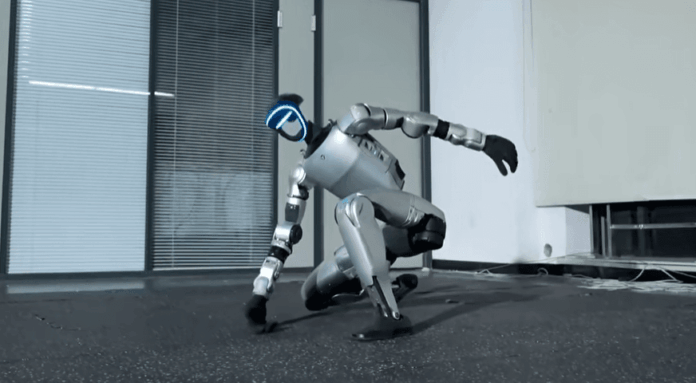
In a pioneering achievement, researchers at the Hong Kong University of Science and Technology (HKUST) have demonstrated the first-ever real-world basketball layup performed by a humanoid robot. The 1.3-meter tall Unitree G1, affectionately named “Little Potato,” successfully executed a fluid three-step layup, showcasing a significant leap in robotic athleticism.
While the robot is not yet ready to compete professionally, this milestone hints at a near future where robots could participate in grassroots basketball leagues across China, such as the popular “Village Basketball” tournaments.
Innovative Imitation Learning Frameworks Powering Robotic Basketball
This breakthrough builds upon HKUST’s cutting-edge research in imitation learning and physics-based control, enabling robots to acquire complex basketball maneuvers from imperfect real-world data. Although full technical details remain forthcoming, the demonstration leverages advancements from their recent publications.
SkillMimic-V2: Overcoming Challenges in Learning from Noisy Demonstrations
At the core of this progress lies SkillMimic-V2, a novel approach accepted at SIGGRAPH 2025, which addresses the inherent difficulties in reinforcement learning from demonstrations (RLfD). Real-world motion data often suffers from sparsity, noise, and incomplete coverage of skill transitions, limiting traditional learning methods.
SkillMimic-V2 introduces three key innovations:
- Stitched Trajectory Graph (STG): This technique links similar states across different skill trajectories, such as dribbling and layup, creating a connected graph that enables the robot to transition smoothly between skills even when such transitions were absent in the original data.
- State Transition Field (STF): Instead of training from fixed points, the robot begins from randomly sampled nearby states, with masked intermediate states acting as buffers. This encourages the policy to develop robust recovery behaviors.
- Adaptive Trajectory Sampling (ATS): By prioritizing more challenging trajectory segments during training, the system reduces failure chains and enhances overall skill robustness.
These methods collectively allow the robot to perform continuous, recoverable basketball actions despite noisy and sparse input data. In simulation environments like Isaac Gym, the robot demonstrated the ability to complete layups under disturbances and transition seamlessly between dribbling and shooting.
Compared to the original SkillMimic, SkillMimic-V2 improved layup success rates dramatically-from 0% to 91.5%-and increased transition success rates from 2.1% to 94.9%.
SkillMimic: A Foundation for Hierarchical Learning of Basketball Skills
The predecessor, SkillMimic, recognized as a CVPR 2025 Highlight, introduced a unified imitation-reward system and a hierarchical learning framework. This architecture enabled robots to master a variety of human-object interaction (HOI) skills, including basketball-specific actions like dribbling, shooting, and layups.
Key features of SkillMimic include:
- A single imitation reward function that eliminates the need for manually designed, skill-specific rewards.
- A hierarchical policy structure where low-level controllers learn individual skills, while a high-level planner sequences these skills for complex tasks.
- Extensive datasets (BallPlay-V and BallPlay-M) containing approximately 35 minutes of real basketball interaction data, enabling realistic training.
SkillMimic outperformed previous methods like DeepMimic and Adversarial Motion Priors (AMP), achieving higher success rates and supporting long-duration control tasks such as dribbling around obstacles and chaining multiple basketball moves.
PhysHOI: Early Simulation-Based Learning of Dynamic Human-Object Interactions
Tracing back to 2023, the PhysHOI framework laid the groundwork for these advancements by focusing on physics-based imitation learning of dynamic human-object interactions. This approach fed both the current simulated state and reference demonstration into a policy network, which then generated actions executed within a physics simulator.
Optimization was guided by a combination of kinematic and contact-grasp rewards, encouraging the robot to replicate demonstrated behaviors accurately. PhysHOI demonstrated robustness in basketball manipulation tasks, even when ball sizes varied, setting the stage for subsequent real-world applications.
Meet the Lead Researcher: Yinhui Wang
Driving this rapid progress is Yinhui Wang, a second-year PhD candidate at HKUST under Professor Peng Tan. Wang, often dubbed “the world’s top basketball robotics researcher,” has a rich academic background including studies at Peking University and Xi’an Electronic Science and Technology University, alongside internships at IDEA Research, Unitree Robotics, and Shanghai AI Lab.
From initial simulation experiments in 2023 to real-world demonstrations in 2025, Wang’s work exemplifies the accelerating pace of innovation in robotic sports. With hardware like the Unitree G1 evolving swiftly, the gap between research prototypes and practical robotic athletes is closing faster than ever.

