
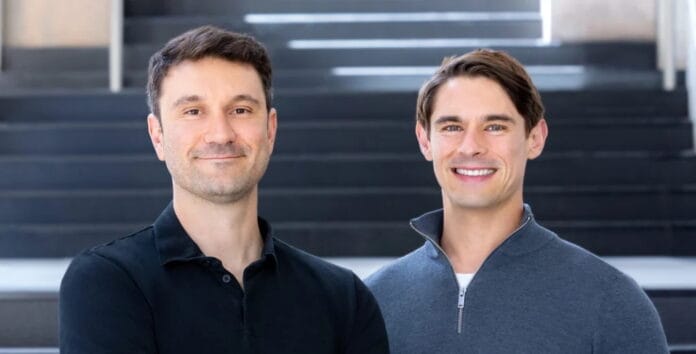
Last month, Periodic Labs, the new startup founded by Liam Fedus – one of OpenAI’s most respected researchers – and Ekin Dogus Cuuk, his former Google Brain coworker, emerged from stealth with a $300 million seed funding round. The round was led by Andreessen Hoowitz with Felicis cutting in the first check, and included a Who’s Who of angels and top VCs.
The company was founded when Fedus and Cubuk (whose friends called him Dogus) had a conversation about seven months ago. Cubuk was a leading machine learning and materials science researcher at Google Brain. After hearing endless Silicon Valley take on how generative AI could radically change the scientific discovery process, they decided to finally make it a reality. Or at least, to start a startup that tried it.
According to Cubuk, “there are a few things in the LLM area, in experimental science, and in simulations which made this a good time,” he told TechCrunch.
He said that robotic arms capable of handling powder synthesis – the process of mixing new materials and creating them – had recently proven to be reliable. Machine learning simulations have become accurate and efficient enough to model complex systems, such as those required to create new materials.
Third, LLMs have powerful reasoning abilities, thanks in part to the work of Fedus at OpenAI and his team. Fedus was part of the original team that created ChatGPT and ran OpenAI’s post-training team. This team refines models once they have been developed.
The picture was clear when it was stitched together: A simulation could theoretically find new compounds, a robotic arm could mix materials, and a LLM could analyze and suggest course corrections. AI-automated materials science was ready to build. In 2023, Cubuk was a researcher of the The “GNoME”a groundbreaking paper that outlines a model for training to discover new materials. He was also a researcher who October 27-29, 2025
Equally importantly, the founders realized that even failed experiments would be valuable for their new startup because data is the lifeblood of AI. AI science provided a new source of real-world data for training and post-training. The founders believe that this could turn the existing motivation system upside down, rewarding success over exploration and rewarding paper publication through grants.
Fedus told TechCrunch that “making contact with reality and bringing experiments into [AI] the loop — we feel this is the next Frontier”.
Felicis wins deal; OpenAI doesn’t invest
Fedus, after his discussion with Cubuk and the OpenAI leadership, went to them to share his resignation as well as his plan. He then gleefully Tweeted the world that he would be leaving with what seemed to be OpenAI’s blessing and investment.
I sent this to my colleagues at OpenAI.
Hello all, I’ve made the difficult decision of leaving OpenAI as an employer, but I look forward to working closely with you as a future partner. Working with world-class teams and contributing to the mission of OpenAI to create and… The founders of Periodic confirmed to TechCrunch that OpenAI was not a supporter of Periodic. Fedus refused to explain why they didn’t want OpenAI’s funding.
Fedus’ tweet sparked a frenzy among VCs to court the company. “It was almost as if I were being reverse-pitched. Fedus laughed and explained that neither he or Cubuk “knew how to make it.” Other investors sent multi-page documents to pitch themselves.
However, the first call they received was from Peter Deng. He is a former OpenAI co-worker who has become an investor at top seed firm Felicis. (Deng left OpenAI to join Felicis in 2025. Deng told TechCrunch that Liam is a big deal at OpenAI. He’s well-loved and a researcher who has impacted the field a lot. “When I heard that he had left, I immediately texted him.”
Deng and Fedus met for coffee in San Francisco’s Noe Valley neighborhood. Fedus, fueled by caffeine and enthusiasm for the conversation, invited Deng to continue their discussion on a walk through the area’s famedly hilly terrain. Pitch walks are a Silicon Valley cliché, but they do happen.
It was a hot day. Deng, in a sweater, sweated, and scrambled, trying to keep up with Fedus’s fit and friendly founder, until the Fedus founder said something which “literally stopped my tracks”Deng told TechCrunch. Deng recalled that he told Deng, “Everyone talks about science, but to do it, you have to actually do it.”
They needed to give AI an fully equipped wet laboratory to test its ideas in real-world, controlled settings.
The truth about these models, is that they know everything within the normal distribution. Deng said that we can take a lot of data and it will just regurgitate the information it has.
Testing hypotheses is a necessary part of discovering something new. Deng recalls: “I wrote the check on the spot in the middle of Noe Valley’s hills.”
Fedus remembers when Deng asked him how he could get involved. Fedus told Deng that the startup needed money for laptops and temporary offices. “He’s like, great. I’ll give it to you right now.” It was just a huge vote of confidence.
Deng didn’t pull out his checkbook in the street. He returned to the office, elated by the deal. However, Felicis’ attorney informed him that the company was not yet incorporated and therefore could not sign a contract. It didn’t have a name or a bank account, let alone a way to transfer funds. Deng grinned.
They had all those things and as many term sheets as they could handle. Cubuk and Fedus used the $300 million to hire over two dozen of the best AI and scientific talent, including Alexandre Passos, the creator of o1 & o3, Eric Toberer, a materials scientist with key superconductor discoveries, and Matt Horton who created two of Microsoft’s GenAI Materials Science tools. The list goes on
Since the team members are experts in different fields, from AI to Physics, each of them gives a graduate-level lecture every week to the other members. Cubuk said, “We feel that a tight coupling of the team is extremely important.” He wants everyone to be able to understand everything they are building.
Periodic Labs, has also set up their lab and is working on experimental data, simulations, and testing some predictions. The initial mission is to discover new superconductor material, which could be a goldmine discovery. Superconductors that are more efficient could power the next generation of powerful, but less energy-consuming technology.
However, the robots are still not up and running. Cubuk said that it would take some time to train the robots.
This is all a big gamble. Whether or not it is powered by AI, scientific discovery can be slow, difficult, and unpredictable. There are no guarantees that this team of experts will find the results they’re looking for, or make other discoveries on the way.
We know that model makers are moving towards more AI science. OpenAI VP Kevin Weil announced last month that he would be launching a unit called OpenAI for Science to “build the next greatest scientific instrument: An AI-powered platform which accelerates scientific discoveries.”
The investor who wrote the “love letter” didn’t get the deal, although Fedus said that it was “very flattering.” Other seed investors included DST, Nvidia’s venture capital arm NVentures and Accel, as well as angel backers such Jeff Bezo Elad Gil is scheduled to speak about how AI has transformed the startup landscape on October 29 at Disrupt, San Francisco.Correction: This article has been updated to reflect the new lead of the seed funding round, and to include Cubuk’s groundbreaking research paper on materials science.

