
By 2025, Voice AI Agents have reached a pivotal milestone, showcasing unprecedented advancements in natural language fluency, contextual understanding, and widespread commercial integration. Fueled by breakthroughs in speech recognition, natural language processing, and multimodal data fusion, Voice AI has evolved far beyond simple command-response tools. It now serves as a fundamental interface for human-computer interaction, streamlining business workflows, enhancing medical diagnostics, and even providing emotional support.
Rapid Market Expansion and Industry Penetration
The Voice AI ecosystem is witnessing remarkable growth, with the global market expected to surge significantly by 2034, driven by a robust compound annual growth rate (CAGR). The intelligent virtual assistant sector alone is forecasted to reach substantial market value. North America currently dominates, holding over 40% of the market share, yet adoption is accelerating worldwide across all continents.
Enterprise sectors are key drivers of this expansion. The Banking, Financial Services, and Insurance (BFSI) industry leads adoption, followed closely by healthcare and retail. Notably, the healthcare voice AI segment is expanding rapidly, with a CAGR surpassing many other verticals. Retail voice AI is also growing swiftly, projected to increase at a 31.5% CAGR through 2030.
On the consumer front, voice assistant usage has reached record levels, with hundreds of millions of active users globally engaging regularly. Smartphones remain the primary platform, with over 90% of users preferring mobile applications for voice interactions. Recent surveys indicate that a majority of users acknowledge AI’s transformative impact on their everyday routines.
Cutting-Edge Technological Innovations
Speech-to-Speech Processing and Real-Time Conversational AI
A groundbreaking development in Voice AI is the rise of speech-native architectures that process audio inputs directly, eliminating the need for traditional multi-step pipelines. These models achieve ultra-low latency-often under 300 milliseconds-enabling fluid, natural conversations with AI agents. Platforms such as OpenAI’s GPT-realtime now support seamless language switching mid-dialogue, sophisticated instruction adherence, and nuanced emotional expression, setting new standards for conversational AI performance.
Real-time conversational AI is rapidly replacing scripted chatbots across industries. Emerging applications include intelligent meeting assistants capable of transcribing, translating, moderating, and summarizing discussions with contextual awareness, enhancing productivity and collaboration.
Integration of Multimodal Inputs
Voice AI has transcended single-modality limitations by integrating speech with text, images, and video inputs. Leading-edge systems like Google’s Gemini 1.5 and OpenAI’s GPT-4o exemplify this trend, enabling simultaneous processing of voice, visual, and tactile data. This multimodal approach powers smarter smart homes, immersive AR/VR experiences, and advanced automotive interfaces where voice commands, gestures, and eye tracking operate in harmony.
Emotional Intelligence and Voice-Based Health Diagnostics
Modern Voice AI systems are increasingly adept at recognizing emotional states such as stress, sarcasm, and subtle mood shifts through vocal patterns. Emotionally aware virtual assistants can tailor responses or escalate issues to human agents, significantly improving customer satisfaction and operational efficiency.
Voice biomarkers are revolutionizing healthcare by enabling early detection of conditions like Parkinson’s disease, Alzheimer’s, cardiovascular ailments, and even COVID-19 through voice analysis-often before physical symptoms appear. This innovation is driving new frontiers in remote health monitoring, telemedicine, and clinical research.
Privacy-Centric On-Device Processing
Heightened privacy concerns and stringent regulations have accelerated the adoption of on-device voice processing. Edge computing solutions such as Picovoice and experimental frameworks like Kirigami facilitate speech recognition and biometric analysis directly on user devices, enhancing response times and safeguarding personal data. Given that voice data is classified as sensitive personal information under regulations like GDPR, these privacy-first approaches are critical for compliance and user trust.
Multilingual Capabilities and Dynamic Code-Switching
Top-tier Voice AI platforms now support over 100 languages, with projects like Meta’s Massively Multilingual Speech (MMS) covering more than 1,100 languages. Real-time translation technologies offer near-human accuracy across 70+ languages. The ability to fluidly switch between languages within a single conversation-known as code-switching-has become a standard feature, catering to the needs of global, multilingual users.
Addressing Deepfake Risks, Compliance, and Ethical Standards
The surge in voice synthesis and cloning technologies, exemplified by companies like ElevenLabs, has heightened concerns over voice deepfakes. Advanced detection mechanisms now analyze acoustic fingerprints, behavioral patterns, and digital traces to differentiate genuine speech from synthetic imitations.
The regulatory environment is evolving swiftly, with GDPR and other frameworks imposing strict requirements on consent, data protection, and transparency. Ethical AI guidelines are being developed to tackle challenges related to bias, accountability, and fairness, especially in sensitive sectors such as healthcare and finance.
Key Players Shaping the Voice AI Landscape
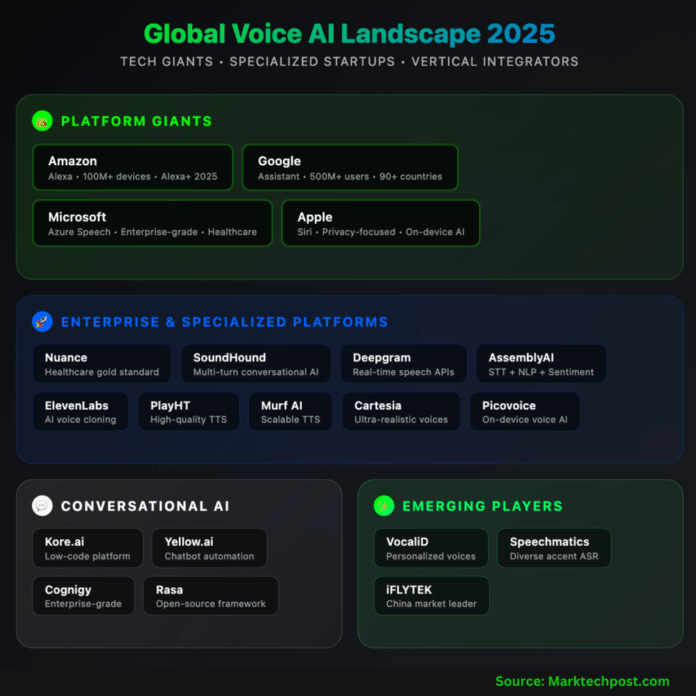
The Voice AI market comprises a diverse array of technology leaders, innovative startups, and specialized providers. Below is an overview of prominent contributors as of 2025:
Major Technology Corporations
- Amazon: Alexa remains the largest voice AI platform globally, embedded in hundreds of millions of devices and deeply integrated with e-commerce and smart home systems. The 2025 launch of Alexa+ introduced enhanced conversational and autonomous agent features.
- Google: Google Assistant serves over 500 million users across more than 90 countries. Google Cloud Text-to-Speech offers a vast library of 380+ voices in 50+ languages. Gemini AI underpins real-time translation and multimodal user experiences.
- Microsoft: Azure Speech delivers enterprise-grade speech recognition, synthesis, and live translation, with strong ties to productivity suites and healthcare applications.
- Apple: Siri continues to prioritize privacy with on-device processing, expanding its contextual understanding and seamless integration within the Apple ecosystem.
Enterprise-Focused and Niche Platforms
- Nuance (Microsoft): Renowned for healthcare and enterprise speech recognition, particularly in clinical documentation and customer service automation.
- SoundHound: Specializes in multi-turn conversational AI for automotive, hospitality, and retail sectors through its Houndify platform.
- Deepgram: Provides real-time speech recognition APIs tailored for contact centers, media, and conversational AI applications.
- AssemblyAI: Offers speech-to-text, natural language processing, and sentiment analysis services for developers and enterprises.
- ElevenLabs: A leader in AI-driven voice cloning and synthesis for entertainment, gaming, and audiobook production.
- PlayHT and Murf AI: Deliver scalable, high-fidelity text-to-speech solutions for content creators, educators, and businesses.
- Cartesia: Focuses on ultra-realistic, low-latency voice generation optimized for real-time interactions.
- Picovoice: Provides on-device voice AI solutions for IoT and privacy-sensitive use cases.
Conversational AI Development Platforms
- Kore.ai, Yellow.ai, Cognigy, Rasa: These platforms offer low-code, enterprise-grade conversational AI tools for building chatbots, voice bots, and automating customer service workflows.
Emerging Innovators and Specialized Providers
- VocaliD (Veritone): Creates personalized synthetic voices for individuals with speech impairments and unique brand identities.
- Speechmatics: Develops automatic speech recognition technology optimized for diverse accents and demographic groups.
- iFLYTEK: China’s leading speech recognition and synthesis company, with a strong domestic market presence.
Final Thoughts
In 2025, Voice AI has transitioned from a supplementary feature to an essential pillar underpinning global business operations, healthcare innovation, entertainment, and everyday life. The fusion of speech-native processing, multimodal integration, emotional intelligence, privacy-first design, and multilingual support heralds a new era of seamless human-machine communication.
Both established tech giants and agile startups are propelling this transformation, each carving out distinct roles within a rapidly evolving ecosystem. Enterprise adoption is delivering tangible returns, while consumer expectations continue to rise alongside technological capabilities. Although regulatory and ethical challenges persist, the potential for Voice AI to positively impact society has never been greater.

