
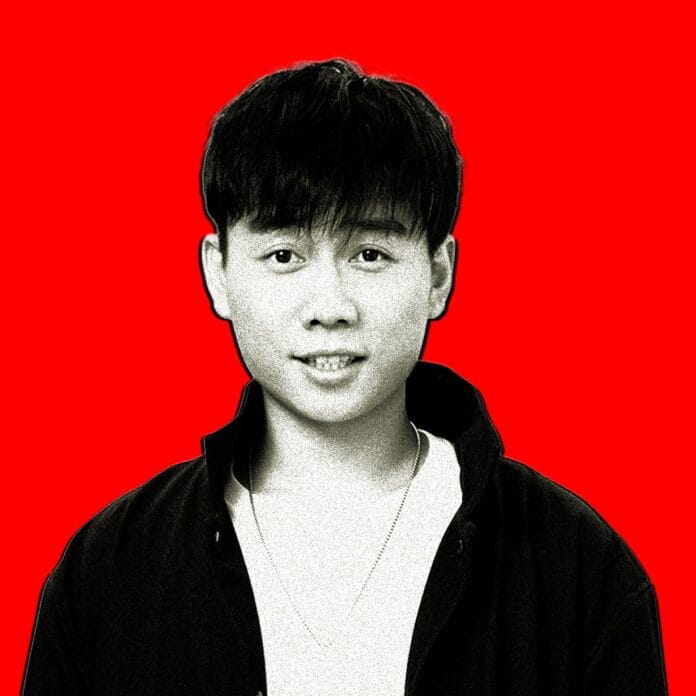
Our terminally Online readers probably have seen This videowas originally posted on Chinese social media. Two guys who at first appear to be about to have a fistfight, suddenly break into a romantic yet robotic tango routine. Next, they appear with a bowl of noodle soup and a wineglass. It looks like it was generated by AI but it’s not. It’s 100% human intelligence.
When I spoke to Tianran, the 29-year old Chinese creator of the video (he is the one holding noodles), he said that he had no idea how far his AI-impersonation sketch had traveled. Two users who shared the video on X received over 11 million views. Other reposts received tens or thousands of likes across Reddit, TikTok and Instagram. Mu, who does not have a presence on any of these social media platforms, knew little about His virality outside China had never been interviewed by the international media.
Tianran’s video “AI: He’s using all of my lines!”
Mu has not been the only comedian to try and imitate the style AI-generated videos. But he nails all the elements: the clumsy body movements, the spaced out facial expressions, and even the unpredictable plot development. I was one of the many viewers who were shocked by how accurately he captured AI slop videos.
Mu told me that the half dozen AI imitation videos he filmed are only a small portion of his acting career. He wanted to be an actress since college, and spent the summer following his freshman year at Hengdian World Studios – the world’s largest movie studio – looking for background acting opportunities. He began making comedy sketches for Chinese social media in 2019. Content creation now occupies most of his time.
His AI imitation videos were so successful that a Chinese generative AI firm offered him a sponsorship contract. They paid him 80,000 RMB ($11,000) for two more sketches to promote the company’s video. Mu’s global virality should have led to more opportunities.
Mu shot two versions for the sponsorship. One with AI-generated footage, and one without. He secretly hoped that the advertiser chose the latter because it puts human acting skills in the spotlight. But the advertiser selected the AI-based version. “That feels like it is starting to steal jobs away from human actors, don’t you think?” Mu says.
Mu appeared on my timeline last week again when he released A sequel of his first AI imitation series. This time, he mimics the videos created by Sora – OpenAI’s newest generative video tool. His new video, while more subtle, still manages that unsettling feeling that has endured despite the advancement of AI videos.
Mu claims that AI is accelerating and there’s a constant battle, but it isn’t man versus machine. The battle is between humans who create AI models and other humans, and both sides are constantly trying to outdo each other. “We’re making fun of AI’s flaws and eerieness, but AI creators probably are improving them too.” Mu says that this year’s AI is already looking more human.
Act like AI
Mu studied AI slop videos before he made his AI imitation sketch. He wanted to know what mistakes AI makes and then recreate them in his scripts.
AI can often misunderstand the purpose of an object in a frame. A hanger is used to hang clothes but it is also the weapon of choice for Chinese parents who physically punish their kids. This dual use inspired Another video of Mu’s last year shows him pretending to hit the boy with a hanger when the boy’s shorts suddenly come off. Mu looks as if he forgot what he was doing and decided instead to hang the shorts up.
Tianran’s video. Please view with discretion.
Another issue that is common in AI-generated videos, is the lack of consistency. Objects change shape and humans change their appearance or outfits. Many people didn’t notice that in Mu’s most watched video, two actors played the same character to mimic that same inconsistency. All of Mu’s videos are acted by his college friends. They are working full-time but are willing to return to Mu’s sketches.
The strange expressions of people’s faces are perhaps the most unsettling aspect of many AI generated videos. I saw many people commenting how Mu mastered his empty focus of eyes. He confirms that this is another observation he made, after watching a lot of AI slop. “The AI’s eye tends to wander. One moment it looks here, and the next it looks there. He says that he might be looking somewhere else when he is talking to you. “It’s just unnatural. So act unnatural.”
Tianran’s video “When AI imitates human, humans must imitate AI back!”.
OpenAI released Sora late last month, a social media application that allows users create and share short AI Videos. Mu says he found it difficult to find flaws in the clips that people made with Sora. However, he still managed to find a few. In addition to the wandering gazes and inconsistencies in the timeline, Sora’s human characters often laugh exaggeratedly, in an off-putting manner, with their hair frantically shaking in the air. Mu mimicked that laugh in his new video released last week and it struck a chord once again with his Chinese fans.
Mu said he has no immediate plans to create another Sora impersonation, partly because the video quality is so high that it’s almost impossible to make parodies. “By the end of next year, there may be nothing left to mimic.” “If I tried to act it, I would just be acting like a person,” he says.
Can AI replace actors?
Several commenters have stated that Mu’s videos reassured them that AI cannot replace people. Mu is less sure about this. He says that as a director and creator of content, he sees the potential of AI to transform moviemaking. He believes that movie directors and producers will likely use AI liberally in the next two to three years.
As an actor, however, he is scared. Mu hasn’t had any acting roles for a while, aside from his social media sketches and small TV commercial gigs. It’s hard enough to compete with other actors who work hard, but soon AI actors could take his job.
Mu doesn’t use any AI-generated content in his own content, except for sponsored posts, because he wants his acting to be recognized. His WeChat avatar shows him staring at a cake with a replica of an Oscar trophy on it. Winning an Oscar is his dream. Mu says that his ultimate goal is to direct, write and star in a movie of my own, and win an award. This is a copy of the Made in China newsletterby Zeyi Yang and Louise Matsakis . You can read previous newsletters by clicking here.

