
Intelligent agents have arrived, fundamentally challenging long-standing beliefs within software development teams-especially the very concept of what constitutes a “product.”
Consider a memorable moment from the film Interstellar, where explorers on a distant oceanic planet mistake towering waves for mountains. This imagery aptly captures the current AI landscape: a colossal wave of innovation has been quietly building for years, and now it’s crashing onto the shore.
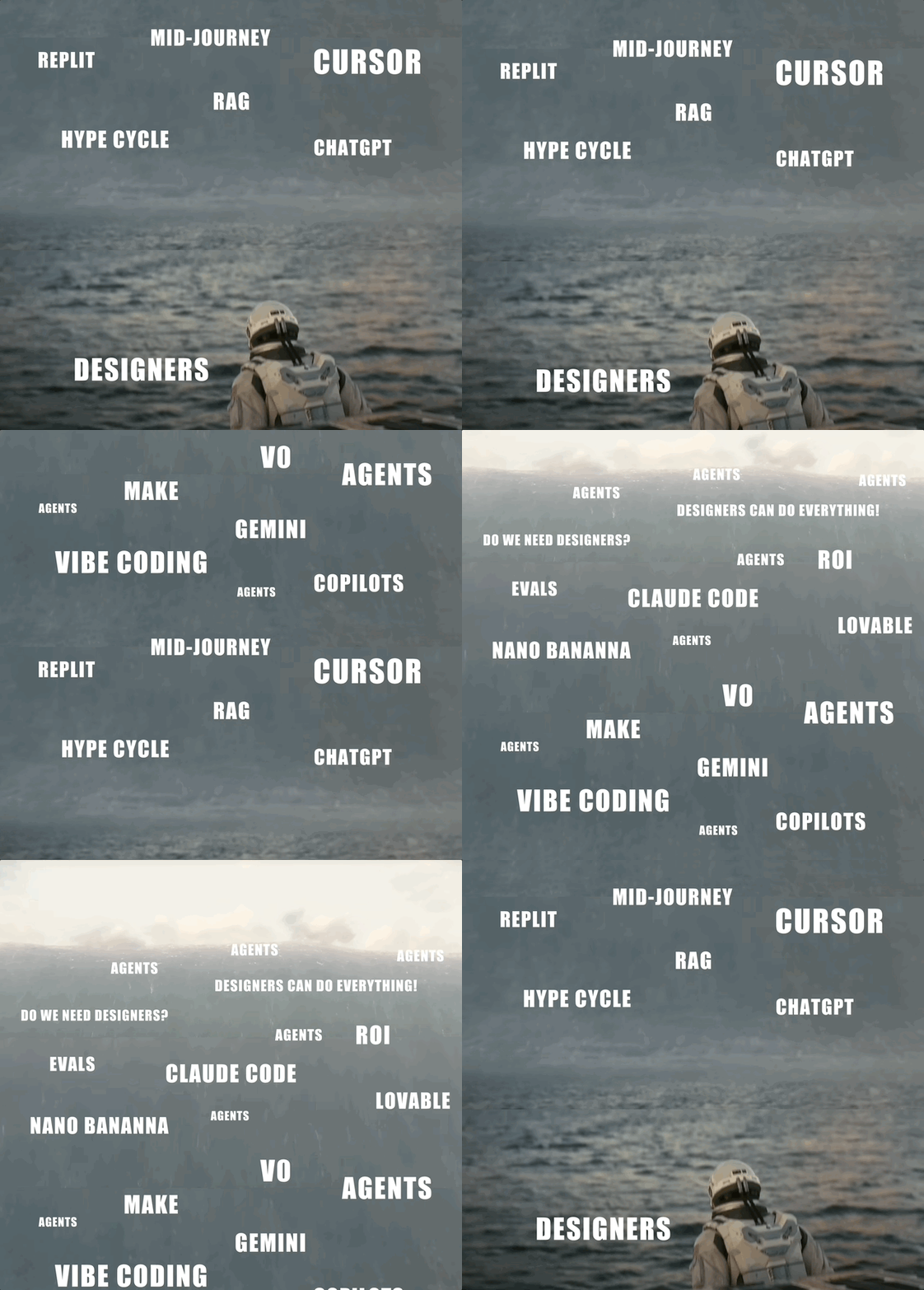
Technologies like generative AI and Vibe Coding have already transformed design and development workflows. Today, a new transformative force is emerging: agentic AI.
The critical question is no longer whether this wave will impact enterprises-it already has. Instead, the focus shifts to understanding how it will redefine the product landscape and development paradigms that organizations have long relied upon. From the perspective of DataRobot’s production design team, these advancements are not only revolutionizing design processes but also challenging foundational ideas about product creation and functionality.
Agentic AI vs. Generative AI: Understanding the Distinction
Unlike traditional predictive or generative AI models, agentic AI systems operate autonomously. They independently make decisions, execute actions, and adjust based on new data without requiring continuous human input. This autonomy introduces immense potential but also conflicts with the deterministic frameworks that most enterprises depend on.
Deterministic systems guarantee consistent outputs for identical inputs, ensuring predictability and control. In contrast, agentic AI is inherently probabilistic-identical inputs can lead to varying decisions and outcomes. This fundamental difference introduces complexities in governance, monitoring, and trustworthiness that enterprises must address.
These challenges are not hypothetical; they are actively unfolding within real-world enterprise environments.
To support organizations in securely scaling agentic AI, DataRobot partnered with NVIDIA to co-develop the Agent Workforce Platform, leveraging NVIDIA’s AI Factory architecture. Simultaneously, we integrated business agents directly into SAP ecosystems.
These collaborative innovations empower enterprises to deploy agentic systems safely and efficiently within their existing infrastructures.
Bridging the Gap: From Experimental Pilots to Scalable Production
Many organizations struggle to translate AI experiments into tangible business outcomes. A recent MIT study revealed that 95% of generative AI pilot projects fail to produce measurable results, often faltering when scaling beyond initial proofs of concept.
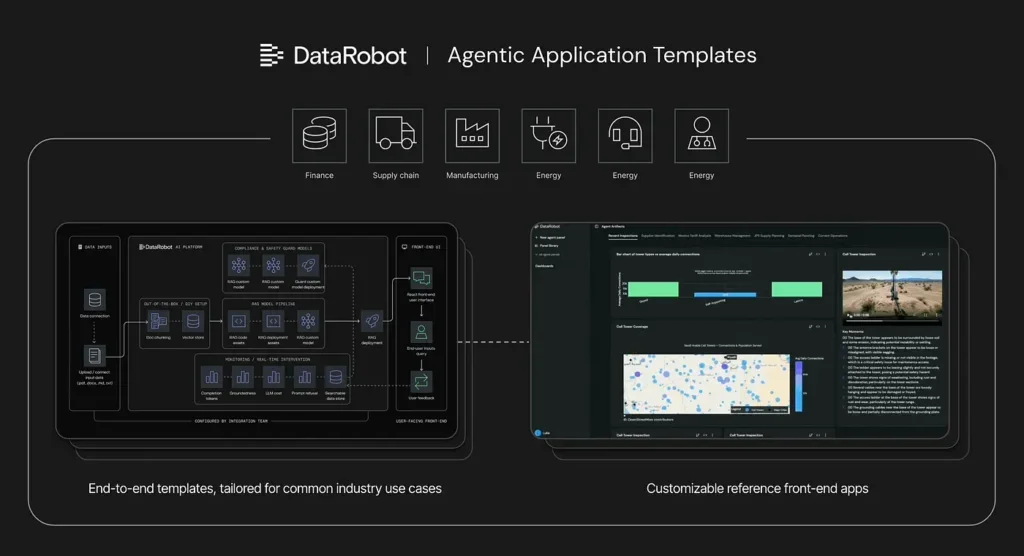
Transitioning from pilot phases to full-scale production involves navigating significant technical hurdles. Recognizing this, DataRobot shifted from offering raw AI components to delivering comprehensive “meal kits” – agent and application templates that include pre-configured modules and tested workflows ready for immediate deployment.
These templates encapsulate best practices tailored to common enterprise scenarios, allowing practitioners to duplicate and customize them using the platform or preferred APIs.
The result: enterprises can launch production-grade dashboards and applications within days rather than months.
Empowering Practitioners: Simplifying Platform Interaction
One of the biggest obstacles for AI teams is building user-friendly front-end applications that leverage agents and models-whether for demand forecasting, content creation, knowledge retrieval, or data exploration.
While large enterprises with dedicated development resources can manage this, smaller organizations often depend on IT or AI specialists who may lack app development expertise.
To address this, DataRobot offers customizable reference applications as foundational starting points. These work well for straightforward use cases but can be challenging to adapt for more complex or unique needs.
Some practitioners turn to open-source tools like Streamlit, but these often fall short in meeting enterprise standards for scalability, security, and user experience.
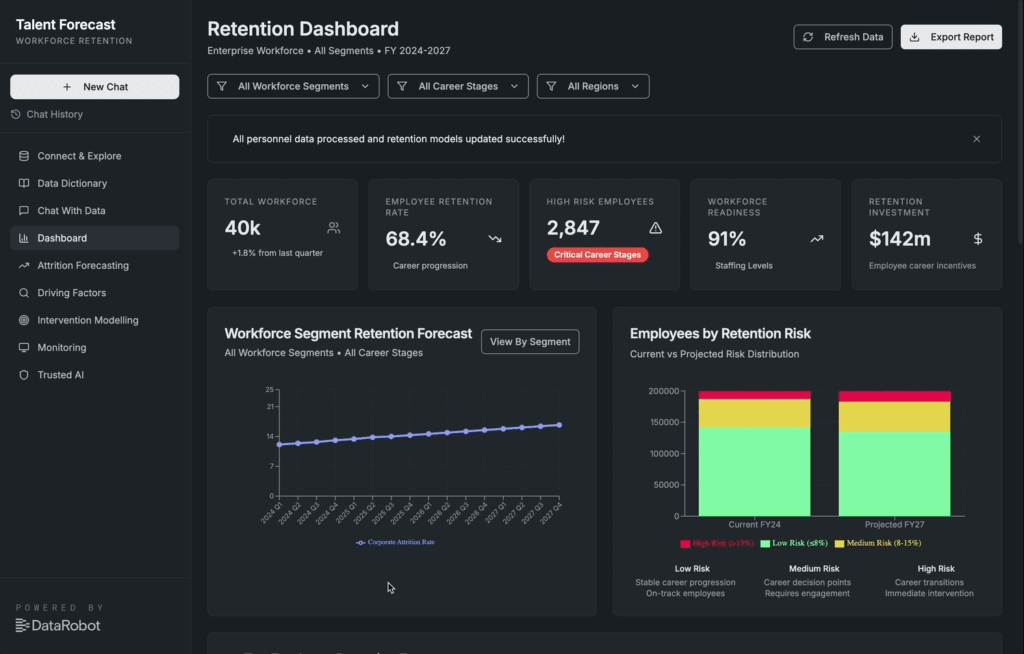
In response, DataRobot is pioneering agent-driven solutions, such as dynamic supply chain dashboards powered by agents. These dashboards feature rich visualizations and sophisticated interface elements tailored to client requirements, all supported by the Agent Workforce Platform backend.
This approach accelerates development and enables users without deep app-building skills to create enterprise-grade interfaces that meet rigorous standards.
Agent-driven dashboards democratize access to high-quality enterprise design.
Striking the Balance: Automation vs. Human Oversight
The rise of agentic AI echoes challenges from the AutoML era. When automation takes over engaging tasks, practitioners may feel marginalized; yet, when it handles repetitive work, it unlocks tremendous value.
DataRobot’s experience with AutoML showed that automating algorithm selection and feature engineering democratized AI but also left experts concerned about losing control.
The key insight: automation thrives when it accelerates expert workflows by eliminating mundane tasks while preserving human control over business logic and process design.
This philosophy guides DataRobot’s approach to agentic AI-automation should enhance expertise, not replace it.
Practical Control: Managing Autonomy in Agentic Systems
As autonomous systems become mainstream, a crucial question arises: how much autonomy should agents have versus how much control should users retain? This balance manifests in two layers:
- The underlying infrastructure for creating and governing workflows
- The front-end applications through which users interact with these workflows
Increasingly, enterprises are developing both layers in tandem-configuring platform foundations while generative agents build React-based applications on top.
User Roles and Expectations
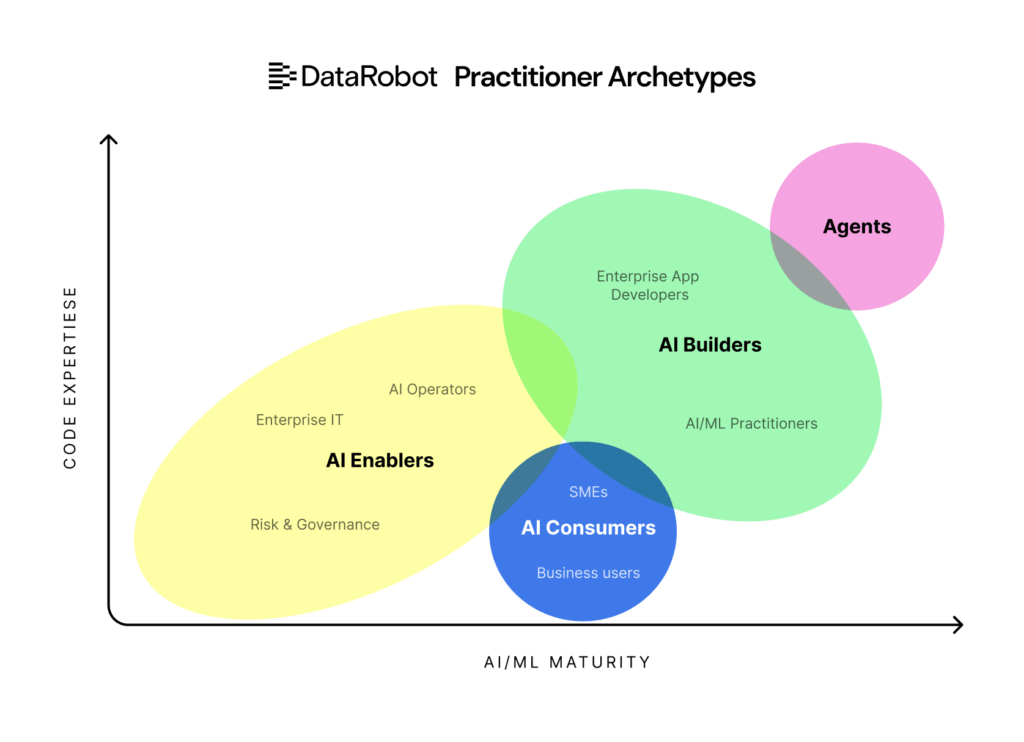
- Application developers: Comfortable with abstraction but expect debugging and extensibility options.
- Data scientists: Demand transparency and the ability to intervene.
- Enterprise IT teams: Prioritize security, scalability, and seamless integration with existing systems.
- Business users: Focused primarily on outcomes and usability.
Now, a new “user” category has emerged: the agents themselves. Acting as collaborators within APIs and workflows, agents necessitate rethinking feedback loops, error management, and communication protocols. Designing for this diverse ecosystem requires governance and user experience standards that accommodate both humans and machines.
Real-World Applications and Emerging Risks
These are not experimental prototypes; they are live production systems serving enterprise clients. Practitioners without deep app development backgrounds can now build customer-facing software that manages complex workflows, visualizations, and business logic.
Agents handle React components, layouts, and responsive design, freeing practitioners to concentrate on domain-specific logic and user experience.
This democratization is evident across industries. Field teams and non-designers are creating demos and prototypes using tools like V0, while designers increasingly contribute production-quality code. While this broadens the pool of creators, it also introduces new challenges.
With more individuals able to deploy production software, enterprises must implement robust mechanisms to ensure quality, scalability, user experience, brand consistency, and accessibility. Traditional review processes cannot keep pace; quality assurance systems must evolve to match the accelerated development tempo.
From Products to Adaptive Systems: A Paradigm Shift in Design
Agentic AI is redefining the very notion of a “product.” Instead of static tools designed for broad audiences, enterprises can now develop adaptive systems that dynamically generate tailored solutions for specific contexts on demand.
This evolution transforms the role of product and design teams. Rather than delivering isolated products, they now architect the underlying systems, constraints, and design principles that guide agents in creating consistent user experiences.
To maintain quality at scale, organizations must prevent the accumulation of design debt as multiple teams and agents generate diverse applications.
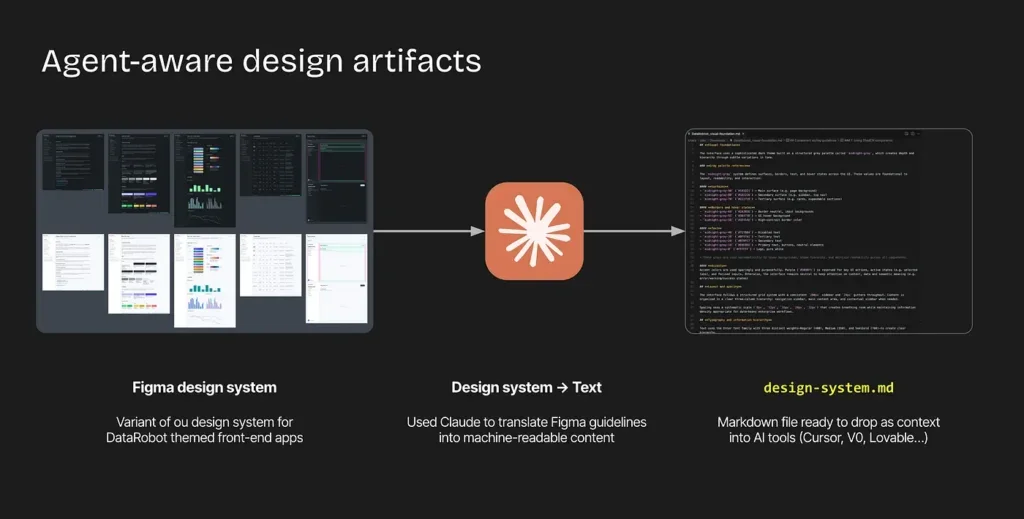
At DataRobot, the design system has been converted into machine-readable formats, including Figma guidelines, component specifications, and interaction principles documented in markdown.
By embedding design standards upstream, agents can autonomously generate interfaces that are consistent, accessible, and aligned with brand guidelines-reducing the need for manual reviews that slow innovation.
Designing for Agents as Active Users
Another emerging reality is that agents themselves are now users of platforms, APIs, and workflows-sometimes interacting more directly than humans. This shift demands new approaches to feedback, error handling, and collaboration design.
Future-ready platforms will optimize not only human-computer interaction but also human-agent collaboration, ensuring seamless cooperation between all parties.
Guidance for Design Leaders Navigating the Agentic AI Era
As traditional boundaries blur, one constant remains: the core challenges of design and development persist. Agentic AI does not eliminate these difficulties; it amplifies their urgency and raises the bar for design excellence. When anyone can rapidly deploy applications, user experience, quality, governance, and brand alignment become critical competitive advantages.
Persistent Challenges
- Contextual understanding: Identifying the true unmet needs being addressed.
- Designing within constraints: Ensuring compatibility with existing architectures and systems.
- Linking technology to business value: Confirming that solutions solve meaningful problems.
Principles for Success
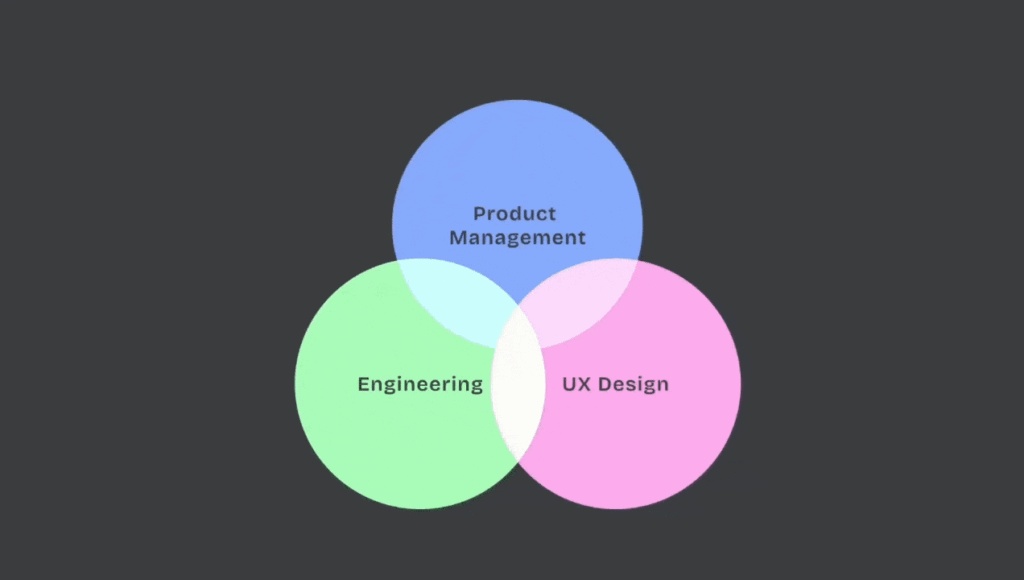
- Focus on systems, not just products: Build foundational frameworks, constraints, and contexts that enable high-quality experiences to emerge organically.
- Exercise informed judgment: Leverage AI for speed and execution, but rely on human expertise to guide strategic decisions.
Embracing the Future: Harnessing the Agentic AI Wave
Much like the towering waves in Interstellar, what once seemed distant and abstract is now an undeniable force reshaping the enterprise landscape. Agentic AI is no longer a future prospect-it is actively transforming industries today.
Organizations that master this technology won’t merely ride the wave; they will define the future of product development and innovation.
Discover more about the Agent Workforce Platform and how DataRobot supports enterprises in advancing from AI experimentation to scalable, production-ready agentic AI systems.
