
Flock Safety Broadens Drone Surveillance to Private Businesses
Once exclusively serving law enforcement agencies, Flock Safety has unveiled a new initiative to provide drone surveillance technology to private enterprises. This move targets companies aiming to enhance their security measures, particularly those seeking to reduce incidents of retail theft.
How Flock’s Drone System Operates in Commercial Settings
Businesses across the United States can now install Flock’s automated drone docking stations on their properties. When authorized by the Federal Aviation Administration (FAA) to operate beyond the visual line of sight-a regulatory framework that is gradually evolving-Flock’s security operators can deploy drones within a designated perimeter, often spanning several miles.
Keith Kauffman, a former police chief and current head of Flock’s drone division, explains the operational shift: “Instead of responding to a 911 emergency call, the drone is activated by an alarm signal. The response mechanism remains essentially the same.”
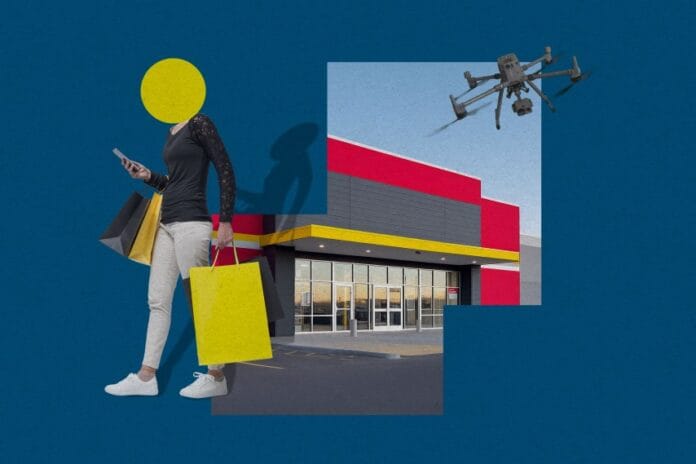
For instance, in a retail theft scenario, if security personnel at a large store such as Lowe’s observe shoplifters exiting the premises, they can launch a drone from its rooftop docking station. Equipped with high-resolution cameras, the drone can track the suspects as they move.
“The drone tails the individuals. If they get into a vehicle, you simply press a button to follow the car, and the drone maintains visual contact throughout the pursuit,” Kauffman elaborates.
The live video stream can be monitored by the company’s internal security team or, if necessary, relayed directly to local law enforcement agencies for immediate intervention.
Current Adoption and Potential Markets
While Flock is actively negotiating with major retail chains, no formal agreements have been finalized yet. The only confirmed private client is Morning Star, a California-based tomato processing company that utilizes drones to safeguard its distribution centers. Beyond retail, Flock is targeting hospital campuses, logistics warehouses, and energy sector facilities such as oil and gas plants for drone security deployment.
Regulatory Landscape and Challenges
The FAA is in the process of finalizing regulations governing drone flights beyond the operator’s line of sight. The outcome of these rules will significantly influence whether Flock’s commercial drone applications will be fully permissible under federal law.
From Police-First Responders to Private Security Tools
Flock’s expansion into the private sector builds on its pioneering role in law enforcement drone programs nationwide. Police departments have increasingly used drones as rapid-response tools, deploying them to incident scenes to provide real-time aerial footage faster than officers can arrive.
These initiatives have yielded notable successes, such as aiding in the rescue of a missing child in the forests of Colorado. However, they have also sparked debates over privacy infringements, disproportionate surveillance in minority communities, and demands for transparency regarding public access to drone footage.
Privacy Concerns and Ethical Implications
Flock’s other surveillance technologies, including automated license plate readers, have faced scrutiny for enabling government agencies like ICE and Customs and Border Protection to access data collected by local police, raising fears about mass deportation enforcement.
Rebecca Williams, senior strategist at the ACLU’s Privacy and Data Governance program, views Flock’s move into private security as “a natural progression, but one fraught with risks.” She highlights the ongoing erosion of Fourth Amendment protections in the digital age, where government entities can acquire private data without warrants by purchasing it from third parties.
Williams warns that stalled legislative efforts to regulate such data transactions only exacerbate these concerns. “Flock has become the Meta of surveillance technology, amassing and monetizing vast amounts of personal information. This expansion is deeply troubling,” she asserts.

