
OpenAI’s Accelerated Path Toward Advanced AI Research Assistants
OpenAI is rapidly pushing the boundaries of deep learning, developing models capable of tackling increasingly complex challenges with greater speed and efficiency. In a recent livestream, CEO Sam Altman revealed an ambitious roadmap: by September 2026, OpenAI aims to deploy an AI-powered research assistant at an intern level, progressing to a fully autonomous AI researcher by 2028.
Transition to a Public Benefit Corporation: Unlocking New Growth Opportunities
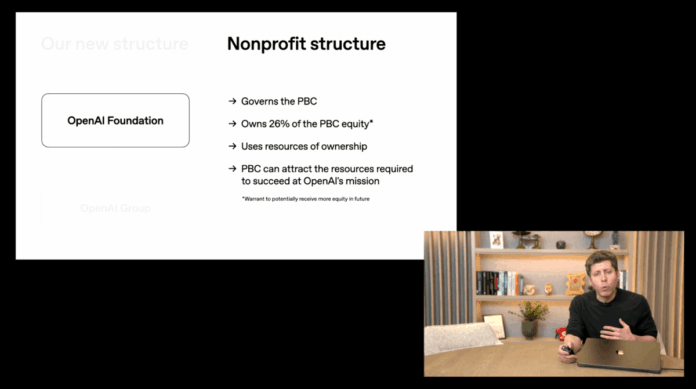
This bold vision coincides with OpenAI’s recent transformation into a Public Benefit Corporation, a shift from its original non-profit framework. This change removes previous operational constraints, enabling OpenAI to attract more substantial investments and scale its infrastructure to meet the demands of cutting-edge AI development.
Defining the AI Researcher and Superintelligence
Joining Altman in the discussion, Jakub Pachocki clarified the concept of the AI researcher-not a human scientist, but an autonomous system capable of independently managing and executing extensive research projects. He further described superintelligence as AI systems that surpass human capabilities across a broad spectrum of critical tasks.
Strategic Focus: Algorithmic Breakthroughs and Extended Computation
OpenAI’s strategy hinges on two pillars: continuous innovation in algorithms and significantly increasing “test time computation,” which refers to the duration models dedicate to problem-solving. Pachocki highlighted that current AI models can operate effectively within a five-hour window, matching elite human competitors in contests like the International Mathematical Olympiad. He anticipates this computational horizon will expand swiftly, as dedicating more processing power-potentially entire data centers-to complex scientific problems becomes feasible.
Accelerating Scientific Discovery and Technological Innovation
These advancements are designed to propel scientific research forward, enabling AI to uncover insights faster than human researchers and address challenges beyond human reach. The potential impact spans diverse fields including medicine, physics, and technology development. Altman emphasized that the new corporate structure supports OpenAI’s aggressive timelines while upholding a commitment to responsible AI development.
Governance and Funding Commitments
Under the new arrangement, the OpenAI Foundation-a non-profit entity-retains a 26% ownership stake and oversees the organization’s research direction. The foundation has pledged $25 billion to initiatives focused on curing diseases and ensuring AI safety. Meanwhile, the for-profit arm’s enhanced fundraising capabilities are critical for scaling infrastructure, with OpenAI committing to an unprecedented 30 gigawatts of computing power, representing approximately $1.4 trillion in investments over the coming years.
Looking Ahead: The Future of AI Research
OpenAI’s vision reflects a broader trend in AI development, where increased computational resources and sophisticated algorithms converge to unlock new frontiers in scientific discovery. By 2028, the company expects its AI research assistants to not only augment human researchers but also independently drive breakthroughs that could transform multiple industries.

