
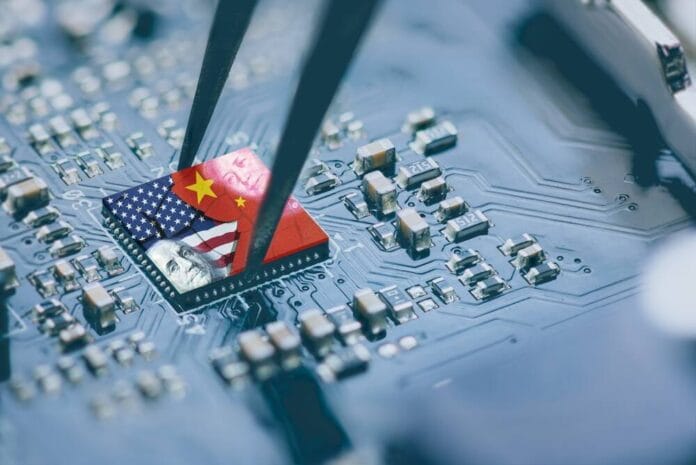
Republican Chair of the US House Select Committee on China protested this week the Trump administration’s decision to lift restrictions on Nvidia GPUs and similar chips, warning that the chips could be abused to advance Chinese AI and Military interests.
“We must not allow US companies to sell these vital artificial intelligence (AI) assets to Chinese entities,” The committee’s chair, Representative John Moolenaar of Michigan, wrote a letter to Secretary Howard Lutnick in which he expressed his concerns.
In April, the Trump administration blocked the sale of Nvidia H20 and similar silicon for fear they would find their way into Chinese Supercomputers. Nvidia’s MI308 and Nvidia H20 were initially released as a scaled-down version of their more powerful siblings to comply with US export control regulations governing the sale AI accelerators to China.
Nvidia estimated that the decision would cost the GPU giant nearly $10 billion in the first half its fiscal year 2026. AMD reported that the export ban will cost the company $1.5 billion in lost revenue in 2025.
This was the week that the export ban was lifted. The chipmakers announced their application for licenses to resume the sales of the accelerators. Nvidia reported that both Nvidia “U.S. government has assured NVIDIA that licenses will be granted, and NVIDIA hopes to start deliveries soon.”
and AMD executives have argued that if the US makes obtaining US semiconductors too difficult, they will seek alternatives. Moolenaar rebutted this claim in his letter to Lutnick, dated Friday. Moolenaar’s comments are in line with recent findings from Canadian research firm TechInsights that SMIC, Middle Kingdom’s leading chip manufacturer, is still generations behind the rest of world. Apple spends $500M to recycle rare earths, caught between China and Trump. Apple spends $500M on rare earth recycling as it tries to find a middle ground between China and Trump.
“Tencent reportedly used H20s to train its Hunyuan-Large model — a project that almost certainly used one or more computing clusters requiring over 200 [petaFLOPS] of computing power (roughly 4,550 H20 GPUs), which meets the US definition of a ‘supercomputer.'”
If you’re wondering what a supercomputer is, the US Export Administration Regulations define a computer as: “A computing ‘system’ having a collective maximum theoretical compute capacity of 100 or more double-precision (64-bit) petaFLOPS or 200 or more single-precision (32-bit) petaFLOPS within a 41,600 ft3 or smaller envelope.”
According to the little information available on the H20’s higher precision performance the chips support up 44 teraFLOPS single-precision which roughly aligns to the figures cited by Moolen
Moolenaar concluded his letter by requesting a briefing from Lutnick, no later than the 8th of August, to assess how Lutnick plans to evaluate license requests for H20 and other similar chips. The Register Contacted Moolenaar’s Office
for a comment but did not hear back by the time this article was published. (r)

